Skip to navigation | Skip to content


Posts tagged ‘drawing’

Clifton Graffiti

Because it’s a posh area, there’s not much graffiti in Clifton but there is some and it’s often more quirky than the brightly-coloured tagging popular in other parts of Bristol.

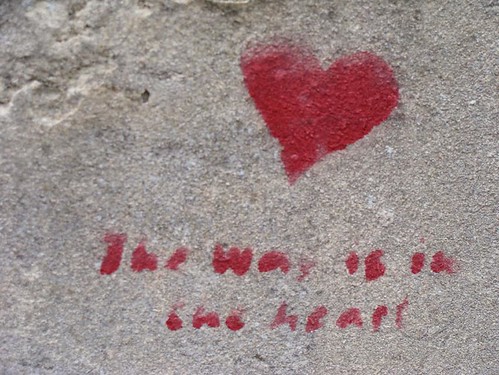
It’s a bit hard to decipher but the text reads “the way is in the heart” - yay, Zen graffiti!

graffiti heart
Kirsty Hall: Graffiti Heart, April 2008

Someone having fun juxtaposing a house shape with this very appropriate sign. Or perhaps it’s a warning, with the cross through the house indicating that they’re a bad agency to use?

graffiti house
Kirsty Hall: Graffiti House, May 2008

These next two bits of graffiti have been ineffectively painted out, I love the resulting subtleness.

This one reminds me of Jean Dubuffet’s art…

painted out
Kirsty Hall: Graffiti Covered With White Paint, May 2008

…while this one’s like faded Arabic writing.

painted out 2
Kirsty Hall: Graffiti Covered With White Paint, May 2008

Very Jean Miro.

Abstract graffiti
Kirsty Hall: Abstract Graffiti, May 2008

My favourite shot, I can imagine this as a huge oil painting in a gallery.

abstract close up
Kirsty Hall: Abstract Graffiti Close Up, May 2008

It’s not really graffiti if the council does it!

practical mark
Kirsty Hall: Practical Mark, April 2008

Work For Sale

I’m delighted to announce that several of my drawings are now available for sale at The Shiny Squirrel.

The drawings were inspired by The Diary Project drawings but they’re done on nice paper instead of envelopes! They come mounted but not framed to keep postage costs down and so that you can choose your own frame. The drawing with the blue ovals is particularly beautiful in real life - it’s my personal favourite from this set. You can’t see it clearly from the photograph but the blue background of the ovals are covered in tiny circles of white ink.

OK, enough sales talk, I need to put some clothes on, dry my hair and then get on the Manley ferry to go and visit the Art Gallery Of New South Wales and the botanical gardens, which are conveniently located next door to each other.

Facing the empty page

Kirsty Hall - photograph of drawings in progress
Kirsty Hall: Drawings in progress, Feb 2008

Starting a drawing can be scary. Drawing on crappy paper (that’s a technical term!) can be one way to overcome the fear of the blank page.

When I was first learning to draw, my dad would bring home piles of A3 computer paper from his office for me. It was the large thin folded stuff with perforations down the side. Apparently it sometimes used to spool through the printers and couldn’t be re-used - at least that’s what he told me!

It was great paper to draw on because there was never any fear of wasting expensive cartridge paper: it was already waste, so it didn’t matter if I ruined it. I used to sit in front of the TV drawing actors, newsreaders and the like. Documentaries and interviews were the best because they featured a lot of fairly stationary head shots. For a teenager living out in the country with no access to life classes, it was a surprisingly effective way to practice portraiture and speed drawing.

Drawing the envelopes for The Diary Project was similar - if I messed up an envelope it didn’t matter and I felt no guilt about tossing it in the recycling. In fact, I sometimes used to draw on the front and back of a couple of envelopes just to loosen up or to test out new techniques or materials. Now my envelopes are all finished and I want to take what I’ve learnt into making drawings on ‘real’ paper with the idea of making a series of drawings that could be sold. Yet even after a year of daily drawing, it’s still surprisingly intimidating to sit down in my studio and look at those empty sheets of good paper. Maybe I just need to take a stack of envelopes upstairs to comfort myself with…

Ariana Page Russell

Ariana Page Russell is a fine example of an artist really working with what she’s got - in her case, a skin condition called dermatographia. Here she explains it in her own words:

My own skin frequently blushes and swells. I have dermatographia, a condition in which one’s immune system exhibits hypersensitivity, via skin, that releases excessive amounts of histamine, causing capillaries to dilate and welts to appear (lasting about thirty minutes) when the skin’s surface is lightly scratched. This allows me to painlessly draw patterns and words on my skin, which I then photograph.

Ariana Page Russell - Index

Russell also takes these images one step further creating temporary tattoos and wallpaper from the photographs of her own skin welts.

Ariana Page Russell - Pivot (detail)

Megan Auman

I’ve just discovered the sculpture and steel jewellery of artist, Megan Auman. I don’t know how I’ve missed seeing it before because she’s been mentioned by Cally, whose blog I read regularly.

‘Long Leaf Necklace’ - Steel jewellery by Megan Auman
Long Leaf Necklace’ by Megan Auman

Isn’t this fab. Despite studying and making silver jewellery, I’m not much of a jewellery wearer but I’d make an exception for this. I particularly love that it’s made from steel instead of a precious metal, that really adds to the aesthetic for me - the stark black against the white makes me sigh with visual lust. I’ve been playing around with lots of colour in my new art journal lately but apparently I’m not over my monochrome thing and honestly, I don’t want to be - colour fills a certain place in my soul but black and white will always own my heart.

I had already noted the resemblance of Megan’s work to my own drawings but I was amused to discover that she also did a smaller series of daily drawings in 2007. Megan also has an interesting blog that’s worth a look - apparently she’s going to be making a life size sofa out of metal, I look forward to seeing it.

Book Review of The Decorated Journal

The Decorated Journal by Gwen Diehn is a book that focuses on art journalling.

Gwen Diehn book

The book is divided into sections, the first is an extensive exploration of the different materials used in art journalling including paper, pencils, paints, pens, glue and other commonly used materials. This section is, to my mind, the strongest in the book. It contains handy tables that show the advantages and disadvantages of different types of glue, a section on the paint colours you’ll need to be able to mix a good palette, lots of information about the different grades of paper, explanations of the properties of various different materials and clear advice on what to buy and why. There’s even a page on making your own ink and paint from naturally occurring pigments that you’ve gathered! I also like the way she emphasises investing in a few well chosen, quality materials rather than getting suckered into buying endless new products that are actually quite limited in scope.

In the second section of the book, Diehn describes different types of journalling. She categorises journals into 7 different types and provides techniques that she thinks are particularly appropriate for each. I wasn’t totally convinced by her categories and most of the stuff I objected to occurred in this section.

The third section of the book is called ‘Pages In Stages’ and Diehn splits the working process into ’starters, middles and toppings’.explores how to work with the different levels of the page through techniques like layering, collage and using text. This is one of the shorter sections in the book since it’s basically reprising things that have already been described in earlier sections.

The final section of the book deals with some basic bookbinding - Diehn is a big fan of making your own journals so that you can control the size and type of paper and she demonstrates how to make several simple handmade books plus how to customise existing journals and reuse the covers from old hardback books. I have several other bookbinding books already so there wasn’t a whole lot here that was new to me but the information seemed clear and competent and it’s obvious that it’s something she’s passionate about.

Although there is undoubtedly much of value here, this is not a book that I can wholeheartedly recommend. The main problem I had with this book was Diehn’s tone, which I found overly lecturing and didactic. It’s very clear that she feels there’s a right and a wrong way to do things - for example, she assumes that paper buckling is always to be avoided but personally, I’ve found that buckled paper can be an interesting design element on a journal page rather than a problem.

Sure, it’s important to learn ‘the correct way’ to do things and I can understand her desire for ‘good practice’ but I also felt she could have recognised that art journalling is an expressive, experimental and free space for the artist, where the rules don’t always need to apply. It’s not that what she says is necessarily wrong - I agree with many of her opinions - but the way she says them invariably seemed to get my back up. Reading her words made me feel as though I was back at art college again. This isn’t surprising since Diehn is a tutor at an art college but I didn’t find it at all helpful or inspiring. Since I’m currently trying to unlearn quite a few of those art school conventions, I don’t need this approach. I took particular exception to her saying things like “you have to earn the right to draw the details”: I think that’s a staggeringly unhelpful thing to say to anyone, whatever stage of drawing they’re at.

In addition, I wasn’t particularly blown away by the journal pages shown; they often seemed to fall into a particular style and I felt there could have been a lot more variety. There also frequently seemed to be a disconnect between the illustrations and the text and it was sometimes hard to work out why a journal page had been selected to show a particular technique or idea.

However, many people might find her ‘voice of authority’ reassuring and comforting rather than invasive and irritating, as I did. If you want a book that tells you to ‘buy this colour’ and ‘don’t do that’, then this would be a good book to invest in because, despite my personal reservations, there is a huge amount of good information in here. In particular, if you’re new to art or art journalling and want to know about different materials and to be talked through the basics, then this book has a lot to recommend it. I just didn’t like the feeling of being talked down to but I’m well aware that this may be my personal hang-up. Certainly the book gets generally positive reviews on Amazon.com and elsewhere.

I borrowed this book from the library and while I’m glad that I’ve read it because I did learn some interesting new stuff, I was even more glad that I hadn’t bought it or added it to my Christmas list because personally I would have been disappointed. That said, I’m sure that many people would find it invaluable but I’d advise getting it from the library or checking it out in a bookshop before you buy to make sure it’s right for you.

Playing catch up

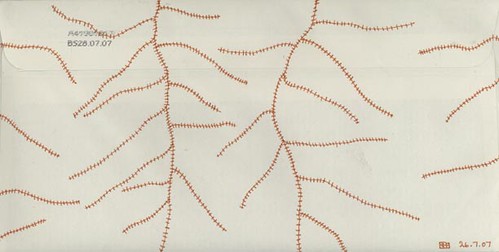
Sometimes correspondences in your work surprise you. me-jade recently added these two photos of mine as ‘favourites’ on Flickr.

DP 207
Kirsty Hall: Diary Project envelope from the 26th July 2007

Kirsty Hall - photograph of a red thread drawing entitled Parse
Kirsty Hall: Parse, January 2007

Although I wasn’t conscious of it when I was drawing the envelope, when I saw the two images next to each other, I was struck by how very similar the shapes are.

I’ve been concentrating on updating The Diary Project blog this week: I’m woefully behind on it and it’s getting embarrassing. I’ve been updating the blog in small chunks because that’s all I can manage right now - writing the little musings is getting to be almost impossible. I’ve pretty much run out of things to say about my work: I didn’t know this was possible but apparently it is!

I did an update on Sunday and another one this morning plus I’m about halfway through scanning more than a month’s worth of envelopes. I scanned to the end of October yesterday and felt very pleased with myself before realising that hey, we’re already half way through November.

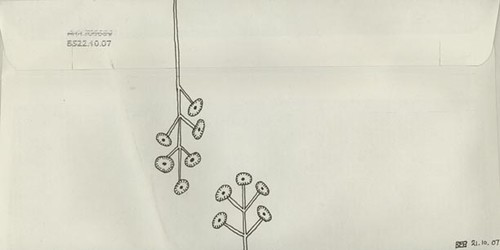
Here’s my favourite drawing from the latest update:
DP 294
Kirsty Hall: Diary Project envelope from the 21st October 2007

Hopefully I’ll get another chunk done tomorrow - although frankly, if I never have to write another word about my damn drawings, it’ll be way too soon! In the meantime, I’m off to scan envelopes, which is time consuming but thankfully a lot less mentally taxing and I can catch up on podcasts while I’m doing it.

The Joy Of Pens

Apparently my muse really needed pens today!

pens

A visit to both the craft store and the art shop this morning - conveniently but rather dangerously located a couple of minutes away from each other - resulted in rather more shopping than I had originally planned.

I bought 2 bottles of liquid acrylic (the only kind of acrylic I can stand the smell of), some varnish, some small metal brads and some stamps for the Diary Project - so far, so good. Unfortunately I then went a bit bananas with the pens and got 10 different ones that do a variety of exciting things. I’ve been doing lots of pages in my new art journal and need pens that will write over difficult surfaces such as soluble oil pastels; I’m hoping that at least some of these will.

For any fellow pen geeks out there, here’s what I got:

A waterproof black Faber-Castell Pitt Artist pen - I have some of their sepia ones but I haven’t tried the black before. I’m always on the look-out for good quality black pens for The Diary Project - at this point, I’ve probably tried most of the ones on the market.
Two Copic Ciao double-ended markers - I’ve never tried these before but I’ve heard good things about their ability to draw on almost every surface.
A Staedtler Triplus gel-liner in silver - because everyone needs a silver pen
A Sakura Gold Shadow pen in grey - these make a sort of two-tone metallic outline.
A Sakura Souffle pen in dark grey - these give a slightly embossed 3-D line, so they should be good when I want colour to stay contained within a certain area.
A Sakura Glaze pen in black - these dry to a nice glossy finish and can be used on all sorts of surfaces. I’m a bit excited by the idea of the clear one that you can write with and then layer colour over so it magically appears but I’ll see how I do with this one first.
A Sakura waterproof and archival Micron 01 black ink pen - again, to test out for The Diary Project.
A Sakura fine point gold marker - see silver pen comment!
A Sakura White extra fine marker - surprisingly the most expensive pen at £3.10. I do already have a white ink gel pen that I use in the Diary Project but it sticks a lot, the one seems to give a much smoother line.

You know, I wasn’t doing too badly until I saw that Sakura display in the craft shop - I’ve never seen this brand before and they were so alluring that I lost all sense of reason! What’s truly scary is that I could easily have spent a lot more. I was actually pretty restrained: I didn’t buy any sets and I didn’t get every kind of Sakura pen they had, I could have added another 4 or 5 to my basket but chose not to. Instead I deliberately got a selection of different things to test out, with the idea that if I like any particular kind, then I can add a set or two to my birthday/Christmas list.

We all have things we find hard to resist - for some people it’s magazines, clothes or electronics; with me it’s art materials. It used to be books as well but I’ve managed to get into the habit of mostly ordering those from the library instead of from Amazon.

I can mostly control my addiction to art materials - I often go for months without buying anything at all but every so often I just need a bit of a splurge. My wallet is definitely a lot lighter - altogether I spent just under £40 and about half of that was on the pens. I came out feeling that I probably ought to feel guilty but really I just felt utterly gleeful and still do. I guess sometimes you just need to do these things.

Well, I guess I’ll see you later - I’ve got a hot date with some pens!

Anita Groener

Unfortunately, I haven’t been able to find out all that much about Dutch artist, Anita Groener but I like the way her work alternates between spareness and complexity.

Anita Groener - Labyrinth IX
Anita Groener: Labyrinth IX

Anita Groener - Freeway

These two works form part of the Crossing series. Over the space of three years Groener drove about 12,000 kilometers between The Netherlands (her homeland) and Ireland (her adopted country) and these regular road trips became a huge influence on her studio practice. She describes this series in the following way:

The verb Crossing signifies movement, a movement which is not uniform but which is drawn back and forth. In my drawings I try to capture the delineation of movements of thought processes occurring in space and time, between here and there, between the point of departure and arrival. The journey of the line marks the surface turning it into visual patterns. What you see is a physical manifestation of the layers of routes and directions taken in this process, revealing its manifold meanings.

Annie Vought

Artist Annie Vought meticulously cuts paper to make her beautiful and witty wall pieces. Her recent work has concentrated on writing, while previous work explored the human body through cut up anatomy drawings.

Annie Vought - To Do
Annie Vought: To Do, 2006

As a compulsive list-maker, I just adore the absurdity of this piece - just think of the hours it must have taken to cut away the paper from something as transitory and throwaway as a to-do list. She’s clearly a woman after my own heart!

The use of shadows in these works interests me and I see obvious parallels with my own thread drawings where the shadows also work to complete the image. Unsurprisingly, it also delights me that she uses pins to attach the delicate cut paper to the wall.

Annie Vought - Slightly
Annie Vought: Slightly, 2006

Kirsty Hall, art, thread drawing
Kirsty Hall: Thread drawing - work in progress

—-

Vought is also involved in a radical form of curating in public spaces through her involvement with the Budget Gallery.

The Budget Gallery is not in a specific place. We don’t have a building, so we’re beyond low-rent. We don’t even pay rent. We set up our gallery in co-opted public spaces like vacant walls and fences. The shows are carefully co-ordinated, prepared, and publicized. The pieces are displayed much like a traditional gallery. We paint walls white, install art works and labels. We announce openings that are attended by hundreds. Refreshments are served and one can often hear jazz playing in the background. Of course, this is no traditional gallery - it’s all taking place on the sidewalk. In the end it’s a blend of all the greatest things about attending an art show, a garage sale, and a block party rolled into one.

Check out their project rules:

1. We use underutilized public spaces for our exhibitions.
2. If work doesn’t sell at the opening, it stays, in public, unguarded, for at least 1 week.
3. After the opening the unguarded work is sold on the honor system.
4. All art work in our shows will be sold, stolen*, or vandalized** and we can not pre-determine the outcome.
5. Our commission is arbitrary, optional, and determined by the artist.

*Having a work stolen is the highest honor of the Budget Gallery because it means someone wanted the work so badly they were willing to abandon personal and societal mores to acquire your piece of art. In our eyes, this may be considered a more valuable compliment to you than a simple monetary transaction.

**We suggest you consider vandalism a form a collaboration.

I find that a fascinating concept but also very challenging: it certainly brings up a lot of issues around letting go of control.

How would you feel about your work being shown in these circumstances? Could you deal with it? Would it upset you to have your work stolen from an unguarded public wall? Would it upset you more to have it vandalised?

I think I would have to make work especially for that space, with those aims in mind because if my regular art was stolen or vandalised I’d be upset. I actually had my degree show vandalised and even though I’d known beforehand that it was a possibility because of the extreme delicacy of the piece, I still had to go and cry in the toilets for a while!

Andrea Ebert

I just discovered Brazilian artist, Andrea Ebert on Flickr.

Andrea Ebert - Apoio, drawing
Andrea Ebert: Apoio

I just love the simplicity of her line. You can see more of her work at her website or on her Flickr.

Il Lee

Il Lee - biro drawing
Il Lee

Korean-born artist, Il Lee uses simple disposable ballpoint pens to make his huge, dense organic drawings.

If you’re New York based, his work is exhibited at Queen’s Museum until the end of September.

I spotted this fantastic artist on the ReadyMade Blog.

Ulf Nawrot

Ulf Nawrot from Germany seems to be doing a post-it project. Unfortunately I can’t tell you much about it because his site doesn’t have any information apart from the images and his contact details.

Ulf Nawrot - Post It Drawing
Ulf Nawrot: Post It Drawing

The page of post-it drawings is utterly fab though - go have a look. While the individual drawings are fun, you definitely need to see them all together to get the full effect. It really shows how effective a repeated form can be - even though the drawings are all quite different, the yellow of the post-it’s and the repeated size, ties them all into a coherent visual whole.

Yay me!

And I’ve done it! Yep, there’s a new post over on the a-n Diary Project blog so I am now officially up to date with the Diary Project.

Sure, there’s probably a dozen other things that I could do for the project, especially in terms of promotion, but now that I’ve done that blog post there’s nothing that’s urgent or lingering.

My tip of the day: make a start on something that you’ve been procrastinating about. It probably won’t take nearly as long as you think and you’ll feel fantastic when you finally get it off your to-do list and your conscience.


« main blog page


All tags