Hmm, apparently I did something weird this morning and this post vanished into the ether even though I'm sure I published it. Even more annoying, it didn't save most of it, so I've had to rewrite it. Fortunately most of it is based on an old piece of writing from way back in 2001, so it wasn't too much work. I've even managed to put in a couple of pictures - if I'm very patient, I can link to photos that are already on Flickr, I just can't upload any new ones. Using dial-up is like wading through treacle and I can't wait to get back to the 21st century and a fast broadband connection although I am enjoying hearing the old modem sound again, it's quite the nostalgia trip.

Anyway, it's time to raid the vaults... this has been edited slightly to tighten up the language and grammar but is more or less unchanged from the original.

Still Life
1/7/01

I have come to realise that much of what I make is actually Still Life. My photographs, in particular, have a Still Life sensibility. I am looking at small things - like hot raspberries on the beach or the reflection in a bowl of water - and saying that they are small yet important. It seems to me that that is what most Still Lives do: they take everyday things and set them apart so we can truly see them.

blue bowl 02
Kirsty Hall: Blue Bowl Reflection, circa 1999

Still Life demands that we really look at the flagon of wine and the apple; the bowl of cherries; the lifeless carcasses. It ponders the flowers, the glass and the tablecloth. It shows us the texture of everyday life and forces the realisation that actually these things are amazing: the bread we eat, the soft cheese, the pile of fruit, the luscious cakes, the humble or grand spread. This is what keeps us alive after all. This is what nourishes us. Of course we also need vast epic pictures of the imagination and portraits that force us to look at our frail human bodies. We need art to consider many things but it seems odd that Still Life should so often have been considered the least important subject matter in art, when it deals so intimately with life and death.
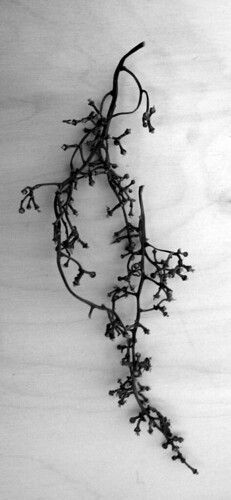
Grape stem 01
Kirsty Hall: Grape Stem, May 2003

Mortality is a vital component of many Still Lives. Those flowers will soon be dead: they are just caught for a moment in time. Caught at the point of perfection? Or perhaps already weeping their petals onto the rough-hewn table or perfect lace. That food will spoil or be devoured by a hoard of hungry mouths. Even that fine glass goblet will eventually be broken or lost. The table itself will be consumed by history. Who knows what happened to the musical instruments, the sheet music or the pile of books? They are lost to us except for this captured image.

It is that quality of stillness that I love most about Still Lives. More and more my work has been edging towards stillness and quiet, not actual silence but definitely quietness. I think I am looking for contemplation and the mysterious void. Stillness is a quality that I associate strongly with the colour white, which is why I think my work has contained so much white in the last two years. I am searching for that perfect moment perhaps, that moment of clarity and stillness?

Sorry for the radio silence. We're transferring to a new ISP and despite the fact that we were paid up until the end of June, our incompetent old ISP cut us off early so we've been totally without email and internet access since last Thursday. But it gets even better, we found out today that they managed to cut us off so completely that it will be another week and an extra £50 before the new ISP can get us reconnected. We're not best pleased as you can probably imagine. Don't use BE Internet, that's my advice.

Fortunately my partner has just managed to cobble together dial-up access but it's slow and frustrating. So while I plan to do a couple of posts this week, I warn you now that it's likely to be all text.

I've actually quite enjoyed having a bit of an internet break. The weather has been lovely, so I've been out in the garden a lot and I've been catching up on my reading. Although I'm cross that we've been jerked around, another week without blogs, Ravelry and endless noodling around online doesn't sound too bad.

1 Comment

Sigh, I'm not sure where this week went. Do you have weeks like that? One minute it's Monday, the next it's Sunday and you're not sure what happened to the in-between bit. I seem to be having more and more of them - maybe it's true that time speeds up as you get older.

I have been working fairly consistently on my embroidery piece this week and I hope to get it finished later today or tomorrow. I've decided to set myself an informal target of finishing a piece of art a week because I need a bit of a push.

Kirsty Hall, photograph of red thread drawing in progress
Kirsty Hall: Red Thread Drawing In Progress, June 2008

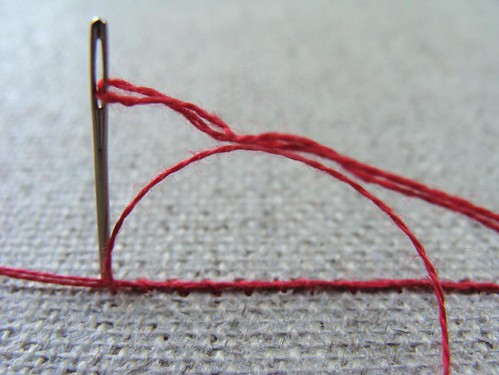
It's been very interesting watching this evolve because I've been doing it freehand, so it's been at least a hundred different temporary drawings so far. It's impossible to keep things in place, the loose thread spills across the surface and moves with every stitch I make. I find it a very meditative way to work; accepting that perfect arrangements of thread will come and go each time I pick up the canvas.

I once read a quote from a writer who said that as soon as you'd written the first line, your novel was committed to a certain path but before that first sentence, anything was possible. That's not the case with this work. Certainly as I sew the loose thread into place, the number of ways the remaining thread can fall on the canvas become less and less. Yet until the last few stitches are in place, the possibility of change is still there.

I enjoy knowing that I could do a million of these and they would never be the same. I wish I'd photographed every single variation as I went along - hmm, that might make an intriguing little artists' book.

Kirsty Hall, photograph of red thread drawing in progress
Kirsty Hall: Red Thread Drawing In Progress, June 2008

We had tons of rain this week, so I didn't get as much done in the garden as I'd hoped.

Rain on dill 01
Kirsty Hall: Rain on dill, May 2008

But I managed to get more of the left hand bed planted up and it's nearing completion, although I need to go back to the gardening centre for yet more plants and some sand to dig into the annoying patch of clay.

Rain on dill 03
Kirsty Hall: Rain on dill, May 2008

I'm learning to accept that gardening - like art - is a process and there will probably never be a time when my garden is 'finished'. I certainly won't get everything done this year but that's OK; any improvement is better than none. At least that's what I keep telling myself.

Rain on coriander
Kirsty Hall: Rain on coriander, May 2008

I guess that's where my week went - lost in creativity, both indoors and out. Ah well, there are far worse ways to spend your time. I hope you all managed to carve out some creative time this week.

22 Comments

I have a problem with categories. Basically, I'm just not very good at them. I find it difficult to choose tags for blog posts. I have too many sets on my Flickr account. I have too many email folders. I struggle with organising my filing cabinet. I desperately need to go through and rationalise all these things but it doesn't come easily to me.

In terms of organisation, this is obviously A Very Bad Thing. I constantly lose things and I sometimes avoid tidying up because I simply can't decide where stuff should go. And then I end up with this sort of thing!

Messy study
Kirsty Hall: Messy Study, May 2008

[I've tidied my desk since this was taken because the photo appalled me so much. If you have problems keeping your desk clear, check out Inspired Home Office for resources that may give you the push you need. Since tidying up this disaster zone, I've been noticeably more motivated and I'm feeling more on top of things.]

I do have systems but things still stump me. I've got a box that's been sitting in my study unsorted and neglected for 6 months because it's full of the sort of random objects that I find almost impossible to categorise. The pile of papers to be sorted into my filing cabinet is so large that it's developed geographical layers and may actually have started to fossilise down at the bottom.

Since I'm so visual, I sometimes wonder if I should simply file things by colour - but I know that I'd just end up spending ages trying to decide if objects were blue or green instead because having trouble with categories is a global failure in my brain.

TIME TO LOOK ON THE BRIGHT SIDE...

However, while it's a problem in terms of organisation, being bad at categories can be a distinct advantage for an artist because you can see across boundaries to make associative leaps than non-artists often don't. Leaps of logic that make perfect sense in KirstyLand often seem innovative and original to others.

For example, this piece called Lost was made for an exhibition in a church. To make the piece, I carefully broke an unglazed bowl, then mended it with glue, leaving deliberate holes. For the exhibition, the bowl was placed on linen and filled with salt water, which gradually evaporated through the porous clay.

lost 08
Kirsty Hall: Lost, 2003

Lot's Wife was the inspiration for the piece and I combined her familiar story with the Japanese tradition of mending broken bowl with gold to make them more valuable than when they were whole. I'd read about this several years before and had been utterly captivated by the idea of regarding a mended object as beautiful and powerful instead of flawed and damaged. Somehow in my head, this linked with my sympathy for Lot's Wife, who was forced to leave not only her home but two of her adult children. In that situation, what mother wouldn't turn back to see what had happened? Isn't it interesting that she's usually held up as an example of female disobedience but if you turn it around, her story can just as easily be interpreted as being about the power of maternal love.

lost04.bmp
Kirsty Hall: Lost, 2003

As artists, we need to turn things around. We have to learn to look at our problems and disadvantages to see if they also contain power and wisdom for us. It's time to recognise that the things that make us bad at fitting into the 'real world' are sometimes the exact same things that keep us making our art.

4 Comments

Hooray, I've cleared out my links folder. Of course, I still have another two to get through but at least one of the three is empty.

ART

Beautiful microscopic photographs of sand from scientist and artist, Dr. Gary Greenberg.

An elaborate and intricate laser-cut book from artist, Olafur Eliasson

Arthur Ganson makes strange mechanical scupltures.

Tips on being an environmentally aware photographer.

I'm loving Poppytalk's series of interviews with artists about their studio spaces.

Amy over at Life Craft makes intriguing collages and assemblages.

Miwa Koizumi makes ethereal sea creatures from plastic bottles.

There's a ton of drawing lessons over on Drawspace.

I like J.T. Kirkland's pierced wood drawings. He also has a great blog called Thinking About Art.

Reya Veltman makes very lovely pebbles covered with felt. Link found on the excellent This Is Love Forever blog.

RANDOM STUFF

Off-Grid is an excellent environmental site. I was particularly fascinated by this story about Microbial Fuel Cells, which use a combination of very basic technology and the energy given off by soil microbes to provide electricity.

A fascinating collection of objects found under the floorboards of an old British house that's being renovated.

An alphabet made from clothes pegs shaping flesh - ouch!

Animals in formalin - what's not to like?

25 Amazing Everyday Do It Yourself Inventions - the fangs made from a plastic fork are my favourite.

Lost caverns and buried cities from the excellent Web Urbanist.

Ladders made especially for cats - who knew such a thing even existed?

FUNNIES
Andre Jordan's pointed cartoons about disability always make me laugh.

Cookie Monster faces his cookie addiction and asks 'Is Me Really Monster?'

Ah, real comedy of recognition here - The Artist's Decision Tree

Not at all seasonal but as a knitter, this photo story about Christmas sweaters made me laugh a lot and gave me 80's flashbacks!

8 Comments

I sometimes think I was dreadfully scarred by growing up in the 70's. I look at the things I make and I can see the legacy of string pictures and macramé.

3 Score & 10 vs crazy 70's macramé birdcage.

3 score & 10 01
Kirsty Hall: 3 Score & 10, Jan 2006


Random Macrame found on internet but unfortunately I've lost the link

I rest my case!

Well, what can I say? Apart from reproduction prints of paintings or images in books, string pictures and macramé were the primary examples of art that I saw as a child. My parents aren't big art people plus I had three noisy younger brothers so although I'm sure I must have seen paintings in museums, I don't remember visiting an actual art gallery until I was in my teens. By the time I was 15, I had started taking myself off to galleries at every opportunity and had broadened my art horizons a little but before then, pins and string had featured highly in my formative visual experiences.

Ha, you should think yourselves lucky that I don't feel an overwhelming urge to make all my art in shades of orange and brown!

I started a new piece on Wednesday and to my eyes it's got a distinctly 70's look, probably because it's on brown linen. It's another thread drawing but from a brand new series. I've been contemplating this particular series for a while now; it's all to do with pithy phrases, emotional tension, domesticity and lots and lots of red thread. For ages I've been collecting strange trite sayings that people use - things like "well, I suppose it could be worse" or "but apart from that, how are you". I'm fascinated by the emotional gaps in language, the way we use clichés and meaningless phrases, especially in Britain, to cover a vastness of things unsaid. For some reason, this is connected in my mind with endless images of red thread.

red drawing 02
Kirsty Hall: Red Drawing, May 2008

I had an image in my head of a red thread drawing on raw linen that I wanted to test out. I found a natural framed linen canvas that may work although I'm not entirely sure about it because it's sized with clear primer and I think it might be too glossy and stiff. For some reason, I'm a lot more comfortable sewing on framed canvases meant for painting than on loose fabric and when I was in the craft shop, I got scared by the proper linen embroidery fabric and coped out and bought a sized canvas instead. This one is my test piece to see if I can live with the sized surface or if I need to make that intellectual leap and do 'proper embroidery' on 'real fabric'.

It's odd: intellectually I know that what I'm doing is probably embroidery but I don't think of it as sewing. Instead, I always think of it as a very slow and laborious way of drawing.

With little bits of thread.

On fabric.

I mean, obviously I know it is sewing. Except that in my head, it isn't. I cannot explain this.

red drawing 01
Kirsty Hall: Red Drawing, May 2008

I don't know why I feel this way about using cloth. A couple of years ago, I started doing sewn drawings on felt and that didn't bother me so it's clearly something to do with the fabric. When I was about 7 or 8, I had a scary primary school teacher who endlessly criticising the sloppiness of my stitches and I suspect this has a lot to do with my fear of using 'real fabric' and doing 'real sewing'. I did like threading shoelaces through pictures with holes in them though (did anyone else do that, what was it supposed to teach us?) and I don't think it's a coincidence that I now pierce holes in my canvases before threading my needle through. Actually, you have to when using sized canvas because if you make a mistake, the hole doesn't close up again but I also think it takes me to a safer, happier place than the word 'embroidery' does.

8 Comments

I'm in a photo mood this week. Here's some luscious British flora that I took earlier today - not as shockingly vibrant as the Australian photos from yesterday but the colours are still very lovely. And maybe these will seem as beautifully exotic to my Australian readers as their flowers do to me.

Herb Robert grows freely around here. There's loads in my garden and it's so pretty that I always feel guilty pulling it up but if I don't, it takes over.
Herb Robert
Kirsty Hall: Herb Robert, May 2008

No idea what this is but the shape of the stems and buds are just gorgeous.
White Buds
Kirsty Hall: White Buds, May 2008

Red blushed leaves on a shrub at Clifton Cathedral.
Red Leaves
Kirsty Hall: Red Leaves, May 2008

Beautiful pinky-red flower buds on the same shrub.
Red Buds
Kirsty Hall: Red Buds, May 2008

Check out the luminous red stems.
Red Buds Close-up
Kirsty Hall: Red Buds, Close Up, May 2008

20 Comments

I woke this morning thinking of Australia and was inspired to put together another photo essay (you poor people are going to be seeing my holiday photos for months to come!) It's been a little grey in Bristol over the last few days, so some hot tropical colour is just the thing to keep me dreaming of our own summer flowers still to come.

Kirsty Hall, photograph of Australian flower
Kirsty Hall: Australian Flower, March 2008

Kirsty Hall, photograph of Australian flower
Kirsty Hall: Australian Flower, March 2008

Kirsty Hall, photograph of Australian flower
Kirsty Hall: Australian Flower, March 2008

Kirsty Hall, photograph of Australian flower
Kirsty Hall: Australian Flower, March 2008

Kirsty Hall, photograph of Australian flower
Kirsty Hall: Australian Flower, March 2008

Kirsty Hall, photograph of Australian flower
Kirsty Hall: Australian Flower, March 2008

Kirsty Hall, photograph of Australian flower
Kirsty Hall: Australian Flower, March 2008

Edited to add: Erin left the following comment with a few names. "I recognize a few of these from florida and thought you might want to know names. The first is a bottle brush, the fifth looks like perhaps bird of paradise and the last is a canna lily."

29 Comments

I'm a fairly slow artist at the best of times: I like to potter, to muse, to drink lots of cups of tea and endlessly faff around. I generally only work in a very fast and focused way if I've got a deadline. I've always berated myself for this - feeling that I ought to be one of those artists who works for 10 hours every single day of my life, despite the fact that I've never been that sort of artist. Trying to be that person aggravates my Chronic Fatigue Syndrome and then I end up crashing for weeks or months on end, unable to do anything at all. I've gradually come to see that my meandering way of making art is my body's way of protecting itself and that it probably ensures that I get more done in the long run.

I need to appreciate the way I actually make my art instead of continually wishing that I worked faster. Part of that is accepting my own art rhythms instead of fighting against them. I have fast times and slow times, times when I'm making and times when I'm not. After a major piece of work or an exhibition, I invariably need to 'lie fallow' for a little while.

I can always tell when I'm in this stage because the idea of making art makes me incredibly grumpy. I just have no motivation for it and even though I have ideas, I can't bring myself to do anything about them. If I try to push through and do it anyway, I end up ruining pieces or souring myself on a good idea. So instead, I catch up with the rest of my life: I rest, knit, read, organise household stuff, garden, visit friends, bake cakes and declutter cupboards.

It's been five months since I finished The Diary Project and I would normally be out the other side and onto the next big art thing by now. However, with my son being ill and then my trip to Australia, my schedule has fallen behind and I'm still stuck in the unwinding/rewinding stage.

In this particular fallow period, I've been working in the garden. It's been very neglected in the last couple of years because I haven't had the energy for it but in the last week, I've remembered how much I need the garden. Being outside makes me feel a lot better, it helps my mood and my health and I want to get the garden to a level where it's a restful and healing space for me. Unusually, instead of trying to do it all at once and getting overwhelmed and giving up, I've been breaking it down into small manageable chunks and doing one tiny area at a time and I'm starting to see results. I think that 'little and often' was the valuable lesson that I took from drawing every day last year. Now if I can just apply it to my art again...

I can always tell when I'm starting to come out of my art funk when I reach The Manic Mad Project Stage. In the past, I've impulsively wanted to do things like buying a piano (I can't play), learn to play the harp (can't do that either), learn bellydancing (I've got a big belly, it seemed a shame to let it go to waste) and various other ideas that seem perfectly sensible at the time but involve me having far more time and energy than I actually do. My poor, long-suffering family have learnt to to dread the words, "hey, you know what would be a really great idea..."

Sometimes I actually go ahead and start one of my mad ideas, especially decorating projects because for some reason, those always seem practical and achievable. Sadly this often doesn't end well because I'm notorious for running out of steam half way through and abandoning things - especially since the mad project stage is usually a precursor to a new burst of art energy and in a knock-down fight between decorating and art, art always wins.

I've learnt through bitter experience that it's wise to run such things past my family. If they say 'no way, are you completely nuts?' or sound a note of sensible caution, then I probably ought to listen to them. If they say "why don't you take piano lessons first and see if you like it" and my answer is "where's the fun in that?", then it's a sure sign that I've reached The Manic Mad Project Stage and need to get back into the studio before all hell breaks out.

So... last night I decided that I wanted to own chickens. I'm doing up the garden, I want to grow more vegetables and our family is interested in environmental things like micro generation of power (we have solar panels that heat our hot water) and getting off-grid as much as possible. So a couple of urban chickens producing lovely fresh eggs wasn't that out of left field - food yards instead of miles, it would be great!

Actually, I originally thought that both chickens and a beehive would be the way to go but apparently I'm learning because I recognised that bee-keeping was probably a bit beyond me and discarded the idea before enthusiastically announcing it to my bemused family. But I honestly thought that the chickens were perfectly reasonable. One little chicken ark and two chickens - how hard could it be? My family kept chickens when I was a teenager so I know how to look after them - in theory. What could possibly go wrong?

Yes, well... apparently, my family did not share my wild enthusiasm for this wonderful idea and I was told in no uncertain terms that there would be no chickens unless egg prices went through the roof or the fall of civilisation seemed imminent. So it looks like The Manic Mad Project Stage may be starting and the art should be back soon. In the meantime, I faithfully promise my family that I won't start any large decorating projects and I'll continue gardening in a slow, sensible and sustainable fashion.

Um, digging a pond isn't an unreasonable idea, is it?

18 Comments

Something a bit different today - my very first blog tour. Alyson B. Stanfield, author of I’d Rather Be in the Studio! The Artist’s No-Excuse Guide to Self-Promotion is here to promote her book. I recommend visiting the other stops on the blog tour, I read them all last week and it was fascinating to see everyone else's questions.

Read on to find out how you can win a free copy of her book, but first here's our short interview:

KH: Firstly, I’d like to congratulate you on the book, Alyson, I think it’s amazing and an incredibly valuable resource for artists. I’ve already started working my way through the exercises, I’m currently rewriting my old artists’ statement using your guidelines and although it’s not finished yet, I already feel that the new statement is going to be much more accessible and powerful.

AS: Kirsty, I’m so glad to hear that! I’m glad that you found value in the book right away--that you could pick it up and use it immediately.

KH: I did have one small problem with the book though – it was really tough to come up with a question for the blog tour because every time I thought of one, I’d turn the page and find you’d answered it already! It was as though you were anticipating my needs before I even knew I had them.

AS: I’m psychic that way. :)

KH: I know you’re a big fan of blogging for artists, as am I. However, I’ve noticed that much of the art world doesn’t seem to have caught up with us on this; I feel that I’m far better known online than offline. So my question is, how can an artist translate blogging success into offline art world success?

AS: Oh, wow! You are spot on with this question, Kirsty.

First, let’s define “the art world.” I’m going to assume that you mean the traditional art world that is defined by high-end galleries and museums. Is that correct? (I tend to believe that there are many different art worlds that are somewhat oblivious to one another.)

Second, remember that blogging is only one tool in your marketing arsenal. It has to be part of an overall self-promotion plan in which everything works together to help you succeed. Again, I return to your original question, which is a search for “offline art world success.” And I have to reiterate what I wrote in the book: You must define success for yourself (pages 9-12). Knowing what “offline art success” means to you will help you clarify your path.

The best advice I can give you (an artist in the “online art world”) is to keep it up. The more people who know you, the better off you are. It doesn’t matter if the people are in a virtual or real space. It only matters that you are known and that you keep your name in front of people.

At the same time, most art needs to be appreciated in a real space. And most people need to see the art in a real space in order to fully value its complexities. That means getting your art out there and on exhibit as much as possible. Keep showing, keep showing, keep showing. Use your online contacts to set up shows in new venues or to trade venues with artists in other locations. Differentiate yourself from other artists (and other artist-bloggers) as much as possible.

Kirsty, I loved the energy behind The Diary Project. I think this was a stellar example of how to bring the virtual world into a real space. Artists who create online projects such as these should also come up with some sort of marketing plans to go with them. These might include mailings (snail mail as well as email), updates to patrons and potential galleries, being a guest blogger on other sites, creating articles about the experience, issuing press releases, and so forth.

Getting your art appreciated in the real world might also mean developing strategic alliances with others (pages 190-193). In The Diary Project, I can see possible strategic alliances with a stationery (envelope) supplier, stamp collectors, or even with the post office. I can’t tell you that this will meet your definition of success, but I can tell you that these people exist in a real space and are involved in the real as well as the virtual world.

Bottom line: an online presence can’t be seen as separate from your overall goals. Take a serious look at how the blogging fits in with your definition of success and what you need to do to supplement and to build on your Internet fame.

KH: Thanks for your detailed answer, Alyson, that's really helpful to me and I hope it'll be helpful to my readers as well. Guess it's time to do the first step in your book and define just what I mean by success.

Thanks for visiting Up All Night Again, Alyson and best of luck with the book.

And now onto the all-important freebie! Visit this site, read the instructions, and enter. Your odds are good as Alyson is giving away a free copy on most of the blog tour stops. You can increase your odds by visiting the other blog tour stops and entering on those sites as well. I highly recommend that you do this as the book is great, with masses of helpful information and lots of well placed nudges for even the most reluctant artist (and let's face it, when it comes to promoting ourselves, most of us need all the help we can get). In short, it's a very helpful addition to any artist's library. Although I got my copy for free, I would have gladly paid for it; I found it much more useful than the other books I've read on this subject.