4 Comments

There are two basic things that artists need to be visible online:

A visual portfolio
A way of attracting people to that portfolio

Since this is a large subject, I'm going to be breaking it down into little chunks. Today I'll be examining the first of those things.

Visual Portfolios

Basically put, an online portfolio should contain images of your work, some explanatory text and a way for interested people to contact you.

The best way to host an online portfolio is to have your own dedicated website with your own domain name. There are several reasons for this - Lisa Mikulski has a very helpful post on the subject and I absolutely agree with her assessment.

However, putting together a professional website takes both time and money, two things many artists lack. Making your own website is definitely something I recommend and I'm going to look at it more deeply in the future but right now, I want to encourage you to take that first small step towards an online art presence. If you're new to the idea of having an online visual portfolio, then taking a simpler step can be a lot less intimidating and far more achievable.

Even if you're already experienced with the internet, designing a website can be very overwhelming. I'd been 'meaning to get round to it' for at least ten years and had made several abortive attempts to design a site myself. Eventually I had to admit to myself that I was never going to design and code my own site and the only way it was ever going to happen would be if I paid someone else to do it for me so I hired my friend Steve Taylor, who's a professional web designer and he did a fantastic job. It was a very smart decision and I'm happy with the result, but I'd be lying if I said that getting the site up was a quick and easy process: it was a lot of work and took several months.

If you're anything like me, the idea of spending months looking through your old images and writing blurb won't fill you with delight and you'll probably put it to the bottom of your to-do list. Sure, you know you ought to do it but hey, it's so much work and you have that show coming up and you need to be in the studio and, and, and...

Well, I think we all know how that one goes, right! Yep, another year goes by without anything happening and that's another year when you're invisible online to curators, collectors and other people who might be interested in your work if they could only see it.

And that's why I recommend to artists who want an online presence but are limited by time, money or perfectionism issues (that would be all of us then!), that they make a start RIGHT NOW - don't wait until all your ducks are in a row before you begin.

So what is this first simple step, I hear you ask? Well, there are several options but the one that I always recommend is to get a Flickr account.

Certainly you can start making arrangements to get your own website - budget some time and money to do so and if you think you'll procrastinate about it, do what I did and register and pay for your domain name now (type 'domain names' into Google and you'll get dozens of sites who are desperate to sell you a domain name). This stops someone else nabbing your desired domain name but it also pushes you in the right direction. Even though it's very cheap to register a domain name, the fact that you've paid for it for a year acts as both a mental place marker and a little encouraging push: it tells your subconscious that you've made a definite commitment to get your website done and you'll probably find it niggling away at you until you do it. But in the meantime, get some images up on Flickr.

In the next article we'll be looking at why I recommend Flickr.

Get more help
If you'd like more information about building your online presence, check out the free resources section.

I am also available for online consulting if you need one-on-one help.


A huge thanks to Alyson B. Stanfield over at the ArtBizBlog for linking to my previous post about the importance of artists getting online. As a result I had nearly 200 new visitors over the weekend - previous to this I was hugely excited if I got more than 20 visitors in a day, so to get 131 visitors on Saturday and a further 62 on Sunday was a bit mind-blowing.

I was away over the weekend celebrating my 13th anniversary with my honey - I literally finished the post on Saturday morning, emailed Alyson to let her know about it and then promptly left. I had no internet access over the weekend so it was very exciting to log on this evening to discover that lots of people had read the article and that it was being linked in various places. Lots of you also left interesting comments and I'll be answering them all when I've had a chance to unpack and recover from all the driving.

If you've made it here from Alyson's blog then I extend a warm welcome and I hope you'll be back in the future: I'm planning a lot more articles about how artists can best utilise the web. Since I'm an artist and a curator, the articles will be looking at things from both sides of the fence.

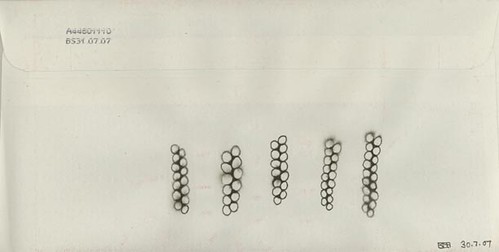
In the meantime, please feel free to investigate The Diary Project - I'm doing a drawing every day for the entirety of 2007 and blogging them. The drawings are done on the back of envelopes, then I put something secret inside and post the envelope back to myself. Since the rule is that the day's envelope has to be posted before midnight, I'd better stop blogging now and get on with today's drawing!

47 Comments

Yesterday I mentioned the importance of having your work available online. Today I'm going to expand on that and give two reasons why I think this is important.

MAKE LIFE EASY FOR CURATORS - THEY LIKE THAT!

Things have changed in the art world: I believe that curators increasingly expect to be able to find information about artists online. Of course, it could just be me, I am very immersed in the net, having been online for about 12 years at this point. However, I personally know several other curators who take a similar approach to me.

That's not to say that curators primarily look for artists online yet (although I know at least one who does) but I believe curators are using the web to expand their knowledge of an artist who has come to their attention.

When I'm curating an exhibition, I still advertise for artists through print media and expect artists to send me postal applications. However, if I get a postal application and I'm interested in the work, my next step is always to Google the artist's name to see if I can find more images of their work. I won't discriminate against an artist if they're not online but it does make it harder for me to accurately judge their work.

In an exhibition application it's usual for the curator to set limits on the number of images that an artist should send. Briefs typically say something like "10 images max" and it can often be less than ten. This is to prevent curators being absolutely inundated in stuff: if you get 50-70 applications for an exhibition you simply don't want to look at every single piece of work each individual artist has ever done!

However, it's quite difficult to judge an artist from 10 imges or less, a CV and an artists' statement. So I Google. Googling artists puts an artist in context for me and expands on the information that they've already sent me, allowing me to make a fairer and more informed judgement about their work. It also allows me to make my own judgement on which piece to include. Sometimes an artist will send me images of what they think is their best piece but if I can see more of their work online, I might find a piece that is actually much more appropriate for the show I'm trying to curate. That can make the difference between being included in a show and being turned down.

So can you see how having a visible online presence can widen the odds for you?

LET OTHER PEOPLE DO YOUR PROMOTION FOR YOU

By being visible online (under your professional name, of course), you allow other people to do your promotion for you. This works largely through the medium of blogging, although occasionally artists are picked up by the larger mainstream media because a story about them has appeared online.

British artist Lauren Porter got global media attention when she made a lifesize knitted Ferrari for her degree show at Bath Spa University.

ferrari

Now I don't know whether she first got attention in the mainstream media and it then spread online or if it was the other way round but either way, the fact that photos of her work were available online meant that it was very easy for bloggers and online communities to distribute the story. It went through the enormous online knitting community like wildfire but a quick look on Google shows that it was also linked in geek blogs, car enthusiast blogs (including the Ferrari Owners Club), craft blogs, art blogs, popular news blogs like Digg and even YouTube: the coverage was truly vast.

Visitors to her Bath Spa University degree show would probably have been in the hundreds, maybe as high as a thousand or so but I'm absolutely certain that millions of people saw her work in newspapers, magazines and online. What a way to start your art career!

Of course, Lauren's piece was an incredibly appealing story and wouldn't have been a hard sell in any media but I believe that any artist can find themselves being promoted by other people through the medium of blogs if they're doing interesting work. Even if you don't break out into the mainstream media, there are a large network of artist bloggers, some more influential than others, who will happily link to your art if you make it easy for them to do so.

Of course, being easily found online won't mean that you never have to do any promotion but it does mean that once you've started the ball rolling, other people might pick it up and run with it for you.

Neither of these things will help you if your work isn't any good: making good work must always be every artist's first priority. But if you've reached the stage where your work deserves a wider audience then building an online presence can help to give you a leg-up in the art world and may bring opportunities your way.

Building a visible online presence should never be all the promotion that you do but it should definitely be some of what you do. If you're not on Google then you're basically invisible in the modern world and artists who want to succeed just can't afford that.

Over the next few weeks, I plan to follow up this article with more detailed ones about how to create a visible online presence.

Get more help
If you'd like more information about building your online presence, check out the free resources section.

I am also available for online consulting if you need one-on-one help.

Sorry for the short absence, I've been meaning to post but I was busy with other things. Anyway, back to our regular scheduled programming.

If you haven't seen it before, George Lucas In Love is a wonderfully affectionate parody/tribute. Made in 1999, it's only 9 minutes long and if you've ever seen and enjoyed Star Wars you'll probably be charmed by it, I certainly was.

Lindsay asked in comments how I find the stuff I link to. I find most of the artists I feature in posts or links from other artist's blogs, I read about 20 or so art blogs and a few of my favourites can be found on the links page of this site. But sometimes I'll find stories or things out in the offline world too. This link is a good example, my partner had seen it before and noticed it was on the Sci-Fi Channel so he called me through and made me sit down and watch it. He also emails me stories about art that he's seen on the web too.

I have a folder on my computer where I store webpages about stories that interest me, which is useful if I don't have time to make a blog post instantly.

On other occasions I've found artists in the newspaper or in art magazines and then looked them up online. I'm always disappointed if I can't find anything about them.

I do think that having some kind of professional visibility online is increasingly important for artists and it's something that I plan to write more about soon. In the meantime, I'd like to encourage any artists reading this who don't already have an online presence, to get themselves a Flickr account and put up some images of their work. You could use a different photo hosting site, there are lots out there, but I adore Flickr because of its community aspects and ease of use. When you sign up, using your real name in your username or your profile will mean that you're searchable in Google. It's a really cheap and easy way to make a sort of mini website of your artwork, without all the scariness or expense of making a website. I've also found the Flickr community to be very welcoming and supportive of art and there are plenty of groups over there dedicated to discussing art and showing other members your work. It can really be a fantastic way to promote your art; according to my beloved Google Analytics, it's my third biggest source of visitors to this site while over on The Diary Project blog, it's the largest source.

2 Comments

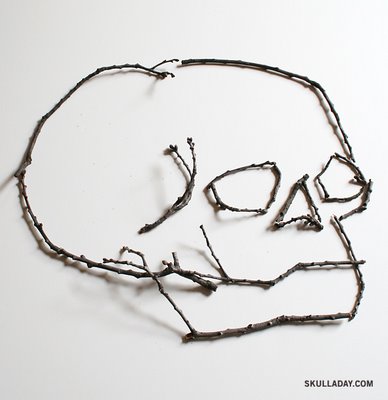
Because you can never have too many skulls!

Skull-A-Day

Skull-A-Day is making and posting a skull every day for a year. There are some wonderfully images and creative uses of a wide range of materials.

I just love the idea of reinventing a very simple, iconic image every single day for a year - it kind of makes the Diary Project seem easy! I think I'd go bananas if I was restricted to one image for an entire year but maybe being restricted to an envelope and whatever you can fit inside it would feel too restrictive to other people. Everyone's art boundaries are different and I can definitely see the joy in being able to explore so many different materials whilst having the focus of repeating a single image.

I'll definitely be keeping an eye on this project - they only started in June so they've got quite a way to go but they've certainly got off to a roaring start. Oh, and if you want to participate they also post skull images sent in by readers.

4 Comments

Since launching the site I've become hooked on Google Analytics and check it daily to see how the site is doing. It's like a little competition with myself, did I get more visitors yesterday than the day before, do I have someone from a new country? Partly I'm trying to work out if my (very slow and rather laid back) promotion is working but mostly I just find it fascinating. You can see which site people came from, which countries people are from, which pages they looked at and how long they stayed - it's absolute heaven for a nosy person!

For instance, who is the single visitor from Hong Kong? Or how about the person in Portugal who's visited three times? I don't think I know anyone in either of those places, so how did they find me? See, it just sets the brain wondering. (If you happen to be either of these people, please do leave me a comment because I'm dying to know!)

In less than a month I've had 139 visitors from 12 different countries, many of whom have been back more than once. Of course, I'd love loads more but I think that's pretty good for a brand new site. So a big thank you to everyone who's visited and those of you who've been kind enough to mention me in your own blogs, I really do appreciate it.

I've also learnt so much about blogging since launching, which is a little bit odd since I've been blogging on Livejournal since 2003. However, Livejournal is such a self-contained world that blogging outside it is quite different. I have to think about things like 'how many visitors am I getting' and 'are the settings working, can search engines find me'? I never had to think about any of this stuff on Livejournal: my LJ is more of a personal space and I never really conceived of it as being about promoting myself as an artist, so numbers weren't important to me there. In fact, I still have no idea how many people read my LJ, nor do I particularly care because it's just not about that.

I'm currently mystified by the fact that Google found this site within days and I quickly got to number two in their listings*, yet The Diary Project site, which has been running over at Blogger since January doesn't comes up until page 16 despite the fact that my name is in the profile. Last night I spent about an hour researching how to get better search engine visibility: I changed various settings and added my name to the blog title. I've just checked and in less than a day it's gone up to page 3 - boy, those Google spiders work fast.

Oh, and I've changed the comments on here too, so you no longer need to have your first comment moderated. We'll see how that goes - if I'm drowned in spam then I may need to change it back but I thought the moderation thing might be off-putting.

*I'm knocked off the number one spot by another Kirsty Hall on Bebo, which is undoubtedly good for my ego!

2 Comments

Kirsty Hall - The Diary Project, envelope drawing

DP 211, originally uploaded by kmhlamia.

I've just finished a mammoth Diary Project update and it's all up to date again. This is my favourite envelope out of the 9 I've just scanned.

For those of you who haven't checked out the rest of my site and seen the 'work in progress' section, The Diary Project is a year long art project where I'm drawing on the back of an envelope every single day for 2007. The envelope is then filled with something secret and posted back to myself before my daily midnight deadline. Hopefully next year, I'll get an exhibition where all the envelopes can be shown altogether and people will be able to open them and investigate the contents. It's like a very, very slow form of blogging! If you happen to know a gallery who might be interested in showing the work, please let me know: I need to start organising that part soon and any useful suggestions or contacts would be very welcome.

The Guardian had a small piece about photographer Idris Khan today. I can't find that particular piece but here's a long, more reflective article that they did on him last year. I hadn't seen his work before but I think it's wonderful. He scans and layers photographs to produce beautiful blurred, mysterious images that seem to relate as much to drawing as photography.

Idris Khan - every… page of the Holy Koran
Idris Khan: every... page of the Holy Koran, 2004

This image is every page in the Koran scanned and layered. Khan grew up as a Muslim and apparently he made this work to reflect the importance that the Koran had in his childhood. It took him 2 months to make and he followed the correct procedure for handling the Koran whilst making it - I love the implied ritual of that. I think it's an amazing piece, I particularly love the blackness in the centre of the image. Even though that's obviously an artefact of the scanning process it makes me think of the mystic void at the heart of spirituality - the ineffable nature of the divine.

Here's another piece called every... stave of Frederick Chopin's Nocturnes for the piano.

Idris Khan: every… stave of Frederick Chopin’s Nocturnes for the piano
Idris Khan: every... stave of Frederick Chopin's Nocturnes for the piano, 2004

When I look at this piece, I get the sense of the number of times it's been played. It seems to take the ephemeral experience of making or listening to music and fix it in time.

2 Comments

We had the first barbecue of the year, it's been too wet until now. I hadn't realised how much I'd been missing it until this evening. I was so happy just being in the garden, making fire and eating fresh food with my fingers. I need to spend a certain amount of time out in the garden every day or I get a bit cross but it's been so hard lately with all the rain.

Kirsty Hall - BBQ Coals

I loved the way the grill looked afterwards with the contrast of the white ash beneath the blackened metal.

Kirsty Hall - BBQ Coals

A close up of the dying coals, taken in the dark with the flash, you can just see the wisp of flame.

Kirsty Hall - BBQ Coals

The same coals without the flash, I adore the colour on this shot. I tweaked the levels very slightly to brighten the image but this is basically the same colour that the camera captured.

It was so wonderful to stand outside in the dark taking photos with the warmth of the fire under my hands and the smell of the smoke in my hair. Then as I was coming back inside, I saw a bat, which always makes me very happy. I felt quite renewed and emotionally nourished by it all.

Oh, and the food we ate was extremely delicious too!