Blog

I've always noticed cast iron. Even as a kid I was fascinated by the different shapes of gates and railings. Maybe it's because there's a history of blacksmithing on my mum's side: if I'd been born a boy in an earlier generation, I might have spent my days banging bits of metal into ornate curves. So it's no surprise that I like to take pictures of railings, especially when they're deliciously rusty.

This railing is really unusual. I've not seen another one like it and I can't work out what era it's from.

Rusty railings
Kirsty Hall: Rusty Railings, May 2008

Rusted railings
Kirsty Hall: Rusty Railings, June 2008

Rusted railings - close up
Kirsty Hall: Rusty Railings, June 2008

These railing are just round the corner from me and the design is clearly based on oak leaves.

Ornate railings
Kirsty Hall: Ornate Railings, June 2008

I like it when you can tell what the original design is meant to be; sometimes they're so over-painted that it's just a vague organic blob. This decorative cast iron rose is still recognisable but it's becoming softer and less distinct with every layer of paint.

Cast Iron Rose
Kirsty Hall: Cast Iron Rose, June 2008

Two of our ceilings have been painted so often that none of us can decipher the original pattern of the plaster mouldings. One day I decided it was 'baby feet and broccoli' and that has stuck.

See what I mean...
Cream baby feet and broccoli
Kirsty Hall: Cream Plaster Mouldings, June 2008

The white baby feet in the kitchen aren't quite as obscured but I've still no idea what it's meant to be.

White 'baby feet & broccoli'
Kirsty Hall: White Plaster Mouldings, June 2008

Maybe one day I'll get up a very tall ladder and strip all the layers of paint off, but somehow I doubt it: I think we're stuck with baby feet and broccoli.

2 Comments

Tina Mammoser over at The Cycling Artist has been doing a fascinating series of podcasts about her artistic process. Last night, I listened to the latest one and I was very struck by something she said about how artists are either good finishers or good starters.

I'm definitely much better at starting things than finishing. Truth be told, I often dither over starting things too - I like to get everything sorted out in my head first and then I'll suddenly dive in and get going. So when I say that I'm better at starting than finishing, it's all relative: it's just that I truly suck at finishing.

I'm currently at the stage with the red embroidery (yes, the one I said I was going to finish weeks ago) where it's very hard to work on it because it's getting towards an end point. I know it isn't finished yet but I'm having a lot of trouble deciding where the next lines go. It's stopped being filled with infinite beautiful potential every time I drop the thread onto the canvas and the narrowing options are making me increasingly uncomfortable.

My instinct is to rush off and start a new one. A better one. One that will somehow miraculously instantly work without all this tedious humming and hawing.

But I'm plugging away trying to finish this one because I know how I am: new work tends to push old work aside and then the old work doesn't get finished. You wouldn't believe how much unfinished work I have in my studio. One of the things I loved about The Diary Project was that I had a daily deadline so I had to finish; there just wasn't the option to sit around being indecisive for weeks on end.

I wonder how I can incorporate that lesson, that discipline, into my regular practice? I've noticed that I often do better when the rules or limits of a project are clearly laid out at the beginning. Do I need to make all my work that way though? Surely there needs to be a place in my practice for freeform creativity too?

Sigh, you see how I am - these are the sort of knots I endlessly tie myself in. How odd that sometimes the work flows out of me almost effortlessly and at other times, it's this tortured, labyrinthine process. My mother says that I always have to make things difficult for myself; sometimes I think she has a point!

If you feel that you need a creative boost this summer, the lovely Camilla is running an online summer school. I'm still swithering about whether to sign up or not; it looks like fun but I don't know how much energy and time I'm going to have. But I'm certainly going to be dropping in regularly to see how they're getting on.

2 Comments

I am in a place of struggle with my art right now (as indeed, I often am).

I am second-guessing myself all the time. Is this embroidery good? Is there any point to it? Does it mean anything? Is it derivative and boring?

Bah, and indeed, humbug.

The chief enemy of creativity is "good" sense.
Pablo Picasso

I often have to trick my analytical side into letting me make art because my art is essentially nonsensical. It's a daft thing to do. Putting thousands of pins in a piece of fabric or tying thousands of knots in bits of string is loopy, I've always understood that, whilst at the same time (mostly) believing that it still has value. Yet holding those two opposing beliefs (this is daft/ this is worthwhile) in balance is not always an easy thing to do.

It's hard to make art when your mind is tied up in knots like this. Often it seems that we artists spend most of our time clearing out the junk in our heads that stops us making, instead of actually making. Hmmm, perhaps it's time to read one of my favourite books, Art & Fear by David Bayles and Ted Orland, which is all about how not to quit. I reread it at least once a year, it helps get me through times of doubt like this.

All children are artists. The problem is how to remain an artist once he grows up.
Pablo Picasso

I want to get back to uncomplicated creating, making without thinking, joyful making. I miss it. Perhaps I will drag out my pens this afternoon, lie in bed and just draw and draw and draw. I know when I feel like this - dissatisfied, antsy and annoyed with myself and my art - that work is the only cure. I might not make anything good but even lousy art usually moves things along.

One final note: I'm not looking for sympathy here. I am not in crisis, despair or needing reassurance that my art is good: I've been through this many, many times before and I know that I will pull out of it and start making again, usually with renewed vigour and enthusiasm. I am well aware that this is a natural part of the artistic process that most artists periodically go through. I'm putting this out there in the hope that other people will learn that this is just part of making art and so that they don't despair when it happens to them.

And now I'm going to go and take a walk with my camera to get some fresh air, buy something yummy for dinner and hopefully clear my head.

5 Comments

Unfortunately I've been unwell for the last few days but I hope to get some proper writing done in the next day or two. In the meantime, in celebration of having my broadband back, here are some new photos from my garden. When I'm ill, my life often focuses down to very small things; a reflection in a bucket, the wind in the grass, pollen laden stamens, bats hunting across a twilight sky, the cat on my lap.

Kirsty Hall, photograph of Red Lily
Kirsty Hall: Red Lily, June 2008

Kirsty Hall, photograph of Blue Convolus
Kirsty Hall: Blue Convolus, June 2008

Kirsty Hall, photograph of trees reflected in a bucket
Kirsty Hall: Reflection, June 2008

Kirsty Hall, photograph of Grass seeds
Kirsty Hall: Grass Seeds, June 2008

4 Comments

A friend of mine is raising money for the cancer charity Maggies Centres by climbing all the Monroes in Scotland ( a Monroe is a Scottish mountain over 3,000 feet and there are 284 of them!) He'd originally planned to do this in a year but didn't manage it due to various issues, however, he kept going and he's now nearing the end of his project. I'd love to surprise him with a last minute boost from people he doesn't even know, so if you feel inclined, please stop by his site and make a donation.

Hmm, apparently I did something weird this morning and this post vanished into the ether even though I'm sure I published it. Even more annoying, it didn't save most of it, so I've had to rewrite it. Fortunately most of it is based on an old piece of writing from way back in 2001, so it wasn't too much work. I've even managed to put in a couple of pictures - if I'm very patient, I can link to photos that are already on Flickr, I just can't upload any new ones. Using dial-up is like wading through treacle and I can't wait to get back to the 21st century and a fast broadband connection although I am enjoying hearing the old modem sound again, it's quite the nostalgia trip.

Anyway, it's time to raid the vaults... this has been edited slightly to tighten up the language and grammar but is more or less unchanged from the original.

Still Life
1/7/01

I have come to realise that much of what I make is actually Still Life. My photographs, in particular, have a Still Life sensibility. I am looking at small things - like hot raspberries on the beach or the reflection in a bowl of water - and saying that they are small yet important. It seems to me that that is what most Still Lives do: they take everyday things and set them apart so we can truly see them.

blue bowl 02
Kirsty Hall: Blue Bowl Reflection, circa 1999

Still Life demands that we really look at the flagon of wine and the apple; the bowl of cherries; the lifeless carcasses. It ponders the flowers, the glass and the tablecloth. It shows us the texture of everyday life and forces the realisation that actually these things are amazing: the bread we eat, the soft cheese, the pile of fruit, the luscious cakes, the humble or grand spread. This is what keeps us alive after all. This is what nourishes us. Of course we also need vast epic pictures of the imagination and portraits that force us to look at our frail human bodies. We need art to consider many things but it seems odd that Still Life should so often have been considered the least important subject matter in art, when it deals so intimately with life and death.

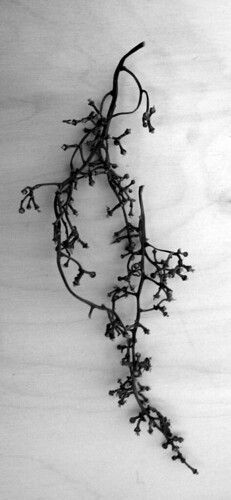
Grape stem 01
Kirsty Hall: Grape Stem, May 2003

Mortality is a vital component of many Still Lives. Those flowers will soon be dead: they are just caught for a moment in time. Caught at the point of perfection? Or perhaps already weeping their petals onto the rough-hewn table or perfect lace. That food will spoil or be devoured by a hoard of hungry mouths. Even that fine glass goblet will eventually be broken or lost. The table itself will be consumed by history. Who knows what happened to the musical instruments, the sheet music or the pile of books? They are lost to us except for this captured image.

It is that quality of stillness that I love most about Still Lives. More and more my work has been edging towards stillness and quiet, not actual silence but definitely quietness. I think I am looking for contemplation and the mysterious void. Stillness is a quality that I associate strongly with the colour white, which is why I think my work has contained so much white in the last two years. I am searching for that perfect moment perhaps, that moment of clarity and stillness?

Sorry for the radio silence. We're transferring to a new ISP and despite the fact that we were paid up until the end of June, our incompetent old ISP cut us off early so we've been totally without email and internet access since last Thursday. But it gets even better, we found out today that they managed to cut us off so completely that it will be another week and an extra £50 before the new ISP can get us reconnected. We're not best pleased as you can probably imagine. Don't use BE Internet, that's my advice.

Fortunately my partner has just managed to cobble together dial-up access but it's slow and frustrating. So while I plan to do a couple of posts this week, I warn you now that it's likely to be all text.

I've actually quite enjoyed having a bit of an internet break. The weather has been lovely, so I've been out in the garden a lot and I've been catching up on my reading. Although I'm cross that we've been jerked around, another week without blogs, Ravelry and endless noodling around online doesn't sound too bad.

1 Comment

Sigh, I'm not sure where this week went. Do you have weeks like that? One minute it's Monday, the next it's Sunday and you're not sure what happened to the in-between bit. I seem to be having more and more of them - maybe it's true that time speeds up as you get older.

I have been working fairly consistently on my embroidery piece this week and I hope to get it finished later today or tomorrow. I've decided to set myself an informal target of finishing a piece of art a week because I need a bit of a push.

Kirsty Hall, photograph of red thread drawing in progress
Kirsty Hall: Red Thread Drawing In Progress, June 2008

It's been very interesting watching this evolve because I've been doing it freehand, so it's been at least a hundred different temporary drawings so far. It's impossible to keep things in place, the loose thread spills across the surface and moves with every stitch I make. I find it a very meditative way to work; accepting that perfect arrangements of thread will come and go each time I pick up the canvas.

I once read a quote from a writer who said that as soon as you'd written the first line, your novel was committed to a certain path but before that first sentence, anything was possible. That's not the case with this work. Certainly as I sew the loose thread into place, the number of ways the remaining thread can fall on the canvas become less and less. Yet until the last few stitches are in place, the possibility of change is still there.

I enjoy knowing that I could do a million of these and they would never be the same. I wish I'd photographed every single variation as I went along - hmm, that might make an intriguing little artists' book.

Kirsty Hall, photograph of red thread drawing in progress
Kirsty Hall: Red Thread Drawing In Progress, June 2008

We had tons of rain this week, so I didn't get as much done in the garden as I'd hoped.

Rain on dill 01
Kirsty Hall: Rain on dill, May 2008

But I managed to get more of the left hand bed planted up and it's nearing completion, although I need to go back to the gardening centre for yet more plants and some sand to dig into the annoying patch of clay.

Rain on dill 03
Kirsty Hall: Rain on dill, May 2008

I'm learning to accept that gardening - like art - is a process and there will probably never be a time when my garden is 'finished'. I certainly won't get everything done this year but that's OK; any improvement is better than none. At least that's what I keep telling myself.

Rain on coriander
Kirsty Hall: Rain on coriander, May 2008

I guess that's where my week went - lost in creativity, both indoors and out. Ah well, there are far worse ways to spend your time. I hope you all managed to carve out some creative time this week.

22 Comments

I have a problem with categories. Basically, I'm just not very good at them. I find it difficult to choose tags for blog posts. I have too many sets on my Flickr account. I have too many email folders. I struggle with organising my filing cabinet. I desperately need to go through and rationalise all these things but it doesn't come easily to me.

In terms of organisation, this is obviously A Very Bad Thing. I constantly lose things and I sometimes avoid tidying up because I simply can't decide where stuff should go. And then I end up with this sort of thing!

Messy study
Kirsty Hall: Messy Study, May 2008

[I've tidied my desk since this was taken because the photo appalled me so much. If you have problems keeping your desk clear, check out Inspired Home Office for resources that may give you the push you need. Since tidying up this disaster zone, I've been noticeably more motivated and I'm feeling more on top of things.]

I do have systems but things still stump me. I've got a box that's been sitting in my study unsorted and neglected for 6 months because it's full of the sort of random objects that I find almost impossible to categorise. The pile of papers to be sorted into my filing cabinet is so large that it's developed geographical layers and may actually have started to fossilise down at the bottom.

Since I'm so visual, I sometimes wonder if I should simply file things by colour - but I know that I'd just end up spending ages trying to decide if objects were blue or green instead because having trouble with categories is a global failure in my brain.

TIME TO LOOK ON THE BRIGHT SIDE...

However, while it's a problem in terms of organisation, being bad at categories can be a distinct advantage for an artist because you can see across boundaries to make associative leaps than non-artists often don't. Leaps of logic that make perfect sense in KirstyLand often seem innovative and original to others.

For example, this piece called Lost was made for an exhibition in a church. To make the piece, I carefully broke an unglazed bowl, then mended it with glue, leaving deliberate holes. For the exhibition, the bowl was placed on linen and filled with salt water, which gradually evaporated through the porous clay.

lost 08
Kirsty Hall: Lost, 2003

Lot's Wife was the inspiration for the piece and I combined her familiar story with the Japanese tradition of mending broken bowl with gold to make them more valuable than when they were whole. I'd read about this several years before and had been utterly captivated by the idea of regarding a mended object as beautiful and powerful instead of flawed and damaged. Somehow in my head, this linked with my sympathy for Lot's Wife, who was forced to leave not only her home but two of her adult children. In that situation, what mother wouldn't turn back to see what had happened? Isn't it interesting that she's usually held up as an example of female disobedience but if you turn it around, her story can just as easily be interpreted as being about the power of maternal love.

lost04.bmp
Kirsty Hall: Lost, 2003

As artists, we need to turn things around. We have to learn to look at our problems and disadvantages to see if they also contain power and wisdom for us. It's time to recognise that the things that make us bad at fitting into the 'real world' are sometimes the exact same things that keep us making our art.

4 Comments

Hooray, I've cleared out my links folder. Of course, I still have another two to get through but at least one of the three is empty.

ART

Beautiful microscopic photographs of sand from scientist and artist, Dr. Gary Greenberg.

An elaborate and intricate laser-cut book from artist, Olafur Eliasson

Arthur Ganson makes strange mechanical scupltures.

Tips on being an environmentally aware photographer.

I'm loving Poppytalk's series of interviews with artists about their studio spaces.

Amy over at Life Craft makes intriguing collages and assemblages.

Miwa Koizumi makes ethereal sea creatures from plastic bottles.

There's a ton of drawing lessons over on Drawspace.

I like J.T. Kirkland's pierced wood drawings. He also has a great blog called Thinking About Art.

Reya Veltman makes very lovely pebbles covered with felt. Link found on the excellent This Is Love Forever blog.

RANDOM STUFF

Off-Grid is an excellent environmental site. I was particularly fascinated by this story about Microbial Fuel Cells, which use a combination of very basic technology and the energy given off by soil microbes to provide electricity.

A fascinating collection of objects found under the floorboards of an old British house that's being renovated.

An alphabet made from clothes pegs shaping flesh - ouch!

Animals in formalin - what's not to like?

25 Amazing Everyday Do It Yourself Inventions - the fangs made from a plastic fork are my favourite.

Lost caverns and buried cities from the excellent Web Urbanist.

Ladders made especially for cats - who knew such a thing even existed?

FUNNIES
Andre Jordan's pointed cartoons about disability always make me laugh.

Cookie Monster faces his cookie addiction and asks 'Is Me Really Monster?'

Ah, real comedy of recognition here - The Artist's Decision Tree

Not at all seasonal but as a knitter, this photo story about Christmas sweaters made me laugh a lot and gave me 80's flashbacks!