Tag Archives: Art thoughts

20 Comments

I'm currently doing Alyson Stanfield's Blast Off course. It's challenging and intense but I'm finding it incredibly revealing and useful. One of the daily lessons was about reconnecting with what made us want to be artists in the first place. Here's what I wrote on the subject:

.................

I've been thinking back to some of the ecstatic points in my life that made me an artist.

1. I would have been about 16 - 17. I was still in secondary school and we were taken on a visit to Glasgow university. I had some free time and went into the Hunterian art gallery, where I was utterly transfixed by a full size Victorian/Edwardian painting of a woman. I can't remember who it was by - I think it was possibly John Singer Sargent - but I sat there for about an hour, totally engrossed in it, with tears running down my face.

2. Standing in the Sacré-Cœur in Paris with clear December sunlight streaming through the Rose Window while the choir sang in Latin.

3. Seeing Eva Hesse's drawings for the first time - I'd always loved her sculpture but the subtlety of her grey-toned drawings blew me away when I saw them in real life.

4. Walked round a corner in the Pompidou Centre and being confronted with Cubist paintings by Picasso. I was in my early 20's and had only been seriously drawing for about three years. I had seen them previously about two years before and been singularly unimpressed - at the time I liked the Impressionists and I thought Cubism was 'modern rubbish'. However, when I saw them for the second time I'd done a lot more art history reading and I suddenly got it. It was a surprisingly visceral moment, like a punch to the stomach! It's a moment that's stuck with me because it reminds me that even if I don't initially like or understand a piece of art, it's always worth taking a second look because my understanding of the visual world is constantly evolving.

But my defining moment was when I was 18 years old, sitting in an English lecture at college and getting absolutely FURIOUS at the way the lecturer was completely pulling this book apart and remaking it in his own image. I found it so disrespectful, I was sat there thinking, "write your own damn book, mate!" and it suddenly hit me, "I don't WANT to do this, I want to be the person MAKING things, not the person analysing other people's things!"

Now I look back and I think, yes, THAT was the moment when I stepped through the looking glass!

..................

I've had many other meaningful encounters with art in my life but those are a few that stand out. Was there a defining moment in your life that took you down the path you're on now? Have you ever experienced a piece of art that overwhelmed you with emotion? Please leave a comment, I'd love to hear about it...

44 Comments

The excellent book, Advice To Young Artists In A Postmodern Era by William V. Dunning is one that I think every artist should own. At one point, Dunning talks about the value of immersing oneself in art. This is what I'm doing at the moment. With the exception of a little bit of knitting and gardening to keep me grounded, I've spent the last few days immersing myself in thinking, reading, viewing and writing about contemporary art.

And I've come to a conclusion.

The denizens of the contemporary art world desperately need to drop what I refer to as 'art wank'.

Enough already. Enough dull academic shows that no one but a tiny elite care about. Enough 'clever' critical writing that says nothing. Enough postering. Enough big words. Enough drowning art in philosophy. Enough bullshit.

I know that art is often hard to write about - I'm currently trying to bash my artists' statement into shape and it's resisting furiously! - but the way most critics talk about art is just ridiculous.

I am tired of it. I am tired of feeling like an idiot when I try to plough my way through it. I've been making, looking at and reading about art for years. I studied it intensively in college and wrote essays on it. I still read about art constantly.

So if I can't understand what most art writers are on about, what chance does someone whose art education ended in high school have? On Friday I read an 'explanatory' pamphlet at the Arnolfini gallery that managed to make an already boring show even more dry, academic and obscure. I left the gallery wondering what the point of my visit had been. If I'd been visiting a contemporary gallery for the first time, I certainly would have felt no desire to go back. After this sort of experience it's easy to see why people think that modern art is rubbish.

In my 30's, I returned to art college after a break of about six years spent raising my son. It was my third shot at getting my degree. Having been thrown out of an English course at the age of 18 and then having left a Fine Art degree when I accidentally got pregnant at the end of my first year, I was understandably quite nervous about my ability to do the work.

I vividly remember being set a reading list that included the art historian, Rosalind Krauss. All summer I struggled valiantly with it, trying to comprehend her points and getting more and more disheartened. Her words seemed to have nothing at all to do with my own experience of being an artist and the concerns and ideas that were floating around my head when I was making sculpture. I ended up wondering how I was going to cope at art college? If I couldn't understand this set text, surely I was FAR too stupid to go.

On the first day, we sat in a large circle and the tutors asked us how we'd got on with the reading list. Someone confessed to finding Krauss impenetrable. 'Ah yes,' said the Head of Sculpture, "she is very difficult, isn't she. I don't really understand her myself, to be honest." The entire group let out an audible sigh of relief and I sat there thinking, "well if YOU don't even understand it, why the hell did you assign it?"

I never had to refer to Krauss again and at the end of my degree, I took great joy in turfing the damn woman off my bookshelves.

Don't get me wrong. I'm not saying, 'don't read'. I love to read and always have. I especially love non-fiction and I read widely and voraciously both inside and outside my field. A lot of my ideas come from my reading. What I'm saying is, when we write about art, can we try to sound as if it matters, as if it's alive, vibrant and important and as if the writer is actually interested in what they're discussing.

I do understand that art historians and those who analyse art, experience it in a very different way to those who actually make it. And I also know that every artist needs to find a way to talk about their work. Many artists look at it as a necessary evil but I've always found it both helpful and vital to define my practice in the right words.

What I don't think is helpful and vital is when the convoluted language of the historians, critics and philosophers infects the language of artists. I don't think we're doing our work any favours if we cloak it in fancy buzz words and arcane concepts. I know that every profession has its jargon and I know that some concepts are very difficult to explain but the art world needs to stop pretending to be smarter than it is because really, I don't think we're fooling anyone!

Still, on the plus side, 'art wank' is an excellent cure for insomnia...

7 Comments

You know that internet joke that goes:
1. Set up online business
2. ???
3. Profit!

Um yeah, that kind of IS my business plan!

I mean, it's slightly more sophisticated than that. It actually goes:
1. Make lots of work
2. Show work online and in exhibitions
3. Build up reputation
4. ???
5. Make lots of money, er well, some money anyway

Seven years after graduating, I have come to the conclusion that it's not the world's most efficient business plan. Steps 1 to 3 are coming along nicely but unsurprisingly, steps 4 and 5 continue to elude me.

I have been struggling a lot with the money thing lately, most particularly with how it relates to my art. Recently I came to the conclusion that I'm just not comfortable with money.

Don't get me wrong, I have no problem spending it - although actually I'm usually pretty sensible with that side of things. My problem is more with the concept of getting paid for what I do.

I think on some level my image of myself just doesn't include the idea, 'earns lots of money'. Certainly I'm much more mentally comfortable in the voluntary/low income sector. I have no idea why this is. Some misplaced notion of bohemianism, perhaps? Some basic insecurity or lack of self belief? I suspect both these things come into play but looking back, I can see that I've never been motivated by money. I don't care about status symbols like fancy cars and designer clothes and as long as I have enough money to get by, I'm perfectly content.

My motivation has always been internal rather than external. I had a hard time when I was at school because I hated what I saw as all the 'jumping through hoops'. I've become somewhat better at that over the years but I'm still the sort of person who will work my fingers to the bone if I'm interested in something but if I'm not interested then it's like pulling teeth, no matter how much money you offer me.

Naturally I understand that everyone has to do things that they dislike and I'm not so spoilt that I'll refuse to do boring things. I've done my share of mind-numbing paid jobs in the past and if my health was better, I probably still would be. There are also plenty of art tasks that don't fill me with joy: I dislike documenting my work, writing exhibition proposals and doing graphics for posters but I crack on and do them because they are part of being an artist. However, I'm doing these things because getting my work out there matters to me; again it's self motivation rather than the external motivation of money. I don't want to get the work out there to make money, I want to get the work out there so that the work is out there. I find this makes quite a fundamental difference when it comes to the 'getting paid' part of the equation.

One of the most obvious ways that my conflicted relationship with money manifests is the difficulty I have with the idea of selling my art. I have wavered back and forth on this for years. There are some real practical issues - most of what I make doesn't lend itself easily to selling. For example, because of the length of time my work takes, most of it would not be economically viable unless I charged astronomical prices.

However, I've noticed that I'm also extraordinarily resistant to the thought of selling my drawings, even though they're a much easier and more realistic prospect. Oh sure, I have a ton of excuses for that one - "they're not good enough", "I don't know how to sell", "I just don't feel ready" and "I don't like putting a value on things that I make" - but I can see that it all comes down to my fundamental unease with money.

Another example: before today, it had never once occurred to me that my photographs might have a market. Because I don't think of them as 'art', attempting to sell them had never even crossed my mind. And now that I have thought about it, I want to run away really fast! I am formulating new excuses in my head already. It's abundantly clear that the true problem is not with the kind of work I make; it's with the very idea of selling.

It often feels as though money is a strange language that I don't speak. In fact, it's as though my brain is wired in such a way that it doesn't even recognise that it IS a language. I think I have 'earning money blindness', in the same way as I have 'pass blindness' - you could be showing very obvious interest in buying my work and I simply wouldn't notice. Yes, this has actually happened to me - the person in question had to spell it out to me and when she did, I was completely floored and didn't know what to do.

You see the problem - I truly suck at this stuff. Plus I clearly have ISSUES.

Expect more posts on this subject, as I work my way through this money thing. Yes, internet, you are my therapy. Aren't you lucky!

10 Comments

    'I don’t know what you're thinking of doing,' said Pippi, 'but as for me, I'm not one who can take things easy. I happen to be a turnupstuffer, so of course I never have a free moment.'
    'What did you say you were?' asked Annika.
    'A turnupstuffer.'
    'What's that?' asked Tommy.
    'Somebody who finds the stuff that turns up if only you look, of course. What else would it be?' said Pippi...'The whole world is filled with things that are just waiting for someone to come along and find them, and that's just what a turnupstuffer does.'
    Pippi Longstocking by Astrid Lindgren, translation by Edna Hurup

Isn't that just the perfect description of what an artist does - I knew there was a reason that Pippi was one of my childhood heroines.

    'What sort of things?' asked Annika.
    'Oh all sorts,' said Pippi. 'Gold nuggets and ostrich feathers and dead mice and rubber bands and tiny little grouse and that kind of thing.'

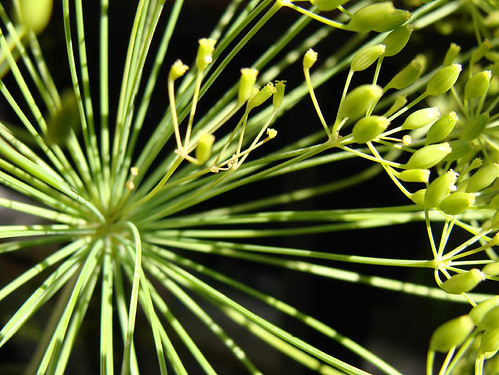
Yesterday, I turned up these images of my dill plant.

Dill 02
Kirsty Hall: Dill, July 2009

Dill 03
Kirsty Hall: Dill, July 2009

Dill 04
Kirsty Hall: Dill, July 2009

Today I turned up: several hours of art time, some thoughts that turned into art journal pages, my original Puffin copy of Pippi Longstocking, the first hint of ripening on one of my tomatoes and a quite unseemly amount of chocolate. No tiny little grouse though.

What small wonders have you turned up today?

4 Comments

I was reading this post about titles over at The Painter's Keys.

Here's the original question:

"What are your thoughts on changing the names of artwork to fit a venue, exhibit, or buyer? For example, is it okay to modify my often generic titles to more specific places, particularly when sending things off to shows? Is this wrong or deceitful? And, if changed, should new titles stay that way?"

In my opinion, if you need to change the title, then you just didn't get it right in the first place!

Of course, this doesn't apply to 'working titles', which are merely placeholders until you have a proper title but I think that there is a point at which the title is set in stone. For a book, this is when it goes to the printers or when the advance publicity goes out. For a work of art, it's usually when the work is exhibited.

There are exceptions, of course. If you're constantly remaking a piece in different places, then altering the title for each remake can be an appropriate way to differentiate them. Antony Gormley does this with his well known piece, The Field but they all still contain the word 'field' in the title. Repeatedly changing a title could conceivably also be an important conceptual part of a work - for example, if your actual subject matter is the way that perceptions of the art change depending on how the work is 'framed' by the title. But I see a big difference between both these examples and changing the title just to suit other people or to try and score a sale.

I know that titles aren't important to all artists but for me, they're a vital part of the work. I don't consider a piece properly finished until it has a title and I think about them a lot. I keep lists of possible words or phrases in my sketchbooks and often find scraps of paper scattered randomly around the house with prospective titles written on them.

The only time I've ever changed a title is when the title I've given it didn't 'stick' for some reason.

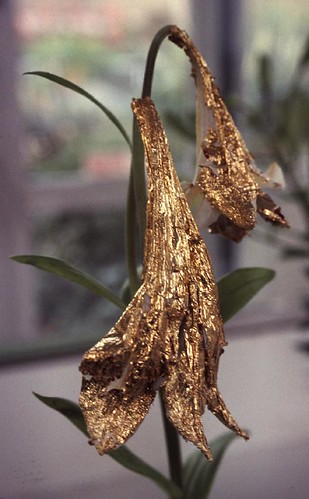
For example, this piece was originally called Do More With Less. The whole piece was my sarcastic riposte to my college tutor telling me to 'do more with less' - because naturally, when accused of 'gilding the lily' my response was to do exactly that!

gilded lily 01
Kirsty Hall: Gilded Lilies, 2001

But the original title was clunky and I could never remember exactly how it went, so it was discarded in favour of the more prosaic Gilded Lilies. And in retrospect, I can see that the more fanciful title was, er... gilding the lily.

gilded lily 02
Kirsty Hall: Gilded Lilies, 2001

I've also accidentally named things twice when I've forgotten that I'd already titled a work. When this happens, it's obvious to me that the original title wasn't quite right or I would have remembered it. When I name my work, I'm trying to find a title that so precisely and elegantly captures the essence of the piece that a name change would be utterly inconceivable.

I try never to change a name once the piece has been formally exhibited (although I couldn't swear that this has never happened). Changing a title in order to make the work more palatable (something I've been asked to do only once) or simply in order to try and sell the work, makes me very uncomfortable. Certainly, I think that changing titles multiple times simply in order to suit the audience, venue or exhibition is confusing and dubious: the work needs to have integrity.

So what do you think? Is titling important to you? Would you re-title a work in order to sell it?

12 Comments

I am lazy.

"What's that?', I hear you cry, 'you spend months patiently tying knots in string, sticking pins through fabric or drawing every day for a year, how can you possibly call yourself lazy?'

Ah, but it's a very specific kind of laziness and over the years - as I have come to understand it - I have adjusted my art practice to accommodate it.

I know myself and if I worked with the sort of materials that needed a specialist working environment like a forge or a foundry, I wouldn't get much art made. If I undertook huge expensive projects that involved lots of paperwork, funding bids and meetings with planners and architects, I would never get any art made.

Heck, even if my studio was in another building, I would struggle. When I graduated, I hired a studio space on the other side of town because I thought that's what you were meant to do. I kept it for a couple of months before recognising that I was working extra hours to pay for it but was hardly ever there and even when I was, I found it an uninviting place to work.

Eventually I realised that when I'd been a student, I used to make most of my work at home and then take it into college when it was finished. I tended to use my studio in college as an experimental installation space or somewhere to think, rather than somewhere to physically make work. I'm sure this is partly because I'd grown accustomed to fitting my art around parenting when my son was young. Having evolved as an artist whilst making work in the evenings on the kitchen table, a separate studio space felt like a barren and alien environment to me.

So now my studio is on the top floor of my house. Yet even that is not close enough and I tend to make my art in my study, my bedroom, my living room, my garden, on the dining room table and only occasionally in my studio.

I do enjoy the quiet and contemplative space of my studio, especially when I need to think, draw or make more mess than usual. But I also need my art to be part of my daily life; something I can pick up and put down as easily as the morning paper or my cup of tea. So art, for me, is largely a domestic affair and you'll often find me making my more repetitive pieces in front of the TV or while listening to a podcast on my computer.

In addition, the sort of materials I use in my art - small, unregarded things like matches, pins, sequins or envelopes - are easily available, safe to use and relatively cheap. This is a deliberate choice on my behalf. Partly because I'm very interested in everyday objects that are so commonplace that they become effectively invisible but also because I am passionate about 'owning the means of production'. I hate to be dependant on other people before I can even start to make my art.

I've never done well if I have to go through multiple steps to get something done and so wherever possible, my practice is organised to minimise that. For example, when I graduated I took out a loan so that I could upgrade my computer equipment and digital camera because I wanted access to the technology I'd used at college without having to go off to a library or rent out office premises.

My materials are a continuation of that desire for independence. I don't need to work a day job to buy the sort of materials I use. Nor do I need to scrabble around for grants or sponsorship or jump through anyone else's hoops before my work can come into being. I've learnt from experience that projects that do need access to specialist knowledge or equipment or more funding than I can provide myself are the ones that invariably end up on on the backburner.

Again, I'm sure my formative years of trying to combine art with parenting also informed my preference for cheap, readily available materials. Although I always bought the best I could afford, I was on a low income and got used to making do with what I had. And I found that I actually preferred it because it was easier to be loose and experimental with thousands of cheap, everyday things than with very rare or precious materials.

Some artists need the heroic struggle; it motivates and inspires them and forms a vital part of their practice. Others find that getting out of the house and into a separate studio space makes them more focused and dedicated. Yet others relish the challenge of working in very expensive materials.

But for me that stuff just gets in the way.

I need the path of least resistance because I find making good, meaningful art quite difficult enough without adding extra obstacles. I am perfectly capable of putting mental road blocks in the way of my own art practice and I realised early on that it would be disastrous if I added further restrictions such as the need for funding, planning permission, specialist studio requirements or expensive materials. So I have consciously set up my practice so that the only thing standing in the way of my art is myself - and believe me, that's usually more than enough!

It's vital as an artist to recognise your strengths and weakness and to play to both of them. Don't make it any harder than it needs to be.

8 Comments

Apologies for the lack of posting - as you may have guessed from my last big post, I've not been too well. I also got stuck in a cycle of perfectionism, the sort where I think, "ah, I absolutely must blog about such and such a thing next but oh dear, I can't until I take some photos or do some more research or until the planets are in the correct alignment!"

Sometimes I just get caught up in these mental loops and stay there until I realise that I'm stuck and do something to free myself - in this case, writing a very different blog post to the one I had planned. So here, to loosen me up and hopefully to inspire you, are two very different but connected videos about the nature of inspiration.

First of all, here's Susan Boyle performing on the reality TV show, Britain's Got Talent. Unfortunately, embedding is disabled, so you'll need to pop over to YouTube to watch it.

Secondly, here's a longer address by writer, Elizabeth Gilbert on the subject of genius, inspiration and creativity. It's twenty minutes but it's well worth your time.

I found this touching in a very different way - much of what she spoke about was deeply familiar to me as a creative person and I just loved the two anecdotes she relates. I've never been sure where I stand on the whole muse concept but I'm sure that we're all familiar with the 'where the hell did THAT come from' sensation when we're making our work.

I found this video on Denise Carkeek's excellent Melancholie Dreams blog. It's well worth a visit and do make sure you check out her wistful and haunting ceramics.

11 Comments

Since I’m currently in the midst of a Chronic Fatigue relapse, I thought I’d do a post about how to continue making art whilst managing an illness. I know it won’t apply to all of you but hopefully it will be useful to some.

Be Realistic
Firstly, it’s important to recognise that ALL artists have challenges in their life. Although it may seem incredibly unfair that you’re limited by your illness or disability, in reality ‘normal’ artists may be struggling just as much to make their art.

It’s easy to look at healthy people and feel jealous but try to remember that NO ONE has unlimited time, energy or money. Many artists need to work part or full time jobs to pay the bills, which drastically reduces the amount of time and energy available for art. Children or other family commitments can also be a serious limitation. Artists working on large, expensive projects may face endless frustrating delays while they scrabble around for funding. No one 'has it easy'.

Identify Strategies
Don’t make yourself more sick by carrying on doing something that is clearly too much. If you are finding it hard to walk or you’re in a lot of pain, then a very active practice that involves shimmying up and down ladders or hours of gruelling physical work may be impossible. Instead, tailor your practice to what you can do and find creative ways to continue to make art.

If you want to carry on making physically demanding things, then maybe you need someone to do a lot of the prep work for you. When Eva Hesse became ill with a brain tumour she employed assistants to make sculptures to her specifications. I employ The Wonderful Zoë two mornings a month to help me with things like admin, framing, organising and anything that involves heavy physical work.

You may need to change the scale on which you work or employ different materials or new techniques. When her almost constant migraines kept her bedbound for months and she could only paint for small stretches of time, Sarah Raphael divided her canvases up like strip cartoons and painted in tiny daily chunks. She also had to switch from oils to acrylics because the smell of the oils was a constant trigger.

When his eyesight started to fail due to cataracts, Monet loosened up his style and began working on his famous waterlily paintings.

I've found that having a small, manageable, daily practice like my current 'Objects For March' project or The Diary Project is helpful - 'little but often' apparently works well for me. I've also annexed an old spare laptop and I've written most of this in bed over the space of several days: right now it's making the difference between being able to blog and not.

Don’t Compare
It’s easy to feel jealous when your peers can accept exciting opportunities that are impossible for you but try not to compare yourself to others too much: it just leads to despair.

I’ve found that it’s more useful to look to people like Frida Kahlo for inspiration - she carried on painting despite being in shocking amounts of pain. Or I look at my college class and realise that even though I am not making art as fast as I want to, I'm still unusual in that I’m consistently making work and showing professionally.

Acknowledge Success
Give yourself props for what you ARE doing instead of mentally punishing yourself for what you’re not.

I have a terrible habit of berating myself for ‘not working’ when what I really mean is that I’m simply not doing as much in the studio as I'd like. I tend to discount anything that isn’t physical making as Not Art even though experience has shown that things like reading, writing, research, thinking, documentation and admin are all vital parts of my art practice.

If you're not strong enough to make art, take a break and if you're able, do something connected to your art instead. When I'm ill, I often use the time to catch up on my reading and documenting.

Allow Yourself To Stop
Art is a higher brain function and creating any sort of art takes a surprising amount of energy. Unfortunately when you are very ill, sometimes you have no choice but to put your art practice down completely for a little while. This can be difficult for artists since many of us are very driven by our art but it’s sometimes necessary. Concentrate on getting well and promise yourself that you’ll find a way to pick it up again as soon as you can. I tend to use my art as a 'canary down a mine' - when the thought of doing anything art-related makes me want to cry then I know I'm 'crashing' and need to recuperate. If I don't try to force things and make the relapse worse, then the art comes back on its own as my health comes back into balance.

Pace and Plan
Find your own rhythms and what works for you. I no longer apply for things that require me to make new work for a deadline because it’s too stressful and it never ends well. Instead I only apply for exhibitions with work that already exists. I don't apply for residencies either because I can't guarantee that I'll be well enough. It can be very frustrating but knowing and (mostly!) accepting my limitations allows me to make more art in the long run.

If you’re exhibiting, do as much as possible well ahead of time. Pace yourself and schedule some downtime for after the show. Ideally you'd schedule some days off beforehand as well but in my experience, that’s rarely possible. Often opportunities seem to come in clumps but try to space things whenever you can. Know your limits and your body and how long it takes you to recover from a show.

Find Support
Depending on your condition there may be specific grants and/or opportunities available. While you may not be comfortable with the 'disabled' tag, there's no harm in seeing what help may exist. Online forms and support groups for your specific condition can also provide valuable information and resources.

It’s also vital to support yourself by pacing, eating healthily and getting enough sleep, especially when you’re experiencing a relapse or if you know that you’re going to be under extra stress. Easier said than done, I know! Accept that you might have to let some things slide. While delicious fresh homecooked meals might be the ideal, remember that getting your vegetables in tinned soup or out of the freezer is better than no vegetables at all!

Finally, do whatever it takes to get yourself through a bad patch, even if that means the house isn't as clean as it could be, your email doesn't get answered promptly or you don't go to all the private views you'd like. Accept that to conserve energy for your art, you may have to let some other things go.

6 Comments

Ah, the dreaded tax return... thankfully, the problem I mentioned with my password was not a permanent one and I got my taxes in on time. I managed to do it in the early hours of last Friday morning; it turns out that if you wait until after midnight then the Inland Revenue website works just fine. Apparently my password wasn't a problem at all, the website had simply fallen down from exhaustion earlier that day. And really, who can blame it? I know from past experience that I am certainly not the only person who does my taxes right at the last minute.

According to the Inland Revenue's own figures, they hit peak numbers on Friday 30th January with 390,000 of us filing our taxes only a day before the deadline. It's a bad habit and I plan to be more organised about it next time around... but then I always say that and I bet those other 389,999 people do as well!

Seriously though, my current accounts are a bit of a shambles and I need to get my art assistant, The Wonderful Zoë, to sort me out. She's been self-employed for years and rolls her eyes at the organised chaos of my accounting 'system'.

I do keep all my receipts (ordered by month in small plastic folders) and all my bank statements (ordered by tax year) but I don't do two things that I should - I don't have a separate bank account for my art business (which makes doing my incomings an absolute nightmare) and I don't keep an accounts book. Both those things have always seemed like just too much of a bother when I rarely make any money at my art but I have decided that this year, it's time to tackle them for three reasons. Firstly, if I start making money in the future then it will be vital to have solid accounting practices already in place. Secondly, if I'm ever investigated by the Inland Revenue, my current practices might look suspicious when really it's just incompetence! And thirdly, it will make doing my taxes a whole lot easier and anything that stops me having a nervous breakdown at tax time is obviously A Very Good Thing: I know that my long-suffering family would certainly be grateful!

The current plan is that Zoë is going to bring one of her account books over for me to have a look at and then talk me through it and then I'm going to open a new bank account, move everything to where it should be and buy and start using an accounts book. Simple, no? My deadline for this is April, so that I can start the next tax year properly with all my new systems in place.

What sort of state are your accounts in? Do you do everything you 'should'? Finances can be a difficult and emotionally tense area for a lot of people and although I believe that artists are generally far more practical and grounded than most people give us credit for, we're certainly not immune to Head-In-The-Sand Syndrome when it comes to our accounts.

23 Comments

Katherine asked to see some of the little drawings that I talked about in my last post. Here are a few of my favourites...

Pencil + gesso 15
Kirsty Hall: Drawing, Nov 08

Pencil + gesso 05
Kirsty Hall: Drawing, Nov 08

Pencil + gesso 07
Kirsty Hall: Drawing, Nov 08

Pencil + gesso 06
Kirsty Hall: Drawing, Nov 08

Pencil + gesso 04
Kirsty Hall: Drawing, Nov 08

Pencil + gesso 03
Kirsty Hall: Drawing, Nov 08

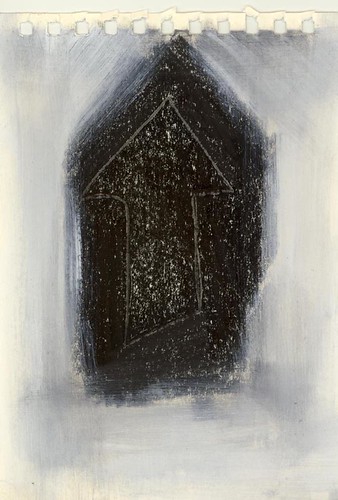
The torn edges are an important part of these drawings and I'm considering framing some onto larger sheets of watercolour paper so that the edges are retained. These are drawn on A6 cartridge paper (105 × 148mm) with a deliberately restricted palette: I'm ONLY allowing myself to use two pencils (a 2B and a 9B) and acrylic gesso. The greys are formed when the gesso mixes with the very soft 9B pencil. Working on this small scale and with such a limited choice of materials really frees me up to work quickly in an uninhibited fashion, which is absolutely what I need right now.

If you want to see more of these, check out my flickr pages.

When I was scanning these, I was thinking about the way that pencil is often regarded as a 'neutral' art material because it's so ubiquitous and considered fundamental to art. Yet actually, graphite is a very particular material with its own distinct properties. The scans don't capture the incredible, shiny, dense, silvery greyness of the 9B pencil but when I'm applying it so thickly, its status as a mineral becomes quite apparent. I've also been playing around in the studio with graphite powder on gessoed panels but it makes a much softer and more fragile mark than pencils, which contain clay and binder for strength and ease of use. I've been wondering what it would be like to densely coat an object with pencil marks or layered graphite? The idea of making sculptures that leave 'drawings' on their surroundings is very appealing to me.

Oh, and if you want to know how those 'simple' and ubiquitous pencils are made, then check out this series of videos from Derwent. It's a surprisingly complex process but certainly a lot quicker and easier than the way it used to be done!