Tag Archives: Series: Artists Online

A series of articles about how artists can create a useful online presence

6 Comments

OK, so how do you improve your Google ranking?

The SiteWizard has an excellent article called How to Improve Your Search Engine Ranking on Google. It might be a bit technical for some artists (it certainly lost me in places!) but it'll give you a bit of background about how Google works. Searching for 'improving Google ranking' will give you lots of information along these lines but the SiteWizard article was one of the clearest I found.

My own tips are a lot less technical!

Use your name

You absolutely must link your professional name with your professional online identity. No one is going to be able to find you if you hide behind a pseudonym!

If you start a new blog, use your name in both the blog title and the username. Google seems to pay a lot more attention to the title and the username than it does to your profile, which is one reason why having your own dedicated domain name is such a good idea.

Even if you host your blog or domain on a free site, which tend to rank somewhat lower than dedicated domains, changing the title to include your name can make a big difference. I was mystified when I searched for myself by name last month and discovered that The Diary Project didn't appear on Google until about page 15. It was outranked by far less important sites, where I was mentioned only in passing, and far newer sites, like this one. I just couldn't understand it. Eventually I worked out that although I had my name in the profile, Google wasn't giving it much weighting. I changed the title of the blog from "The Diary Project" to "Kirsty Hall: The Diary Project" and the page ranking shot right up. It's now on the second page if I search just for my name and the first page if I search for my name + art.

Of course, you might not want to use your professional name in all your online interactions – you don’t necessarily want a curator or potential collector to find iffy drunken photos or blog posts where you're talking about your sex life! Remember that your reputation is all you have online and you need to protect it. Have a personal online identify by all means, but if you don't want it to intersect with your professional identity then make sure you avoid ever linking the two. Google is remarkably smart at joining dots. I linked to my Livejournal in a professional capacity twice and it now comes up in searches of me. This isn't disastrous since I don't write about anything incredibly revealing over there but now I always have to bear in mind that someone searching for me in a professional capacity could find and read that more personal blog. Since I don't want to strengthen that Google association, I deliberately don't link to my Livejournal from here (you're welcome to go and read it though).

Switch Things On

OK, this is an area where I'm not strong but you need to make sure that you've got the right things switched on in your blog or website. If you work with a web designer, make sure they've optimised your site for search engines through using keywords. Check your website or blog software documentation and make sure that you're being indexed by search engines. I used this article by Biz Stone to make sure that I had the right settings activated on The Diary Project, which is hosted by Blogger. Even if you're not on Blogger, it's worth a read because there are some good general blogging and promotion tips.

If you are on somewhere like Blogger, definitely make sure you've added your site to their own listings. It really is worth it: I get a steady stream of visitors to the Diary Project because it's in the Blogger listings. I got 55 visits from there in the last month: it's currently my fourth largest source of visitors to the Diary Project and provides more visitors to The Diary Project than this site does.

Use Your Natural Advantages

If you’re working with an unusual technique or imagery or have a less common name, then you’re always going to be easier to find on Google simply because there’s less competition.

Unfortunately if you’re called Joe Blow and you’re an oil painter, then you’re going to have to work a lot harder to stand out. So pick out the things that are unique in your work and use them in your profile and your keywords. To find those things, imagine you've only seen your own work once in a group exhibition. What would stand out? If you're not sure, ask a couple of friends what stands out for them.

Write a snappy profile

Mention the important things in your profile - your name, where you're from (in case someone is looking for artists just in your area), the materials you use, the imagery you use and any relevant keywords that describe your work. Keep it fairly concise, don't use too much art jargon and and try to employ the sort of terms that would be used by someone searching for work that's similar to yours.

Be In More Than One Place

As Andrea pointed out in comments.
"It’s easier to have a strong web presence of course if you’re something of an internet whore."

Why yes Andrea, yes it is!

One reason that I’m all over the front two pages of Google like a cheap rash, is that I’m in more than one place online. I've used my own name in at least five sites of my own, plus other people have written about me or linked to my sites.

Now, getting yourself in multiple places online is something that definitely takes time and effort and since it's complex, I’ll be discussing the most effective ways to do this in later posts. In the meantime, consider upgrading your profile on any sites you're already on if it's appropriate to do so (see earlier point about professionalism). You could also ask any galleries that show your work if they would link to your website. However, I have been told that some commercial galleries frown on artists being online, so you might want to test the waters fairly gently on that one.

Personally, I haven't always done this well, I used to be positively shy and retiring. For instance, I'd been curating for several years before I twigged that I ought to put my name on the posters of the shows! I genuinely felt that I was much less important than the artists and it was 'putting myself forward too much'. So at the moment, I have very little online documentation of the five years of curating that I did, although I'm planning to put together a curating page on this website in the near future. That said, at least one or two of the shows that I curated turn up in Google when you search for me.

Considering that I didn't get paid for any of the curating I've done, I should at least have been getting some major props for it! It's safe to say that I wasn't doing myself any favours when I was hiding behind that bushel and I regret it now. But at the time, I just wasn't emotionally ready to be more forward. Later in the series, I'll be talking about how to promote yourself when you'd much rather hide under the bed clothes - believe me, it's an area where I have plenty of personal experience!

Link to yourself

If you are in more than one place (see above) then make sure that you link back to yourself in your profiles. Don’t make visitors go searching for your blog, website or Flickr account but instead make it easy for them (there’s that mantra again!) by pointing them directly towards the places you'd like them to go.

Google also looks in the text of sites, so using your name, the name of an art project or your other sites in your own blog posts can also make you pop up on Google more often. You could try doing things like labelling your photographs when you blog them (something I've only just started doing). I don't know for sure that it helps but it certainly won't hurt. Plus it also makes it clear when an image is yours rather than another artist's - important on a blog like mine where I blog both kinds of images, sometimes in the same post.

Linking to yourself in this way also ups your Technorati numbers. Technorati works by giving you a popularity ranking; you start out low and the more sites that link to you, the higher your ranking rises. Now, obviously you shouldn’t try to artificially boost your Technorati rank by linking to yourself more often than is necessary. However, there’s nothing wrong with pointing people at your other sites if it's relevant to what you're talking about or when there's new content over there. It's not manipulative or 'too in your face' unless you're either sneaky or make a big song and dance about it: instead just think of it as being helpful, both for them and, admittedly, for you. Regular visitors will just ignore the hot link but new visitors won’t be left wondering 'hey, what's this other thing they're talking about?'

Start A Blog

If you don't already have one then start a blog.

Blogging improves your Google ranking in several ways.

Firstly, it means that your site has fresh content. Google and the other search engines prefer newly updated sites: a site that’s been updated recently will tend to place higher than a static site that hasn’t been touched in a couple of months or even years.

Secondly, if you’re blogging then you’re usually linking to other people and they’re hopefully linking back to you. I’ll cover this more in more depth in the articles on blogging but suffice it to say that links are very good. The Google spiders love links - it is called the web after all - so the more little threads you have going in and out of your site, the more visible you are to those spiders.

Be Patient

You won't appear in Google instantly so don't be disheartened if you don't see changes overnight. You can help yourself by doing the things I've mentioned but the web is a big place and those little spiders, although surprisingly fast, can sometimes take a bit of time to find you.

If you haven't seen any change in a couple of weeks then reconsider your options. Look at your Google Analytics and Technorati results again, see if you can spot where you're missing out. Keep testing, do more research, do more reading and try new things. Go back and search for yourself in Google again and note any changes. However, be aware that something like building up a blog takes time; you won't instantly get hundreds of visitors unless you're already famous - in which case, you should probably be writing this series instead of me!

Get more help
If you'd like more information about building your online presence, check out the free resources section.

I am also available for online consulting if you need one-on-one help.


22 Comments

The next few articles in the Artists Online series are going to be about improving your search engine visibility. I should point out that I'm not an expert on this, so I'd recommend that you do additional research.

Set a baseline

This should be your first step because simply put, if you don't know where you currently are, you can't know whether you're improving or not. It can also help you spot any obvious mistakes that you're making - I just spotted one of mine!

So, indulge your ego and go type your name into Google.

Try the following versions:
"Your name"
"Your name" + art
artist + your medium + your geographical area
artist + something unique about your work

What do you find? Are you on the first or second page? That's good, you're pretty visible but if there's a lot of variation between the different search terms you might still have room for improvement. If you doesn't appear until 20 or 30 pages into Google, then unfortunately you're effectively invisible because only the most determined person is still hunting for you. Even 10 or 15 pages down is bad because people can be pretty lazy when searching online.

Take a note of the most and least effective ways in which you appear. Try to think of other ways someone might search for your work and test those too.

If I type "Kirsty Hall" into Google then I come up as 5 results on the first page and 10 out of the first 20 results. That's 50%, which isn't bad but if I type "Kirsty Hall" + art, then 19 out of the first 20 results currently refer to me. When I'm searching for an artist, I will generally add the word 'art' to help rule out the non-artists who share their name so clearly a curator who already knows my name has an excellent chance of finding me online.

If they don't know your name it's always going to be harder but it can be done if they've seen your work and remember something distinctive about it.

The search terms, 'artist + pins + sculpture' will bring this site up on the first page. However, if someone has only seen my work with string, then I'm in trouble because I don't appear in the first ten pages of Google at all if you use the search terms, 'artist + knots + string'. I'd just better hope they add the magic word 'sculpture' because that shunts me right back up to the front page!

The search terms 'artists + drawing + envelope' bring me up as the very top result on the first page - how lovely. Unfortunately, only I would know it was me because my name isn't mentioned in the little blurb - instead the words, "Each day in 2007 I am doing a drawing on the back of an envelope, ..." appear. Now that might be enough for someone to identify the Diary Project if they've heard of it before, but to me it instantly says, "oops, I need to change that profile".

Remember my 'Make It Easy For People' mantra from the Flickr posts? Well that applies here too. You need to make it easy for people to find you but you also need to make it easy for them to recognise you when they do find you. While someone might not remember your name well enough to type it into Google, it's quite likely to ring bells if they see it written down.

Being found when someone knows absolutely nothing about you is always going to be the hardest thing to achieve. Despite the fact that I list where I'm from and what I do in most of my online profiles, typing 'artist + Bristol + sculpture' doesn't bring me up until the 19th page of Google. Now, obviously, there's a lot more competition when you're using more general search terms so it's always going to be more difficult to get top results but I clearly need to do some work in that area.

Chart Your Progress

If you already have a website or blog then sign up with Google Analytics and Technorati right now. You can see how many visitors you're getting, which sites are referring them and which other blogs or sites are linking to you. Monitoring your numbers from the beginning means that you can see when things start to improve, which is always encouraging.

Plus being signed up to Technorati can provide a small but steady stream of visitors, in addition to highlighting who has linked to you and in which post. The incredible detail in Google Analytics can help you to work out why things have improved, as well as being endlessly fascinating in its own right. For example, I've just spotted that this site has suddenly had 12 visits from Etsy, which is somewhat mystifying since I'm not even on Etsy. I can only assume that someone from there has linked to me (if you're from Etsy, please do tell me how you got here, I'd love to know).*

Every so often, type yourself into Google to see if your rankings have changed. Don't just look at where you place, look at how often you place. What you're aiming for is to appear in the front two or three pages, over and over again.

Right, now that you've worked out how things stand at the moment, it's time to work on making things better. Don't be disheartened if you're pretty invisible right now, you can make improvements fairly quickly.

* EDIT: Aha, mystery solved. Thanks to Tina Mammoser for pimping me on the Etsy forums.

EDIT: Leonardo Bjork points out that putting your name in quotes can make a big difference to your Google results. Since most searchers know to do that, you should make sure you try it when you run your Google tests.

Get more help
If you'd like more information about building your online presence, check out the free resources section.

I am also available for online consulting if you need one-on-one help.

8 Comments

Short Answer

Yes!

Long Answer

Flickr can definitely reap big rewards in promotional terms with only fairly small investments of time on your part.

I know that posting to groups works because whenever I post an envelope drawing to even a single Flickr group, I always get a spike in my Diary Project numbers. I've had Google Analytics running over on The Diary Project for exactly one month now (I was using a less accurate site meter before then) and in that month I've had 89 direct referrals from Flickr. Posting an image to a group or taking part in a group discussion also often results in someone adding me as a contact, commenting on my photos or finding their way over here.

But that's not the end of the story...

Just this week I had a timely example of how effective Flickr can be when Jeffrey Yamaguchi from 52 Projects promoted my work without any direct contact from me. He had seen an envelope image that I'd posted to his What's Your Project Flickr group, investigated it and then very kindly blogged about The Diary Project.

Now, I've been meaning to write a press release about The Diary Project and send it to various sites but I hadn't quite got round to it yet - er, you know how it is!

52 Projects was on my list of places to send a press release to because I'd read Jeffrey's book and thought The Diary Project might appeal to him. Now, thanks to Flickr, I don't need to send a press release to that particular site.

It was the work of about 30 seconds to post one of my envelope images to the What's Your Project group, it was certainly much easier than writing a press release, looking up Jeffrey's contact info and sending an email. And frankly, it was also less intimidating: posting images to Flickr groups is brilliant for an artist who hates doing promotion because it doesn't feel like marketing. I don't know about anyone else but I always feel a bit embarrassed writing and sending out press releases about my own work (come to think of it, that's probably why I've been procrastinating on the damn thing for so long).

The Diary Project has already had 91 visits from 52 Projects and who knows, maybe some of those visitors will choose to link to the project in their own blogs. So, if we add those two sets of numbers together, you can see that Flickr has provided 180 visits to The Diary Project in the last month with very minimal effort on my behalf. All I did was upload my Diary Project images (something I had to do anyway) and then send a couple out to groups. I don't know how many images I posted to groups but it's unlikely to have been many since I only do it when I remember so it's a little erratic! My promotional investment was probably about five minutes, tops.

However, it is important to note that all the images had the relevant info on them; a concise bit of blurb about the project and a link to the project blog. Without that information, the envelopes are just more drawings amid a mass of art images: knowing the context of the project is what makes them stand out and having the link right there on the image is what encourages people to find out more.

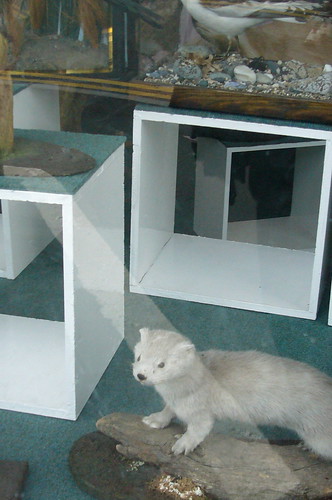
I've had more unusual Flickr contacts too: Garrison over at Holiday Pad Magazine found this site earlier in the week when one of my non-art photos tagged with the word 'holiday' popped up on the rolling feed at the bottom of his site. He tells me it was my recent taxidermy photos that piqued his interest because he couldn't work out why on earth they were tagged as holiday pictures.

Kirsty Hall - Taxidermy Studio, North Wales

Kirsty Hall - Taxidermy Cases, North Wales
Click on the images if you want to find out why I have taxidermy pictures in my holiday photos!

I guess you just never know what's going to attract someone to your site...

You know, I'd been on Flickr for about 6 months before I even started using groups. The first group I joined was a knitting group and it was another couple of months before I suddenly thought, 'hey wait, maybe there are some art groups...'

Up until that point, it had honestly never occurred to me that Flickr could be a promotional tool (I'm slow sometimes...) but using Flickr groups has revolutionised the amount of interest people take in my work, as well as massively increasing my own enjoyment of the site.

Well then, that's a fairly thorough round-up of Flickr and why you should use it. I hope it's been helpful and that you all come to grips with it a bit quicker than I did! I'll probably come back to it at some point but now the series is going to be moving onto other ways for artists to use the web. I haven't quite decided what's up next but I've got several pages of notes at this point and about 20 different topics to cover, including some thoughts that have come up in the comments. My notes keep expanding too, I thought the Flickr topic would be just one post but it seems to have stretched into five.

Get more help
If you'd like more information about building your online presence, check out the free resources section.

I am also available for online consulting if you need one-on-one help.

People on Flickr tend to be an easy audience for an artist to engage with because, by definition, they're already interested in photography and that often spills over to an interest in other visual areas. People on Flickr usually LIKE looking at other people's photos and they're used to doing it.

Ah, a sympathetic audience - the battle is already half won!

You can engage people even further by posting strong shots of your work - use unusual angles, take macro picks, shoot your work in interesting lighting conditions and post research photos that show what inspires your art. Flickr people have a tendency towards visual literacy and they'll respond well to good photography. We all know that it can be hard to take good descriptive photos of your work - the sort of photos that you need for applying for exhibitions. However, I've found that taking more atmospheric shots, especially close-ups, is a lot easier and it tends to be those sort of shots that people on Flickr respond to because they're more photographically interesting.

Flickr is a powerful social network and this is why I recommend it over other photo hosting services. Flickr currently has 4,000,000 users and almost a billion photos hosted on the site. That might sound daunting - with those numbers, who on earth is ever going to see your work? Well, thankfully, Flickr is set up in such a way that it's easy to share your work and make connections with sympathetic people.

There are lots of ways to be more visible on Flickr but basically you need to reach out and participate in the community. You can do this by:

  • Adding people as contacts
  • Joining Flickr groups
  • Commenting on individual photos
  • Marking other people's photos as favourites

If you do some or all of these things, then other people will usually start looking at your photos.

Make Contacts

Making contacts is an excellent way to start creating a little network of like-minded people on Flickr. It's a very informal process; you don't need to already know someone beforehand, it's fine to add someone simply because you like their photos. Very often people will add you back but it's not obligatory, so don't be offended if they don't. If someone is listed as a contact then you'll see their photos on your front page. If they add you back, then any new work you put up will automatically appear on their page, either on their front page or their contacts page. If you're regularly posting photos then all your contacts are getting regular little updates on your art and being reminded about your work in a very gentle and non-invasive way.

So where can you find some people that you like?

Well, it's likely that some of your existing friends are already on Flickr, if they are, then add them as contacts. You can also send invites to friends and family who aren't already there. That should give you a bit of a start in creating a network but if you want to find a wider range of people with similar interests to yourself, then the best way is to join some Flickr groups.

Flickr Groups

Groups are one of the fundamental building blocks of the community side of Flickr. Most groups are a combination of discussion and photos: you can post your images to a place where they'll be seen by hundreds of other people but you can also take part in the discussions, which are a good way to meet individuals.

There are groups on just every subject under the sun and most of them are open membership so you join with the click of a button, very occasionally you'll have to ask a moderator to join.

Consider joining some of the art groups: Artists And Their Art is my favourite because I like their discussions but there are masses of others. You might not like a lot of the work that gets posted to the general art groups, I certainly don't, but there are interesting artists active in some of the discussions. Also, posting photos to a group isn't like being in an exhibition, where you're often judged by the company you keep, it's far more like putting a promotional postcard up in a huge display. Of course, you should still use your discretion - if you hate everything that's posted to a group and the discussions don't appeal, then it might be better to walk on by.

Does your work use a particular technique, image, theme, style or colour? Then there's probably already a group on Flickr that covers it and if there isn't, you can always start one. I'm on a wide range of Flickr groups (61 to date - it's easy to get a little bit carried away!), from the more obviously arty ones to more unusual ones like wabi sabi suki, Coiled Knotted Twisted and Keys Keyholes Locks. Obviously it's impossible to keep up with a huge range of groups: I have a couple that I'm more involved with and just randomly dip in and out of the rest.

When posting images to groups, obey the rules; many groups limit the number of images you can post in a day and off-topic images are likely to be deleted by the mods. Even if a group has unlimited posting, don't post huge clumps of your work to a single group all at once because it drowns out everyone else's work. However, picking an image that you like and posting it to more than one group is completely fine. Personally I try to pick a wide variety of applicable groups for individual images so that I'm reaching a wider potential audience. I also do this so that I don't bore people. The same people often belong to all the groups about a single subject, therefore, to make things a bit more interesting for those people, I post different images from the same series to each of the related groups.

You can find groups by using the search tool on your Flickr page, you can search for groups, people, locations or through your own or everyone else's photos. The Flickr search engines works by searching for tags, which is why you should be using them on your own photos, otherwise you're effectively invisible to the search tool and consequently to other users.

Comments

It's perfectly acceptable to comment on someone's photo even when you don't know them. There's no need to feel shy, just dive in. The person will see that you've added a comment and the comment will usually be publicly available on that photo for others to read. Adding comments usually encourages people to come over and have a look at your work.

Obviously nasty comments are very unprofessional and aren't going to make you any friends: as my father likes to say; "if you can't say something nice, don't say anything at all!" Just ignore the stuff you don't like, there's no requirement to comment on every single thing you see (you couldn't anyway, it would be a full time job!)

Constructive criticism might be fine, especially if you've already connected with the person and know that they're open to it but the culture of commenting on Flickr is generally positive and you should bear this in mind. If you want brutally honest responses on your own work, then you'll probably need to explicitly ask for it in the text of the photo. If you happen to get a troll who hates your work and is just being abusive in comments, you can block them. It's never happened to me but if you're making more controversial work then it could be an issue.

When someone has left a comment on my work, I try to drop them a quick 'thank you' via FlickrMail, especially if they're a new commenter. I like the FlickrMail tool because it means that as well as taking part in the big group discussions, you can have personal side conversations with people. It helps to break up the vastness of Flickr and make it a lot less overwhelming.

Favourites

This is the Flickr tool that I use least but it can be useful. It's basically an extension of commenting: you mark other people's individual photos as favourites and they're then stored on a favourites page on your own page.

Where I have found favourites to be helpful is in finding new people: I've often found interesting new artists by going to the page of someone whose work I like and browsing through their favourites and contacts pages.

The Culture Of Flickr

I hope it's clear by now that Flickr doesn't need to be a dauntingly huge place where you're destined to be invisible but can be a place where, with a little effort, you and your work can be seen and respected.

You shouldn't go into it cynically though - regarding the other members of Flickr as just another marketing opportunity won't go over well. It's rude, disrespectful and contrary to the ethos of the place. Flickr isn't just a huge potential audience for your work; it's a community and you'll be a member of that community. Respect the other members and respond to them with openness and generosity.

Flickr is about sharing and being generous with your time, energy and creative thoughts can reap big rewards there. Every time you make someone into a contact, comment on or favourite one of their photos or write something interesting in a discussion, people are likely to come and see who you are - they'll read your profile and have a quick look at your work. If you're lucky (and you've made it easy for them), they might also go on to visit your other websites or act as an advocate for your work by blogging about you.

Sorry about the length of this one, there didn't seem to be a good place to cut it in half and there was a lot to say. We're nearly done with Flickr posts now though.

Get more help
If you'd like more information about building your online presence, check out the free resources section.

I am also available for online consulting if you need one-on-one help.


I always describe Flickr as 'simple but deep' and that's a good way to think about it. I've already explained that I like the intuitive interface, however, there's a lot more to Flickr than ease of use. I'm still coming to grips with what you can do over there but in my experience, the more you delve into Flickr, the more there is to find.

If you just use Flickr as somewhere to store your images so that you can blog them elsewhere then you're definitely not realising its full potential. Today I'm going to run through a few ways for artists to make the most of Flickr, all of which relate to the powerful communal aspects of the site.

OK, first let's quickly check what you should ideally have on your own Flickr before you start engaging with the Flickr community.

The first thing, as usual, is to make sure your actual work is up to scratch. Post good, strong interesting images of your art. Work in progress shots, clearly marked as such, are also perfectly acceptable - indeed, people usually enjoy seeing those. However, if Flickr is your only online visual portfolio, you may want to keep it a bit more formal and only post finished works.

Now sort your images into collections and sets: you can sort by date, by medium, by series or by any other criteria that makes sense to you. Once you've got the sets and collections you want, set up your front page so that your art collections and/or sets are visible alongside your photostream. This means that anyone clicking on your profile or one of your photos will instantly be able to see that you're an artist and exactly where your art images are. Always make it easy for people!

You also need to have explanatory text under each photo. Obviously it's best to do this when you upload images but if you didn't have time then it's easy enough to do it afterwards either by clicking on individual photos or, if you've got a lot to do, by using the batch organize button in the Organizer feature. When writing the text don't use too much art jargon and be reasonably concise. However, people often like to know a bit about the reality behind the art so it's fine to tell stories or to explain why this is a favourite piece of work.

If you have an art website or blog, then make sure that you include a link in the text of every single photo as well as in your profile. Having a direct html link from individual Flickr photos makes a big difference to the numbers of visitors you'll get to your website: Flickr is my largest source of visitors to The Diary Project blog because there's a direct link on every single envelope image. I'm currently running a small comparative experiment on this. Last night I checked my numbers in Google Analytics, took a note of them, then added a direct link to this site on all the art images that aren't Diary Project images. I'll let you know in a week or two how much difference it makes.

As I mentioned yesterday, your profile should contain an artists statement and/or a mini CV; a link to any other art websites; plus a way to get in touch with you, although you don't have to give out your full address if you're uncomfortable with that. Do think long and hard before putting your home address or phone number online because once it's out there, it will stay out there. I'd recommend putting a rough geographical location though, it helps to orientate people and would be helpful if someone was looking for artists in your particular area.

OK, your Flickr account should now look presentable, although if you haven't done absolutely everything on every single photograph, don't worry over much. My own Flickr follows most of these principles but it isn't absolutely perfect and I don't let it stop me taking part in the wider Flickr community. At some point I need to go through and make sure that I'm following my own advice and everything has the correct tags and explanations!

Right, on to Part 2, where I'll explain how to get started in the community side of Flickr.

Get more help
If you'd like more information about building your online presence, check out the free resources section.

I am also available for online consulting if you need one-on-one help.


4 Comments

OK, so I'm assuming that I've sold you on the benefits of using Flickr. So, how do you go about it?

I'm not going to spell out how to set up an account because that's already well covered in the Flickr FAQ and help pages. What I am going to do is give you tips for using Flickr effectively as a professional artist. Again, I'm chopping this up into manageable chunks: this post will discuss ways to optimise your own Flickr space, while the next post will look at interacting with the wider Flickr community.

Use Your Professional Name

When you're signing up, choose an account name that's as closely related to your professional name as possible. Of course, if you have a common name this might not be possible. The reason for this is that it makes it easier for Google to find you. It also links your Flickr account to your professional online persona.

The observant amongst you will note that my own Flickr name doesn't follow this rule, I'm kmhlamia on Flickr rather than kirstyhall. This is because I set up my Flickr account before I was thinking about using it as a professional space and it simply never occurred to me. Since I'm already known on Flickr by that name, I don't really want to change it, although I am considering it.

You should also use your professional name in your Flickr profile. I have done this and it means that my Flickr page comes up on the third page of Google. Since this website is my primary website, that isn't a problem for me but if Flickr was my main online presence then I'd definitely change my username to get better Google results.

Use Your Profile

Your profile is your friend: you can use it to host a mini CV and a statement about your work. Make sure that you include contact information and if you've got other professional websites, link to them. Don't make it too long - people simply won't bother to read it - and don't link to anything you don't want Google to find!

Think carefully about what you say in your profile since it's part of the professional face you're presenting to the world and it could be read by curators, collectors and fans of your work. However, Flickr is a fairly informal space so it's OK to be a bit more relaxed than you might be elsewhere. Go with what you're comfortable with.

Set Things To Public

You can set individual photos to different privacy levels in Flickr but if you want people to be able to see your work then you need to set your photos to public. You should also set your photos to bloggable to encourage other people to promote your work for you. Setting your images to 'artwork/illustration' instead of 'photograph', can help people to find your work since it's possible to search just for 'artwork/illustration' on Flickr. If your artwork contains imagery that could be considered 'unsafe', then you should read the relevant section of the Flickr FAQ carefully and set your safety level accordingly but be aware that this may limit who can see your art.

Protect But Share

While I approve of Creative Commons in general, I don't usually recommend it to other artists. However, if it's appropriate for your work, then Flickr offers the full range of Creative Commons options. Personally I have kept traditional copyright on all my Flickr images because it's important for me to retain full control over my work. However, I also put a note in my profile saying that it was fine to blog my images without asking but any commercial use needed my explicit permission.

Putting any image of original artwork up on the web is always a risk. Posting lower resolution photos limits the risk of people printing out copies but you do have to keep an eye out for people nabbing your images and claiming them as their own. If you're really worried you can put watermarks in your images before you upload them to Flickr. However, I believe the best defence against this is to become well known online and I'll be discussing ways to build up your internet art profile in later posts.

Tag Your Photos

Tags are one of the most useful tools on Flickr and can help you in lots of ways. Firstly, they make your own life much easier. For example, perhaps you have a series of artworks about the same subject but you uploaded the photos at different times. Instead of searching for each photo individually within your photostream and maybe missing some, you can do a search using your tags. You can also search for images which don't have any tags, just in case you forgot to tag some of those particular photos.

Tags can also make it easier for other people to find your work because they can search for tags within the whole of Flickr or just in your account. Of course, this works better if you've got fairly specific tags; 'painting' will bring up thousands of images but since you can add more than one tag, you can label things in more than one way.

Kirsty Hall - art, performance, pin ritual

I usually use a combination of title, medium, themes, colours and materials for my tags.
For example, this image of Pin Ritual is tagged with the words, pin ritual; pins; art; performance; sculpture; white; repetition; domesticity; labour and textile art.

Decide How Pure You're Going to Be

If you're conceiving of your Flickr space as largely a portfolio for your work then you need to decide how pure you're going to be. Are you going to show work in progress, related visual research or are you just going to show finished pieces of art?

You also need to decide if your personal photos belong on your artistic Flickr account. It is possible to completely separate out the personal and professional by having more than one Flickr account but there does seem to be a fairly large acceptance of mixing photos on Flickr. Including a few more personal photos can make you seem more human rather than less professional, although obviously if photos are really personal then it might not be appropriate to have them within a professional space! However, you can also set privacy levels on individual photos so that only people you've marked as family and/or friends can see them (apparently you can send personal invites to non-Flickr members, something I only learnt today).

If you do want to maintain two completely separate accounts on Flickr then make sure the personal one doesn't link to your professional one and doesn't use your real name in any way or Google will probably join up the dots.

Organise Your Photos

Organising your photos into collections and sets can help your Flickr be both more professional and more accessible. You can set your Flickr page to show both your photostream and your collections or sets and I'd strongly recommend doing so because it allows people to instantly find your art without having to trail through lots of possibly unrelated images (this is particularly important if you do decide to mix personal and professional photos).

Use Descriptive Text

Every image that you upload to Flickr has a space underneath where you can write a description - use it! It's also a good idea to write more general explanations in the descriptive text box of your collections and sets because that provides people with more background to your art, all nicely presented in easily digested little bites.

If you want people to visit your other web spaces, then put a link in the image text. This is what I do with The Diary Project images on Flickr: they all have the same standard explanatory text, with just the date altered and a html link to the Diary Project blog where people can find out more about specific images. My other art images don't have a direct weblink within the text box and I've just worked out that this is why the Diary Project gets considerably more visits from Flickr than this site does.

Right, that's all for this part, next we're moving on to the importance of taking part in the community aspects of Flickr.

Get more help
If you'd like more information about building your online presence, check out the free resources section.

I am also available for online consulting if you need one-on-one help.


17 Comments

So what is Flickr?

At its most basic level, Flickr is a photo hosting service. Photo hosting services are sites on the web where you can upload your own photos, either free or for a small charge. These photos can then be shared with other users of the internet without the need for your own website space. You can read this Wikipedia article if you want to find out more about the concept of photo sharing.

Flickr is not the only photo hosting service, there are plenty of others including Photobucket, Kodak, Fotoblog and Zoomr. I have used a couple of other photohosting services in the past but then switched completely to Flickr because it was so much better. I haven't used every single photo hosting site so I don't know how all the others compare. That said, I do think that Flickr has a lot of features that make it ideal for artists and we'll get to these shortly.

Why do I need a photo hosting service?

Unless you are already in a position to put up a dedicated website where you can host your own photos then in order to make a simple visual portfolio online, you'll need somewhere to host images.

Even if you do have a dedicated website on your own domain name, you'll probably still need a photo hosting site. I find I use Flickr just as much now as I did before this site launched.

Later in this series, I'm also going to be strongly encouraging artists to blog and if you're an artist blogger then being able to quickly and easily share your photos is vital: nothing is more dull than a visual blog with no visuals - I know, I've done it!

However, right now we're going to concentrate on how to use Flickr to make a simple online visual portfolio.

The Advantages of Flickr

It's probably obvious by now that I'm a fan of Flickr. There are lots of reasons for this:

Flickr Is Easy To Use

If you have a computer, an internet connection and a way to get your images onto your computer then you can use Flickr - it really is that simple. Even as a beginner you should be able to upload images, label them, sort them into galleries, tag them and very quickly end up with a presentable display of your art.

Flickr looks good

This is a personal opinion and you might disagree but I think that Flickr has a clean, pleasant interface that looks reasonably professional. In addition, unlike somewhere like Facebook, you can also do a certain amount of restructuring: it'll never be as adaptive and individual as a personal website but you can have a decent amount of control over how your images are displayed.

Flickr is community based

This is hugely important because in effect, Flickr already contains a massive captive audience. What's more, it's a captive audience who are unusually sympathetic to visual culture and already used to looking at each other's images and giving feedback. Naturally a lot depends on how you approach people but I've honestly found the majority of people on Flickr to be very approachable and sympathetic towards artists. You can never overestimate the importance of an interested captive audience, it's like gold dust to any artist and remarkably hard to find. That audience already exists on Flickr; even if you already have your own website, do you really want to ignore that audience?

Flickr Makes Networking Easy

This is related to the community based aspect of Flickr. There are lots of tools on Flickr that break the massive user base down into smaller, move navigable chunks. I'll be talking about these tools in detail in a later post.

Flickr Is Cheap

Flickr is either free with ads and limitations or $25 a year for a more extensive ad-free service. As a way of making a simple yet presentable visual portfolio that already comes with an in-built sympathetic audience, this is a complete bargain!

Of course, Flickr isn't perfect, many Flickr users have been unhappy about some of the changes which have occurred since Yahoo bought the site in 2005. In particular it may not be the best choice if you make art which is very sexually explicit or graphically violent because Flickr does have restrictions on adult content. In addition, you can't actively use Flickr for selling. However, there are lots of artists on Flickr and I've not heard of people being kicked off for promoting their art on there. While it would be wise to avoid things like having prices on your images, I'm pretty sure that you could link to a selling site like Etsy in your profile without any trouble since I've seen plenty of people doing just that. This article from Wikipedia and the Flickr guidelines give more background detail and should give you a better idea if Flickr is a place you'd feel comfortable.

The next article in this series will concentrate on the nuts and bolts of setting up an account on Flickr and some handy tips for making the most of it.

Get more help
If you'd like more information about building your online presence, check out the free resources section.

I am also available for online consulting if you need one-on-one help.


4 Comments

There are two basic things that artists need to be visible online:

A visual portfolio
A way of attracting people to that portfolio

Since this is a large subject, I'm going to be breaking it down into little chunks. Today I'll be examining the first of those things.

Visual Portfolios

Basically put, an online portfolio should contain images of your work, some explanatory text and a way for interested people to contact you.

The best way to host an online portfolio is to have your own dedicated website with your own domain name. There are several reasons for this - Lisa Mikulski has a very helpful post on the subject and I absolutely agree with her assessment.

However, putting together a professional website takes both time and money, two things many artists lack. Making your own website is definitely something I recommend and I'm going to look at it more deeply in the future but right now, I want to encourage you to take that first small step towards an online art presence. If you're new to the idea of having an online visual portfolio, then taking a simpler step can be a lot less intimidating and far more achievable.

Even if you're already experienced with the internet, designing a website can be very overwhelming. I'd been 'meaning to get round to it' for at least ten years and had made several abortive attempts to design a site myself. Eventually I had to admit to myself that I was never going to design and code my own site and the only way it was ever going to happen would be if I paid someone else to do it for me so I hired my friend Steve Taylor, who's a professional web designer and he did a fantastic job. It was a very smart decision and I'm happy with the result, but I'd be lying if I said that getting the site up was a quick and easy process: it was a lot of work and took several months.

If you're anything like me, the idea of spending months looking through your old images and writing blurb won't fill you with delight and you'll probably put it to the bottom of your to-do list. Sure, you know you ought to do it but hey, it's so much work and you have that show coming up and you need to be in the studio and, and, and...

Well, I think we all know how that one goes, right! Yep, another year goes by without anything happening and that's another year when you're invisible online to curators, collectors and other people who might be interested in your work if they could only see it.

And that's why I recommend to artists who want an online presence but are limited by time, money or perfectionism issues (that would be all of us then!), that they make a start RIGHT NOW - don't wait until all your ducks are in a row before you begin.

So what is this first simple step, I hear you ask? Well, there are several options but the one that I always recommend is to get a Flickr account.

Certainly you can start making arrangements to get your own website - budget some time and money to do so and if you think you'll procrastinate about it, do what I did and register and pay for your domain name now (type 'domain names' into Google and you'll get dozens of sites who are desperate to sell you a domain name). This stops someone else nabbing your desired domain name but it also pushes you in the right direction. Even though it's very cheap to register a domain name, the fact that you've paid for it for a year acts as both a mental place marker and a little encouraging push: it tells your subconscious that you've made a definite commitment to get your website done and you'll probably find it niggling away at you until you do it. But in the meantime, get some images up on Flickr.

In the next article we'll be looking at why I recommend Flickr.

Get more help
If you'd like more information about building your online presence, check out the free resources section.

I am also available for online consulting if you need one-on-one help.


47 Comments

Yesterday I mentioned the importance of having your work available online. Today I'm going to expand on that and give two reasons why I think this is important.

MAKE LIFE EASY FOR CURATORS - THEY LIKE THAT!

Things have changed in the art world: I believe that curators increasingly expect to be able to find information about artists online. Of course, it could just be me, I am very immersed in the net, having been online for about 12 years at this point. However, I personally know several other curators who take a similar approach to me.

That's not to say that curators primarily look for artists online yet (although I know at least one who does) but I believe curators are using the web to expand their knowledge of an artist who has come to their attention.

When I'm curating an exhibition, I still advertise for artists through print media and expect artists to send me postal applications. However, if I get a postal application and I'm interested in the work, my next step is always to Google the artist's name to see if I can find more images of their work. I won't discriminate against an artist if they're not online but it does make it harder for me to accurately judge their work.

In an exhibition application it's usual for the curator to set limits on the number of images that an artist should send. Briefs typically say something like "10 images max" and it can often be less than ten. This is to prevent curators being absolutely inundated in stuff: if you get 50-70 applications for an exhibition you simply don't want to look at every single piece of work each individual artist has ever done!

However, it's quite difficult to judge an artist from 10 imges or less, a CV and an artists' statement. So I Google. Googling artists puts an artist in context for me and expands on the information that they've already sent me, allowing me to make a fairer and more informed judgement about their work. It also allows me to make my own judgement on which piece to include. Sometimes an artist will send me images of what they think is their best piece but if I can see more of their work online, I might find a piece that is actually much more appropriate for the show I'm trying to curate. That can make the difference between being included in a show and being turned down.

So can you see how having a visible online presence can widen the odds for you?

LET OTHER PEOPLE DO YOUR PROMOTION FOR YOU

By being visible online (under your professional name, of course), you allow other people to do your promotion for you. This works largely through the medium of blogging, although occasionally artists are picked up by the larger mainstream media because a story about them has appeared online.

British artist Lauren Porter got global media attention when she made a lifesize knitted Ferrari for her degree show at Bath Spa University.

ferrari

Now I don't know whether she first got attention in the mainstream media and it then spread online or if it was the other way round but either way, the fact that photos of her work were available online meant that it was very easy for bloggers and online communities to distribute the story. It went through the enormous online knitting community like wildfire but a quick look on Google shows that it was also linked in geek blogs, car enthusiast blogs (including the Ferrari Owners Club), craft blogs, art blogs, popular news blogs like Digg and even YouTube: the coverage was truly vast.

Visitors to her Bath Spa University degree show would probably have been in the hundreds, maybe as high as a thousand or so but I'm absolutely certain that millions of people saw her work in newspapers, magazines and online. What a way to start your art career!

Of course, Lauren's piece was an incredibly appealing story and wouldn't have been a hard sell in any media but I believe that any artist can find themselves being promoted by other people through the medium of blogs if they're doing interesting work. Even if you don't break out into the mainstream media, there are a large network of artist bloggers, some more influential than others, who will happily link to your art if you make it easy for them to do so.

Of course, being easily found online won't mean that you never have to do any promotion but it does mean that once you've started the ball rolling, other people might pick it up and run with it for you.

Neither of these things will help you if your work isn't any good: making good work must always be every artist's first priority. But if you've reached the stage where your work deserves a wider audience then building an online presence can help to give you a leg-up in the art world and may bring opportunities your way.

Building a visible online presence should never be all the promotion that you do but it should definitely be some of what you do. If you're not on Google then you're basically invisible in the modern world and artists who want to succeed just can't afford that.

Over the next few weeks, I plan to follow up this article with more detailed ones about how to create a visible online presence.

Get more help
If you'd like more information about building your online presence, check out the free resources section.

I am also available for online consulting if you need one-on-one help.