
Welcome to the Cheat's Guide To Blogging - find an old piece of writing, edit slightly, add pictures and serve!
I was just looking up some writing from my degree course for an unrelated reason and found this piece from 1999 that I thought was worth posting
.....
Abstract art has always had a very different role than representational art. Representational art is very much tied to how well the representation works. Is it “a likeness”: by its faithful representation of nature does it somehow capture the soul of the person, animal or place depicted? We usually judge representational art on how well it convinces us of the reality of the image.
Our response to representational art is also determined by sentimental factors. Is it a portrait of someone we love or a place that is special to us? Can we sense a little piece of the person’s soul as we gaze into their unseeing eyes? Do we even like cats or eagles or horses? These things affect how a piece of representational art is perceived by the person who looks at it. Something that may seem kitsch, unappealing or simply bad to one person will be cherished by another because of whom or what it represents.
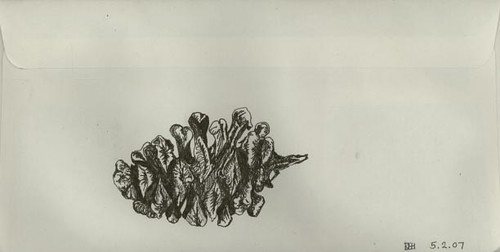
Kirsty Hall: Diary Project Envelope from 5th February 2007
Abstract art is somewhat different. There is less to hold onto. It is a Rorschach blot, a screen onto which the viewer can project their own desires and hidden thoughts. Abstract art opens up the unconscious mind, it forces people to think about what they are seeing.
Many people resist this. After all, it is hard to know what to say when faced with something that doesn’t fall into simple categories like “dog” or “cat” or “child”. We are so deeply used to seeing in symbols and categories that images which do not fall into pre-conceived patterns can be hard to look at. Literally not knowing what we are looking at can make it hard to see at all. Yet it can also challenge our brain to new leaps into the unknown. It can open up places in our mind where poetry might begin. It can inspire us, scare us or anger us.
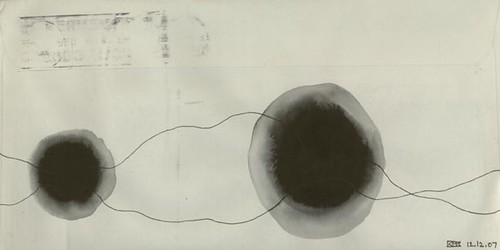
Kirsty Hall: Diary Project Envelope from 12th December 2007
Historically, abstract art and representational art are often pitted against each other. Personally I don’t see them as being in conflict. I think that people make art and look at art for many different reasons and I think that art needs to be broad enough to encompass many different viewpoints and many different ideas.
Many of the problems that people have with contemporary art stem from the fact that they are afraid of it. I think that people are often afraid of looking stupid if they don’t understand art.
But art shouldn’t be a test.
Hey, half the time I don’t understand art and I’ve looked at a lot of it! I’ve also read extensively on the subject and it’s my opinion that most people who write about art don’t understand how artists think and work. So don't look at those words first, just look at the piece and think about how it makes you feel. You might not know as much about art as an art historian or critic but how a piece of art makes you feel is every bit as relevant, worthy and important.
missmilki
Thats exactly what I think...my response to art is almost always emotional. I worked in a contemporary art gallery for a while and felt extremely intimidated at first because almost everyone else working there had a background in art or art history (mine was architecture). In conversations with people I often felt like my opinion on a piece was less valid because I didn't have an art background. Now I realise that even though I really enjoy getting into the context, background and concepts behind a piece my initial response is always bout how it makes me feel. If I don't have an emotional response to a piece of art then understanding the background, context etc is just an intellectual excercise. It may help me to appreciate the piece but it won't help me like it. I hope that makes sense...basically for me an emotional response to art is the most important thing, an intellectual response is an extra bonus layer which can enhance the experience...I think for a lot of people its the other way around.
Btw Love your blog. Been following it for a while (quietly!)
missmilki
Thats exactly what I think...my response to art is almost always emotional. I worked in a contemporary art gallery for a while and felt extremely intimidated at first because almost everyone else working there had a background in art or art history (mine was architecture). In conversations with people I often felt like my opinion on a piece was less valid because I didn't have an art background. Now I realise that even though I really enjoy getting into the context, background and concepts behind a piece my initial response is always bout how it makes me feel. If I don't have an emotional response to a piece of art then understanding the background, context etc is just an intellectual excercise. It may help me to appreciate the piece but it won't help me like it. I hope that makes sense...basically for me an emotional response to art is the most important thing, an intellectual response is an extra bonus layer which can enhance the experience...I think for a lot of people its the other way around.
Btw Love your blog. Been following it for a while (quietly!)
Kim
Like Miss Milki, my background is in design not art. While I have had some art history and art appreciation it was not enough to provide me with "critics eyes" or "artist knowledge" of the subject. But I know what I like and I know how art makes me feel. Being an emotional person anyway, I have sometimes found the intellectual response only serves to muddle what I felt...and I, at 50, don't need that.
I also like the idea of finding other bits of writing that may help with the regular blogging...mainly when I am in more of a studio mood than computer one....thanks for that one!
Kim
Like Miss Milki, my background is in design not art. While I have had some art history and art appreciation it was not enough to provide me with "critics eyes" or "artist knowledge" of the subject. But I know what I like and I know how art makes me feel. Being an emotional person anyway, I have sometimes found the intellectual response only serves to muddle what I felt...and I, at 50, don't need that.
I also like the idea of finding other bits of writing that may help with the regular blogging...mainly when I am in more of a studio mood than computer one....thanks for that one!