20 Comments

I've been in a creative slump lately because I've been unwell. I just haven't had the energy to do much of anything, let alone making art - although of course, I'm still doing my daily envelopes for The Diary Project. But overall, I've just been feeling totally blah about my work - it happens and I know it'll pass but it's still not a fun place to be in.

One of the few things that has been creatively exciting me lately is Camilla Engman's Organized Collection group on Flickr.

So my art practice for the last few weeks has mostly involved collecting little object on the days when I've been able to get out and about and just taking simple photos of them on walls or paving stones. It's small and it's simple but at least it makes me feel as if I'm still doing something.

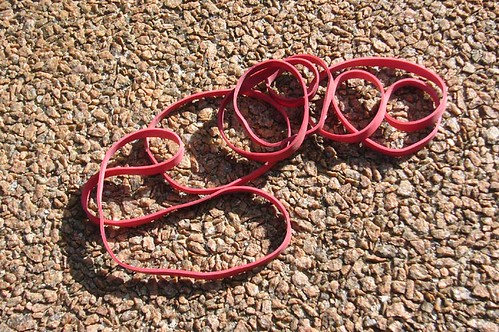
Kirsty Hall, photograph of red rubber bands
Kirsty Hall, found rubber bands, October 2007

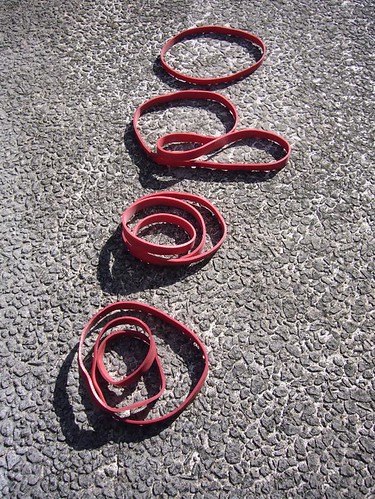
Kirsty Hall, photograph of red rubber bands
Kirsty Hall, found rubber bands, October 2007

One of the things I noticed when I first started joining Flickr groups was how it made me see the world in different ways and how I stretched my photography a little bit because of it. I'd take different photos than usual because I'd think "hey, that would be a good shot for such-and-such a group". If you're feeling the need for a bit of a creative stretch, particularly in relation to your photography, then I'd recommend it.

And having said all that, I'm now going to take myself and my camera outside to the garden to see what I can find, before I need to go for yet another rest.

30 Comments

1: Keep Something Back

You don't have to share your whole process and every piece of art you make. It can be nourishing to keep a private sketchbook or make little test pieces that you don't intend to share. I have a couple of sketchbooks that I don't usually show to anyone. Apart from anything else, we all need a place where we feel emotionally free to make bad art without worrying about an audience!

2: Let Yourself Play

Remember what got you into art in the first place and take some time to reconnect with that joy. This can easily get forgotten when you're a professional artist and bogged down in promotional activities and exhibition schedules, so make sure you also schedule some playing time. Taking classes in a different technique or trying out an exciting new art material can be a good way to access what Buddhists calls 'beginner's mind', that wonderful state where everything is exciting and fresh.

3: Find A Balance

Balance your practice by finding forms that complement each other. For example, if your work takes a long time and involves long and complicated projects, then regularly doing little pieces that can be finished quickly is a good counterbalance. It helps you feel as though you really are getting stuff done. Artists have traditionally done this by using drawing as a complement to painting or sculpture but it's not the only option, performance, photography, writing, music or another form can also fill that need for immediacy.

Conversely, if you tend to complete works quickly, taking on a longer, more involved project can be an interesting challenge. Working in series is often a way of doing this but maybe you can think of other more unusual ways.

4: Love Your Process

I've seen far too many people, particularly at art school, endlessly struggling with a medium or form that they just don't enjoy. Why? Art is hard enough without handicapping yourself with a process that doesn't excite you. You need a certain amount of joy to get through all the bits that you don't like, so don't lumber yourself with a form that just doesn't do it for you - it's not noble, it's just masochistic!

5: Accept The Lows

Anyone who tells you that art is a wonderful, creative thing that always makes you happy is an idiot!

Annoyance, small bursts of depression and large doses of frustration are a normal part of the artistic process. It doesn't mean that you're no good, that you're not cut out to be an artist or that you're doing the wrong thing, it just means that you're engaged with your work. Just make sure that you do have a deep core of love for your process - if you're annoyed all the time then you probably need to reconsider your medium (see number 4).

In my experience, anger and frustration usually happen right before a breakthrough and it's a sign that I need to stick with a piece - although if I'm throwing things around the studio and yelling, I tend to take a day off! Feeling low usually happens when I've just completed something big - I call it The Exhibition Blues - and it's always a sign that I need to step away from art for a while to recharge my batteries, assess what I've just finished and get ready for the next piece.

6: Fill Up The Well

Art doesn't form in a vacuum and it's important to replenish your inspiration on a regular basis. Julia Cameron suggests regular Artist's Dates, where you schedule inspirational treats for yourself and I'd totally agree. This could involve reading art books; going to the theatre or cinema; visiting art galleries or museums; taking photograph's at a farmer's market; going for a walk; taking a day trip or indulging in some new materials at the art shop - the key is that it should be something that nourishes and inspires you. If you're starting to feel a bit stale or low, then try this.

7: Write It Down

Give your brain a helping hand and write down all your ideas, not just the ones that seem immediately good and relevant. You can always edit them later and you never know when a seemingly unimportant thought will develop into a larger project. I often think that I've come up with a brand new idea but invariably I'll find a single sentence in an old notebook that was clearly the original spark. New art takes time to grow, at least several years in my experience. Writing things down is a way of planting your ideas and then letting them develop while you're busy getting on with something else - I call this process 'composting'.

The notebook that I keep by my bed is the most important of the 5 or 6 journals and sketchbooks that I use. I wouldn't want to be without the other notebooks because they all serve different purposes but the majority of my ideas start out in that little bedside book.

Bed is apparently where I think best but it varies from person to person. I know someone who keeps a waterproof board and pencil in her bathroom because she gets her best ideas in the bath. Someone else I know writes ideas on the steamy doors of her shower cubicle and then dashes out to grab some paper before they evaporate! Work out where you think best and make absolutely sure that you keep a way of recording ideas there.

8: Make Art A Priority

You need to make a space for art in your life. If art isn't a priority then it simply won't get done and you'll get to the end of another year wondering why you haven't made any work.

I do know that it's difficult: if you're working another job to pay your bills or raising children, then finding time and energy to make art can be especially tough but you need to keep hold of the idea that you're an artist, that it's central to who you are and that you're going to keep making work somehow.

You may need to work in the margins of the day - on your lunch break, on public transport, as you're waiting for a meeting to start, while the kids are napping or when the rest of the household is asleep. When I worked in a hospital, I used to sketch the visitors to the canteen on my lunchbreak. I didn't do it every day but I did it enough that it noticeably improved my drawing at a time when I had no access to life drawing classes. I know several writers who've written zines and even novels in spare minutes at work. Other artists find ways to incorporate their paid work into their art, perhaps by using it as the subject of their work.

It's easy to think that you need vast swathes of time in order to be an artist but that's not always the case: what you need is a steady and regular commitment. Yes, having lots of time can be great but it can also make you freeze. When I was at college I used to spend most of the day talking to people, pottering around the studio and drinking endless cups of tea and then in the last hour I'd finally get myself in gear and do some work. I've learnt that I tend to do much better with a limited amount of time and a deadline.

If you've got serious limitations to contend with, then another option is to temporarily alter your practice. If you can't make sculpture because you don't have the space, then maybe you can draw, if you can't get access to printmaking equipment, then maybe you can do monoprints instead, if your oil paints are toxic to your toddler then switch to gouache. Don't be afraid to explore the options - you're an artist, you can surely come up with a creative solution.

When my son was small, I couldn't even draw because if he woke up and threw me out of that creative zone, then I wanted to throw him out of the window! I decided this wasn't an ideal frame of mind for parenting, so I switched to photography and writing - both forms I was able to pick up and put down much more easily - until he was older and I had more mental space. And let me tell you, I came out of that restricted period like a bat out of hell, I had so much stored up creative energy that it powered me for years.

9: Create A Supportive Space

It's vital for artists to have support, particularly from the people that they live with. The importance of having people in your life who understand your need to make art can't be overstated. They don't need to like or understand your work, although it helps, but they do need to understand what it means to you.

Again, I know it isn't always possible to have this support - you may be in an existing relationship with a partner who doesn't quite get it or have a birth family who are firmly opposed to you being an artist. You can still make art in these circumstances but you'll have to be prepared to fight your corner and that's draining and takes energy away from your work. Sadly, I have noticed that people who end up quitting art often have families who undermine their choice to be an artist, either directly or more subtly.

I'm incredibly lucky, my family of choice are totally supportive - bemused sometimes, but always supportive. Of course, I say luck but really it was a choice - I put art at the centre of my life and deliberately picked people who support me. When I was single, the two fundamental things that anyone getting involved with me had to accept were:
1) I was a parent and my kid came first
2) I was an artist and I had no intention of giving that up for anyone.

It was always an absolute deal-breaker for me - I can be quite hard-nosed and selfish about my art when I have to be and I just wasn't prepared to trade art for 'love'.

10: Don't Quit!

Ah, the most important tip of all!

David Bayles and Ted Orland talk extensively in Art and Fear: Observations on the Perils (and Rewards) of Artmaking about the importance of not quitting and give a host of reasons why people do, plus ways to avoid it. It's an excellent book and one that I reread most years - every artist should own a copy.

If you want to be an artist then quite simply you have to find ways to keep making art and not stop, no matter what life throws at you. Good luck! And don't forgot to have a bit of fun along the way...

9 Comments

Last night, my son had his 15th birthday 'sleepover' (why do they call them sleepovers when no sleep ever happens?), so I was in nominal charge of 8 teenage boys. This morning, as my son and I cleared up the quite considerable mess, I found myself musing over the similarities between parenting and art.

Art is an everyday thing. Like parenting, it is made up of lots of little moments, a thousand little decisions and a hundred thousand moments of just showing up - what Alison Lee of Craftcast calls "getting your butt in the chair".

Art is usually not the heroic struggle of Romanticism or the epic machismo of the 1950's Action Painters, although those big dramatic moments do sometimes occur, most often in the run up to an exhibition. Instead art - for me at least - is rooted in the everyday; in the daily ritual of the Diary Project envelopes, in the way I sit in my computer chair listening to podcasts while I do another couple of rows on a Thread Drawing canvas, in the slowly changing pile of art books that are permanently in residence under my bed.

Although it is not usually about domesticity, my art is firmly rooted in the home. I am fortunate enough to have a studio at home and like Virginia Woolf, I recognise the importance of having a room of my own. However, my art also takes place in other rooms in the house: in the living room while I'm watching TV with my family, in my bed where I often draw, in our library/dining room where I sit at the big table and stick photos into my sketchbook, in my study as I make work in front of the computer, in the shower where I think up ideas, in the kitchen when I get distracted from cooking by the sudden overwhelming need to photograph the ingredients.

Art permeates my whole life - it isn't confined to a set time or a set place.

In the myths about art, this everyday quality is often omitted. For some reason, it suits people to imagine dramatic moments of crazed genius, a life lived on the bohemian edge and a slow descent into madness, drugs and suicide. We seem to want our artists to be very different from everyone else. Perhaps the reality of getting your butt in the chair, like the daily grind and pleasure of parenting, seems too mundane to most people? Was this great art really made in front of the TV or with radio 4 playing in the background while the artist drank cups of tea and pottered around the studio - how dull! We wanted death threats and overdoses, tortured homosexual love affairs, rats and cockroaches in the studio, drunken pissing in the fireplace, body parts cut off and maybe a couple of tragic stabbings!

But art - like parenting - is not something you do once in one grand and shocking gesture and then never again. Instead, it's a constant trickle, a constant reiteration that this tiny thing, this moment of awareness, this quiet, everyday dedication is the really important thing.

9 Comments

Sheree Rensel commented on this post:

I totally agree with comments presented. I too realize that blogging is very beneficial for aspects related to motivation and building an audience. However, I want to know how blogging has helped your INCOME. How has blogging increased your sales or increased the money you get to support your art?
That is the topic for which I am REALLY interested.

Sheree Rensel - Blue
Sheree Rensel: Blue

Ah Sheree, the answer to that would be 'not at all' since I'm not currently set up to make money off my art. I am slowly coming to terms with the idea that maybe I should try to make some money from my work but it's something that I'm still internally struggling with. For a long time I believed that my work was completely unsaleable because of the fragile and often temporary nature of the things that I made. That's no longer as true as it once was but I'm still trying to reprogramme my brain on this issue. I plan to write more about the issue of money and artists in the future.

That's a long-winded way of saying that I'm probably not the best person to answer your question!

Fortunately, Katherine from Making A Mark left a long and detailed comment, some of which addressed this issue. I'm reprinting the relevant bits here:

Kirsty - I absolutely agree a blog should be for yourself. I personally am less on reading 'commercial' blogs where people are blogging for a business which is not their own or because they think it's 'what you have to do' to sell art. These blogs often seem to run out of steam after a bit.

Blogs which just present work for sale (as one e-bay) are fine by me - but IMO they work so much better with a few details about why the artist chose to paint the picture...

...Re. last comment, here's my observation. The people who appear to sell consistently using their blogs as part of their marketing are those who do good quality work. (By which I mean good quality work will find a buyer if you market effectively). What a blog maybe does for them is speed up the process of increasing awareness - and then once you've attracted people who like watching what you produce then you have a ready market of people who are more likely to buy.

I would agree with this, personally I prefer blogs where the artist is not solely focused on selling, although I have no objections to being gently reminded that they've updated their Etsy shop or that a particular piece is available in a commercial gallery. In fact, I definitely think that artists should do that, where applicable.

However, the artists who seem to have the most success online usually seem to take the long view. For example, Camilla Engman is an artist who's had a lot of success online and she seems to have built up her sales in a gentle and organic way. She cultivates an audience for her work by having relationships with the readers of her chatty and informal blog and maintaining an active Flickr presence including starting a new group called Organised Collection recently. And of course, she makes excellent and consistent work that she offers at a range of prices from affordable calendars and prints to the more expensive original paintings.

Camilla Engman - Collection 2
Camilla Engman: Collection 2

Engman is a lovely example of how to operate as an artist in the offline world too. We had a show of her work at the Here Gallery and she included a couple of packs of her little prints as a thank-you gift for those of us who'd helped with the show. She's the only artist I can recall who did something like this and it was certainly appreciated by those of us who unpacked and hung her show, since we were all volunteers and none of us were getting paid. Getting curators and gallery people on your side never hurts!

Get more help
If you'd like more information about building your online presence, check out the free resources section.

I am also available for online consulting if you need one-on-one help.


4 Comments

Paul Catanese, Assistant Professor of New Media at San Francisco State University kindly sent me info about a panel on art blogging that he's chairing at the College Art Association Conference in Dallas in February 2008.

He brings up some interesting questions in the panel blurb:

An explosion of new blogs from artists, collectors, galleries, residency programs and museums are reshaping notions of professional practice within the arts. Though promotion is certainly a major driver in this arena, sites such as Art.Blogging.LA, Walker Blogs, Art Fever and PORT are especially good at projecting a local arts scene into a broader context. Other models investigate blog as sketchbook, establishing a new format for the open atelier. Does art blogging indicate the emergence of a dislocated, yet thoroughly local arts scene? Can blogs shift the space of studio practice while retaining its capability to be unstructured? Is the quest for site traffic inherently at odds with healthy periods of gestation and dormancy? What models exist for balancing these forces? What are the implications for establishing or maintaining an art practice for those who remain virtually present, yet physically distant?

This jumped out at me: Is the quest for site traffic inherently at odds with healthy periods of gestation and dormancy? This is a particularly interesting question to me right now since I'm currently not at my best health-wise and I'm trying to balance regular updating here with a need for large amounts of sleep and cold medicine (could make for some funky blogging this week!) It's great to see someone recognising that art practice does require these dormant periods where you're cooking up new work and aren't ready to talk about it yet and I can certainly see how that could make keeping a sketchbook type blog difficult. Indeed, I've noticed that it's not uncommon for artists who're doing a blog that's focused on their own work to go a bit quiet on occasion.

Anyway, if you're interested, Paul's currently looking for panel members and the deadline for abstracts is the November 9, 2007.

2 Comments

Sorry about the lack of posts over the weekend, we had visitors and I just didn't get a spare minute to update.

I'm a big fan of Tara Donovan's art. I love the way she uses vast accumulations of objects like polystyrene cups, pins, sheets of glass and drinking straws to make dense, layered sculptures. She stacks the objects but then lets them find their own pattern and form.

Tara Donovan - Haze
Tara Donovan: Haze, 2003

I find the way her work refracts colour very interesting, she often uses translucent materials that become subtly coloured when layered in such large quantities. It seems to me that there's something about the importance of revealing the hidden in her work.

Tara Donovan - Haze
Tara Donovan: Haze, detail, 2003

I must admit that I was envious when I saw her huge block of pins - although I just don't work on that sort of scale, I love that she does. The pins aren't held together with anything other than gravity and their own interlocking chaotic mass.

Tara Donovan - Untitled, 2001
Tara Donovan: Untitled, 2001

If you want to read more about her work, there's a good review here by Paul Brewer and an artnet interview with Donovan here.

Sorry about the odd formatting on a couple of the images in this post, I can't work out why it's doing that or how to fix it.

5 Comments

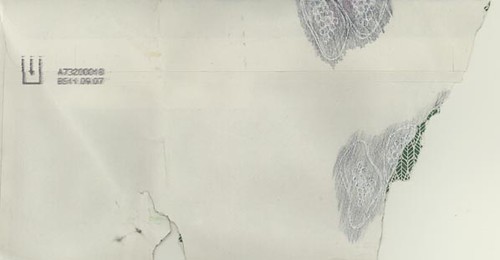
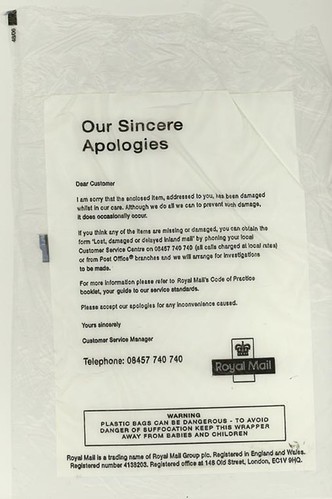
The Diary Project suffered its first real casualty recently when this envelope came back so mauled that the Royal Mail put it in a special 'oh dear, we're incredibly sorry' plastic bag. Amazingly, the contents are still inside.

Kirsty Hall - Diary Project envelope from Sept 10th, drawing on damaged envelope
Kirsty Hall: Diary Project envelope from the 10th September 2007

bag
Kirsty Hall: plastic bag from the Royal Mail

I was totally thrilled, it's the most exciting thing that's happened so far!

The project blog is currently up to date until the 16th September and should be updated again over the weekend, although we have house guests this weekend so it might not happen until Monday. I've been a bit behind with it lately but I'm attempting to get back onto a regular schedule with updates. If I leave it too long it gets completely overwhelming.

I got an interesting email from someone a couple of weeks ago asking me why I post the letters to myself and not to another person. I won't post their original letter because they haven't responded to my request to do so but here's an extract from my reply:

Why do I post the letters? Well, I like the sense of risk involved - the envelopes might get lost in the post or damaged. I'm a bit of a control freak so posting the letters is an interesting way for me to let go a bit. My work has always involved a certain amount of 'letting nature take its course' - in the past I've often made sculptures that rot, decay or slowly change. I like to open myself up to chaos a little because it challenges me and the posting does that. Plus, I've always been interested in the idea of journeys and I love the fact that the envelopes take these little journeys without me.

I wanted to send the envelopes to myself rather than someone else because I wanted to have them all to exhibit at the end of the year. Also, there's just something very absurd about sending letters to yourself for a year and that aspect of the project makes me laugh. And on a completely mundane level, I absolutely love getting post and because of this project, I get a year's worth of letters, which just delights me. I get a little bit excited every time a letter comes home safely.

Oh, and I think that posting the letters also stops me cheating. It's a firm deadline - I absolutely have to get the letter in the postbox by midnight or I've failed for that day. It's good to have that sense of 'I must get this done'. I know that no one but me would know if I did the letter after midnight but somehow having to go out and post them keeps me honest about the project. I don't know why, but somehow it works as an external control.

8 Comments

Artist Annie Vought meticulously cuts paper to make her beautiful and witty wall pieces. Her recent work has concentrated on writing, while previous work explored the human body through cut up anatomy drawings.

Annie Vought - To Do
Annie Vought: To Do, 2006

As a compulsive list-maker, I just adore the absurdity of this piece - just think of the hours it must have taken to cut away the paper from something as transitory and throwaway as a to-do list. She's clearly a woman after my own heart!

The use of shadows in these works interests me and I see obvious parallels with my own thread drawings where the shadows also work to complete the image. Unsurprisingly, it also delights me that she uses pins to attach the delicate cut paper to the wall.

Annie Vought - Slightly
Annie Vought: Slightly, 2006

Kirsty Hall, art, thread drawing
Kirsty Hall: Thread drawing - work in progress

----

Vought is also involved in a radical form of curating in public spaces through her involvement with the Budget Gallery.

The Budget Gallery is not in a specific place. We don’t have a building, so we’re beyond low-rent. We don’t even pay rent. We set up our gallery in co-opted public spaces like vacant walls and fences. The shows are carefully co-ordinated, prepared, and publicized. The pieces are displayed much like a traditional gallery. We paint walls white, install art works and labels. We announce openings that are attended by hundreds. Refreshments are served and one can often hear jazz playing in the background. Of course, this is no traditional gallery - it’s all taking place on the sidewalk. In the end it’s a blend of all the greatest things about attending an art show, a garage sale, and a block party rolled into one.

Check out their project rules:

1. We use underutilized public spaces for our exhibitions.
2. If work doesn’t sell at the opening, it stays, in public, unguarded, for at least 1 week.
3. After the opening the unguarded work is sold on the honor system.
4. All art work in our shows will be sold, stolen*, or vandalized** and we can not pre-determine the outcome.
5. Our commission is arbitrary, optional, and determined by the artist.

*Having a work stolen is the highest honor of the Budget Gallery because it means someone wanted the work so badly they were willing to abandon personal and societal mores to acquire your piece of art. In our eyes, this may be considered a more valuable compliment to you than a simple monetary transaction.

**We suggest you consider vandalism a form a collaboration.

I find that a fascinating concept but also very challenging: it certainly brings up a lot of issues around letting go of control.

How would you feel about your work being shown in these circumstances? Could you deal with it? Would it upset you to have your work stolen from an unguarded public wall? Would it upset you more to have it vandalised?

I think I would have to make work especially for that space, with those aims in mind because if my regular art was stolen or vandalised I'd be upset. I actually had my degree show vandalised and even though I'd known beforehand that it was a possibility because of the extreme delicacy of the piece, I still had to go and cry in the toilets for a while!

8 Comments

I promised a round-up of the comments that other artists have left about their experiences with blogging and here it is, although much later than I'd planned...

Usiku from Writer's Whirlpool writes:

Blogging has allowed me to reach and meet people that possess a range and depth of human experience, yet it reminds me there is a sameness to us all.

What a lovely sentiment, Usiku. One of the things I love most about blogging is the way it can encourage people reach out and help each other - I've seen everything from people offering words of sympathy to people giving real life support such as organising online baby showers, paying medical bills for ill bloggers, supporting families through bereavement or other difficult times, raising funds for charities or coming together to sponsor art projects.

I get so fed up of all the negative portrayals of the internet because it just doesn't reflect my online experience. Blogging is frequently portrayed as a selfish and egotistical thing to do but I've often seen it used as a powerful and meaningful way to connect with other people.

Michelle from Pencil Portraits brings up a point I hadn't considered:

Another benefit to blogging (for me anyway) is that when I am focussed on updating my blog regularly I am more productive in my art, because I can't wait to post it. But I have noticed a definite correlation in lower productivity when I get slack about updating my blog, so even though it takes a bit of time to post, it is definitely worth it for so many reasons.

I love the idea of using a blog as a way of giving yourself motivation - great idea, Michelle!

Mark from Graf Nature Photography: Notes From The Woods writes:

I use my own blog for connecting with viewers of my own work, as well as exploration of my own feelings and analysis of why I do what I do. Turns out, a lot of readers often wonder the same about their own work. Sometimes it helps just to write things down to work out what you are thinking.

Oh, I couldn't agree more, Mark. I've always used writing, and indeed, making my art, as a way to work out what I'm really thinking and feeling. I've always written about my work a lot so writing on a blog wasn't that big a step for me. I think that so many artists work in isolation and having that link with viewers and other artists can be so helpful - just to get an extra set of eyes on the work, if nothing else. One of the reasons I like exhibiting is because of the dialogue and additional perspective that you can get on the work - I guess you can think of blogging as an informal sort of exhibiting process.

That leads us neatly onto Katherine from Making A Mark, who makes a similar point:

1) Blogging can also be thought of as the virtual equivalent of the 'private view'. Thinking of it like that helps people to pitch their remarks - one to one, helpful, informative - but also professional.

2) I like supporting galleries, exhibitions and other artists on my blog - and they come back and tell me they've sold work as a result. More co-operative support for one another would give a nice artistic twist to "the wisdom of crowds"

3) It should never be under-estimated how much slog blogging can feel like at the beginning - but it is habit-forming and it does get easier the more you do it and the more frequently you post. The growth in visitors is also exponential - my second tranche of 50,000 visitors arrived a lot more quickly than the first 50,000!

Woah Katherine - 50,000 visitors! I can't even imagine that yet but maybe I'll get there one day. I do agree that blogging is habit-forming although I think a lot of bloggers get dispirited at the initial 'writing in a vacuum' feeling. I think you've got to be writing for yourself as well as an audience - if you're getting some personal reward that isn't dependant on other people reading or commenting then it's a lot easier to continue. In that respect it's a lot like making art.

Tina from The Cycling Artist blog brings up the importance of regular blogging:

I've been blogging a while but only recently made a pact with myself to do it *every day*. Strangely enough it gets easier. I used to wonder what to blog about, what was interesting enough to write and direct my fans, collectors and other artists too that wasn't just a rambling self-journal. I didn't want it to be for artists only, so had to find a happy balance. Sometimes I get on a bit of a soapbox but hopefully not too often. :)

It's about 20 minutes each day typing up, copying into two blogs (I duplicate my tina-m.blogspot.com blog over to my MySpace account too). It's a nice start to the day actually. And I've just recently found out about RSS feeds and used feedburner.com to set them up - in case any other artists are as mystified about it as I was!

Tina, I'm interested in the fact that you duplicate your blog over at MySpace - do you find using MySpace works in terms of visitor numbers? I've been wondering about setting up an 'outpost' over in MySpace but I don't want to commit to something that's going to take lots of time.

Get more help
If you'd like more information about building your online presence, check out the free resources section.

I am also available for online consulting if you need one-on-one help.


3 Comments

Deanna from Artist, Emerging writes about damage to a piece of her artwork that was returned to her by a gallery.

Deanna is obviously very careful about packaging her work - she makes up special foamcore boxes and wraps her work carefully in archival paper first to protect the delicate wax surfaces of her encaustic paintings. She was pretty unlucky to have a piece damaged.

I don't want to sound as though I'm making excuses for the gallery - they should definitely have been more careful - but I do have some advice on avoiding this situation. Having packaged up loads of works as a curator, I'd strongly recommend that artists include a sheet of packing directions, especially if there are any special requirements for repacking the work. Don't leave things to chance; spell it out in black and white. Wrapping up works to send back is a pig of a job: it's boring and tedious and when you're packaging up 20 or 30 pieces at the end of a show it's often difficult to remember how it looked when it arrived. You also can't guarantee that the people who unwrapped the work will be the ones repackaging it - at the Here Gallery we rely on volunteers and sometimes the people wrapping the work don't have any art experience at all. What seems like common sense to an artist might not be so obvious to someone who isn't an artist. Written directions make life a lot simpler for everyone, plus if the gallery doesn't follow the instructions then you have more ammunition to complain to them.

Unfortunately not all artists are as meticulous as Deanna: I've unpacked work that I was amazed survived the trip through the postal system - work sandwiched between two ill fitting bits of cardboard, work that wasn't well wrapped, even work that wasn't protectively wrapped at all.

Work being sent anywhere should be properly wrapped in bubble wrap (and any other protective packaging that the work needs) before being placed in a strong, well-fitting box.

Please buy or make the correct size of box: don't hack together several bits of cardboard. I know it's good from an environmental point of view but bits of cardboard taped together are a nightmare to get into, even worse to reuse and they tend not to provide enough support to the work, especially around the edges. It's OK to cut down a box that's too large though.

With bubble wrap, you should use larger pieces rather than taping together smaller pieces - the later are horrible to reuse. If you've only just had enough bubble wrap to wrap your work, then the curator probably won't have enough to securely re-wrap it because bubble wrap invariably gets damaged where it's been taped. I know that money is an issue for all artists but please don't skimp on protecting your precious work.

If you're packing more than one piece in a single box, you'll need plenty of packaging between them and you'll also need to consider weight issues. For example, if you're packing a lot of framed pieces then they're usually better stacked upright rather than in a pile with one unfortunate piece on the bottom. Reinforcing the base of the box with extra cardboard can be a good idea when sending heavier work, although if the work is very heavy then you'll need to use wooden packing crates.

Your box should also include: instructions on how to repack the box, a return address label (including postage if required), written instructions on how to install the piece (especially important for sculptural works) and any fittings needed to install the work. Obviously, you should make sure the box is properly taped shut but using too much tape on the box can actually increase the risk of damage because the person will have to use more force if it's very difficult to open. Now mark your box to show which way is up. Boxes should also be marked 'fragile, handle with care' although frankly I'm not sure if that makes any difference to the way the post office treats them!

If I get all that, I'm in heaven.

Professionally packed work containing clear instructions and fittings lets the curator know that you respect and value your own work, so they should too. In addition, by making things easy for them, you also demonstrate that you're courteous enough to care about their time. Knowing that I'm following the artist's wishes and don't have to sit around worrying about how a piece should be hung takes a lot of stress out of the process for me. Then all I have to decide is where it should be hung. Believe me, I much prefer that!