Blog

José Leonilson was a Brazilian artist who died tragically young in 1993. He was only 36 when he died from AIDS, part of that generation of male artists that we lost far too soon.

His work has the sort of quiet melancholy that I always admire.


José Leonilson: 34 with Scars, 1991

I love this piece, especially the indelicate, puckered, slightly haphazard embroidery and the way the fabric is not stretched taut but instead is just hanging loosely on the wall. It's pretty obvious why I like his work, since it relates quite strongly to my own, particularly my thread drawings:

Kirsty Hall, 'Parse', red thread drawing
Kirsty Hall: Parse, 2007

There are correspondences between our respective drawings too - although this small watercolour and ink drawing is more figurative than my style, I could easily imagine it on a Diary Project envelope.


José Leonilson: Desire is a Blue Lake, 1989

I like the emptiness in this drawing, it takes a certain amount of artistic nerve to leave a lot of white space on the page.

10 Comments

It's about time I got back to some of my more serious articles, so I'm starting a new series about how the internet is changing the economic aspects of the arts.

THE NEW CREATIVE ECONOMY: PART 1
Don't Sue Your Customers!

The internet has undoubtedly changed how we engage with the arts, particularly in relation to music but also in other forms of creative expression. There's no question that many sectors of the arts need a new funding model - but suing your customers isn't it!

Ongoing battles between the entertainment industry and illegal downloaders are contributing to a damaging fall in consumer trust, according to new research from the PR agency Edelman. The number of UK consumers who said they trusted the industry fell from 47% in 2007 to 31% this year, with confidence disturbed by moves by the music industry to track down and punish illegal music copying, and high-profile scandals in broadcasting.
All quotes are from this article in The Guardian by Jemima Kiss.

Ah, the sweet sound of chickens coming home to roost!

The internet can be a disaster or a boon to the arts, it depends on how willing you are to embrace change. If you can see the potential and are willing to engage with your audience online, you can do well. If you resist the online changes and particularly if you treat your customers badly - as the mainstream music companies have been doing for several years now - your customers will return the favour.

Surveying younger consumers aged 18-34, Edelman found that 55% would take "direct action" against a company if they objected to its practices, 53% would share negative opinions with friends and 46% would ignore a firm's marketing and advertising. Even more damning, a further 39% said they would not invest in those companies.

I've been predicting this for years - anyone with half a brain can see what's happening, except the entrenched and outdated big music companies apparently. If they don't change, they will die. The only reason they've survived as long as they have is that musicians and music consumers didn't have a choice before but conditions have changed. Musicians are no longer so reliant on record companies to fund, distribute and promote their music; computers and the internet make it cheap and easy to produce and then promote your own music online. In addition, there are now there are new online music companies who use different financial models and who treat both customers and musicians much better:

Magnatune is an ethical record label based on downloading MP3's. You choose the amount you want to pay and the artists get 50% of the price. You can then legally share your download with three of your friends. This article by John Buckman about why he started Magnatune is well worth reading because it exposes the problems with the traditional record companies.

The Podsafe Music Network is a promotion network that allows podcasters to download music that they can play on their shows for free without restrictive licensing agreements. Links back to the musicians from the podcasts allow listeners to buy music that they hear on podcasts; I've done this several times when I've heard something that I love.

Independent online record store, CD Baby only sell CD's that come directly from the artists, who receive a large percentage of the cover price. I recently bought two Amy Steinberg CD's from them after hearing one of her tracks on a podcast. My CD's cost about £7, allowing me to return to joy of buying albums on spec, something I used to do a lot as a teenager when music was a more reasonable price than it was in the 90's. In addition, the emails I got from the company were charming and funny and the CD's arrived quickly from the States. I'm hugely resistant to buying music from the mainstream record companies because of the way they behave but I'd definitely buy from CD Baby again because they're cute, well organised and they treat musicians well.

Although prices of CD's have dropped recently for several reasons, musicians signed to major labels still only get a tiny fraction of the profits and may even lose money on record deals. The mainstream record companies still rip off both customers and musicians and then have the nerve to constantly bitch in the media and sue people. As is now becoming ever more apparent, this is a bad long term strategy.

The question I've been asking myself lately is "if I'm willing to buy Fairtrade to ensure producers in the third world are treated fairly, why am I supporting unethical music companies who mistreat musicians by underpaying them and trapping them into restrictive contracts where they often lose the rights to their own music?"

My solution has been to boycott the major record labels whenever possible and buy the music they produce secondhand but this means that the musicians don't get anything at all, which I'm not happy about. There has to be a better way and hopefully some of these new online music businesses will provide a way forward where everyone is treated fairly, especially the people who make the music in the first place.

Let's end on a positive note:

...the survey showed 56% of young UK consumers would rather buy legal content, if it was at a reduced price, than download illegally. That compared well with the 27% who refused to pay for content, and the 17% who said they might pay, but could continue to download illegal content as well. Much piracy, this would suggest, is fed by the lack of a legal online alternative.

If the mainstream music companies start treating their artists fairly, stop suing schoolkids, adapt to the changing conditions of their industry and do a lot of grovelling, then they may have a chance to survive. If they don't, they're history...

Maybe you're asking yourself what this has to do with the visual arts, but as my dad says, "everyone's useful, if nothing else they can always serve as a bad example!"

Get more help
If you'd like more information about building your online presence, check out the free resources section.

I am also available for online consulting if you need one-on-one help.


Before I went to Australia I was lucky enough to get two You Make My Day awards. The first was from the lovely Cally, who's been mentioned here several times in the past. The second was from Australian artist, Feed The Dog (check out her gorgeous cushions on Etsy).

Thank you both, I appreciate it and I'm sorry it's taken me so long to respond.

"You make my day-Award" works like this:
1. Write a post with links to 5 blogs that make me think and/or make my day.
2. Acknowledge the post of the award giver.
3. Display the "You Make my Day Award" logo. (Optional)
4. Tell the award winners that they have won by commenting on their blogs with the news.

So I now need to pass on the favour and give them out to five other people. Not all of these are blogs but they are all sites that I regularly visit and get excited about.

You Make My Day Awards

I've written about Suzi Blu before and I'm still a big fan. Her videos make me laugh but they also inspire me to get off my butt and into the studio. I admire her sense of fun, her utter passion about art and creativity and the way she just gets on and does things.

I love Elsa Mora's quirky style. Elsa is a prolific and dedicated blogger and I admire the commitment and honesty she brings to writing about both her art and her life.

Eliza from Back Yard is to blame for getting me into the 101 Things meme and for that she certainly deserves an award! She's been quite unwell lately but before appendicitis struck (ow, get better soon Eliza), she was blogging up a storm about her creative process.

Goblins are traditionally the low level bad guys in role playing and video games - just there to be killed for points. Goblins is a wonderful web comic that turns that convention on its head and explores life from their point of view. I once had a dream where I was Queen Of The Goblins, so it makes me happy to see my little guys getting the love they deserve. Funny, poignant, hard hitting and beautifully drawn and written, this comic continually amazes me with its quality. Although it's far from daily, it always makes my day when a new episode appears and it's well worth your time to start at the beginning of the archives and catch up with the story so far.

If you're a knitter, crocheter or otherwise interested in fibre arts and you haven't signed up for Ravelry yet, you absolutely must. I love it there and spend far too much time on the forums when I should be in my studio (bad, naughty artist!)

So there you go, 5 great places to check out on this lovely Sunday afternoon. I'm suitably inspired: I'm going upstairs to my studio to get cracking with some work - or at least some tidying!

4 Comments

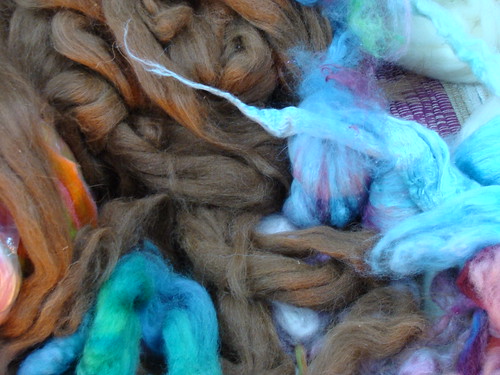
A couple of weeks ago, I booked myself onto a day-long spindle spinning workshop at Get Knitted, my favourite Bristol yarn store. I've wanted to learn to spin for several years, ever since a friend gave me her slightly broken spinning wheel but I didn't want to spend money getting it fixed until I knew for sure that spinning was something I wanted to pursue. I have to be careful to balance my need to enthusiastically throw myself into new things with keeping a focus on my existing art: I am very easily distracted! However, number 55 on my 101 Things list is Learn to Spin, so when I saw the workshop advertised, I jumped at the chance to do it.

I've been feeling very unenthusiastic about my art for months now but this workshop really released my creative juices: I came home this evening ready to get right back into the studio and start making again. There were 9 of us on the course and our teacher was Jen from the hand-dyed yarn company, Fyberspates. Jen got us all spinning with a simple wooden and plastic spindle in an amazingly short time. Spindles are an ancient technology, possibly one of the oldest in the world - apparently in the Middle Ages they sometimes used a stick and a potato if they didn't have a nice carved wooden spindle to hand! We got to play with wool, alpaca, silk, mohair, linen and even a little bit of cashmere. Just sinking my fingers into all the different types of fibre was an education and it was interesting to see how we all differed in which ones we found easiest to spin.

Kirsty Hall, photograph of mixed fibres for spinning
Kirsty Hall: Mixed Fibres For Spinning

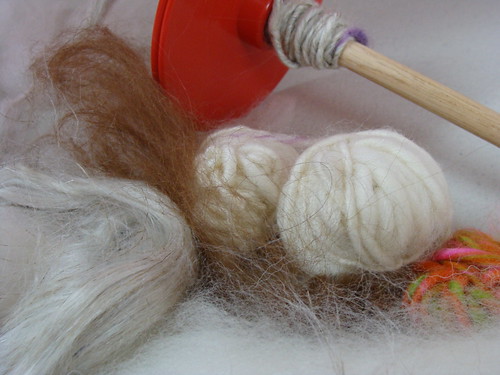
My tiny lumpy balls of yarn don't look like anything special but to me they're quite magical because hey, I made yarn! Actual yarn, from fibre - how cool is that? OK, so it's not very good yarn - a 5 year old medieval child with a potato could probably have made better. It's extremely uneven, going from thick to thin and back again and some places aren't twisted enough but I don't care, it's a beginning. This is the incredible thing about learning something new; the joy of looking at something that you've made with little technical skill but with utter concentration and passion and knowing that you're back in that humble place of Beginner's Mind. Every artist should keep feeling their way back to that place; it kicks you out of your complacency and gives you that little skip in your creative spirit that charges you up.

Kirsty Hall, photograph of Homespun Yarn & Spindle
Kirsty Hall: Homespun Yarn & Spindle

A Boring Bit
There's been a bit of downtime on the site this week because we needed to upgrade WordPress after a possible spambot incursion - so if anyone's had trouble getting the site to load, that would be why. A couple of things are still a bit funky: the gallery pages aren't quite right and the blog archives have done a bunk but hopefully we'll get everything back to normal soon. If you're very observant, you may also have noticed that we've switched on a confirmation box for comments. I'm sorry about this, I know they're a nuisance but I was getting upwards of 400 spam on the blog every single day and it was driving me absolutely nuts.

2 Comments

Sorry, didn't mean to disappear like that, I was hit by a virus and today is the first day I've felt like myself in more than a week.

So, what's been happening? Well, I bought a new camera with the last of my holiday money and I'm absolutely loving it. It's a Sony Cybershot DSC-H3 and it's so much better than my little Panasonic Lumix DMC-FX01. When I was in Australia I completely hit the limitations of the Panasonic and was finding it frustrating that I often couldn't get the shots I wanted because I didn't have enough zoom.

I've also realised that I take a lot of indoor shots and close-ups and while the Panasonic is OK on macro, it sucks in poor light. That's not to say that the Panasonic is a bad camera: if you want to photograph groups of people outdoors then it's a great choice. It's light and small enough to easily carry in a pocket and has a proper wide angle lens, which is unusual in a compact digital of that size and you can even use it underwater if you have a special case for it. I think it's a nifty little compact; it's just not a good fit for the kind of photography that I do.

The Sony has 10x zoom compared to the 3.6x of the Panasonic and a noticeably better macro setting. The lens feels like a higher quality to me and I can see the difference in the photos I'm taking. It's larger and heavier than the Panasonic but still light enough to carry around with me, which is hugely important. I looked at a couple of larger cameras with even better zooms but realised that I would end up leaving them at home half the time. There's an old photography saying that 'the best camera is the one you have with you' and it's so true.

I don't have a card for the new camera yet so I'm relying on the internal memory and it can only take 14 images before it's full. Usually I take as many photos as I want and then decide which ones I like once they're on my computer screen. I generally only junk images directly from the camera if they're obviously blurry or bad. But when I went out for a walk today I had to delete quite a few decent photos so that I could take better ones. In a way it was quite freeing because I was having to look at each image and make a conscious positive decision to keep it. When you can only take 14 images, each image has to really work to earn its keep! I can see how this could be an interestingly disciplined way to take photos but I'm still looking forward to my memory card arriving.

OK, that's enough yakking about the new camera, let's see what it can actually do...

Kirsty Hall, photograph of sunlit puddle on flagstones
Kirsty Hall: Sunlit Puddle, Bristol, April 2008

Kirsty Hall, photograph of watery window
Kirsty Hall: A Watery Window, Bristol, April 2008

Kirsty Hall, photograph of manhole cover
Kirsty Hall: Manhole cover, Bristol, April 2008

8 Comments

Sorry for the week of radio silence: I got back last Friday but have been busy picking up the reins of my life and getting over jetlag and a cold.

Although Australia was fantastic and I had an amazing time, I'm glad to be home. I missed my family and while I loved the sunshine and sea, I do quite like this damp little island that I call home.

Happy Face
Kirsty Hall: Happy Face Graffiti, Bristol, Feb 2008

Getting off the plane I was struck both by the cold (it was snowing when I got back) and the gorgeous softness of the light we have here. Australia was so bright that I needed my sunglasses most of the time and the glaring light created strong shadows that gave everything a stark quality.

Australian Bush, Blue Mountains
Kirsty Hall: Australian Bush, The Blue Mountains, March 2008

I found myself very aware of the relentless fierceness of the heat: there's no doubt that Australia is a harsh environment and many of the objects that I saw were weathered and bleached by the sun.

Worn fence posts
Kirsty Hall: Worn fence posts, Australia, March 2008

The light in Britain can occasionally be that strong but usually there's a subtle quality to the light and colour here that I very much enjoy. I'm not saying that I wouldn't enjoy a bit more warmth and sunshine but I like our rain-washed colour spectrum. I find that living with grey skies and muted colours so much of the year gives me a heightened appreciation of splashes of bright colour when I finally do see them.

Purple sky
Kirsty Hall: Purple Sunset, Bristol, Jan 2008

Unfurling
Kirsty Hall: New Leaves Unfurling, Bristol, Feb 2008

8 Comments

Yesterday’s colour was green. Not only was it St Patrick’s Day – apparently celebrated with great joie de vivre in Sydney – but I spent a delightful afternoon exploring the Royal Botanic Gardens with local artist, Wendy Shortland. Wendy kindly showed me around this beautiful green space and we had a grand old time admiring the plants and wildlife.

There was much to see and I took plenty of reference photos of natural forms. Yet the thing that struck me most was the strangeness of the living bamboo covered with graffiti. I don’t always like graffiti; often it can seem intrusive and destructive and I’m particularly ambivalent about graffiti on trees and rocks. Up in the Blue Mountains, seeing graffiti on trees in the rainforest threw me into a rage at the stupidity of people. However, in this case, it had resulted in powerful totemic sculptures that reminded me of the Aboriginal funeral poles I’d seen a couple of days earlier in the Museum of Contemporary Art. The harsh scratched writing had been softened, stretched and transformed by the living plants to form a beautiful monument to the basic human urge towards mark-making. I am still ambivalent about this need to mark other living things as our territory, yet it was impossible to deny the compelling accidental beauty of the end result.

Graffiti on Bamboo
Kirsty Hall: Graffiti on bamboo, Royal Botanic Gardens in Sydney

Graffiti on Bamboo
Kirsty Hall: Graffiti on bamboo, Royal Botanic Gardens in Sydney

Graffiti on Bamboo
Kirsty Hall: Graffiti on bamboo, Royal Botanic Gardens in Sydney

I’ve always been captivated by this sort of communal art form where aesthetics are not always the driving force. In the early 90’s, I spent a lot of time looking at African sacred objects that had been worn smooth by thousands of respectful hands or covered with nails to the point of bristling. I also studied Western traditions of sacred objects – medieval relics, votary offerings, rosary beads, museum displays and the like. I longed to make something with that same sort of presence but realised that it wasn’t possible for me to simply copy an existing form or process and ‘fake’ a sacred object. Years later, it’s something I’m still struggling with and much of my work using repetitive processes hinges on that concept of how to imbue an object with power and meaning.

Back in the gardens, I was also very enamoured with the enormous fruit bats that hung from the trees like giant cocoons.

Fruit Bats
Kirsty Hall: Fruit Bats, Royal Botanic Gardens, Sydney

En masse, they are incredibly noisy – a plane overhead will set of a cacophony of squawking. Indeed, Australian wildlife as a whole seems quite loud to me, many of the birds can raise a real racket – the evening roosting of the parrots has to be heard to be believed. Perhaps they need to state their presence so loudly to combat the daunting distances of this vast land.

Today, I too am feeling daunted – only two and a half days left and still so much to see. Part of me wants to rush over to Sydney again and spend another afternoon looking around, while a greater part of me is arguing for a day spent on the beach in Manly! There has been so much rushing around lately and I feel overfull of textures, shapes, sounds and experiences; I know it will take me months to digest what I’ve seen here.

2 Comments

I'm delighted to announce that several of my drawings are now available for sale at The Shiny Squirrel.

The drawings were inspired by The Diary Project drawings but they're done on nice paper instead of envelopes! They come mounted but not framed to keep postage costs down and so that you can choose your own frame. The drawing with the blue ovals is particularly beautiful in real life - it's my personal favourite from this set. You can't see it clearly from the photograph but the blue background of the ovals are covered in tiny circles of white ink.

OK, enough sales talk, I need to put some clothes on, dry my hair and then get on the Manley ferry to go and visit the Art Gallery Of New South Wales and the botanical gardens, which are conveniently located next door to each other.

5 Comments

Up in the Blue Mountains doing the tourist thing for a couple of days, so here's a post that I prepared earlier...

Rust Belt is a collaborative project between jewellers, Anna Bario and Page Neal. Their aim is to explore ways in which jewellery can be made from "re-purposed materials using low-impact, environmentally conscious practices."

I first came across their work on the Daily Poetics blog, where I was very taken with their wonderful and innovative use of glass bottles to package their jewellery. I've never seen jewellery shown this way before and I think it's totally inspired. It's both practical and beautiful - the jewellery is protected in transit and then you have a stunning way to display it when you're not wearing it.

Rust Belt, glass bottle packaging of jewellery
Rust Belt Alluvial Collection: Packaging

However, once I visited their site, I was even more impressed by the environmental commitment at the heart of their work and the depth of their research. As someone who dabbles in silversmithing, the pollution caused by mining metals is a concern for me, so it's absolutely fantastic to see other artists tackling these issues head on. If you're a contemporary metalworker, then their blog is a must-read but I'm sure it would be interesting to non-metalworkers too.

Oh, and did I mention that their jewellery is utterly lovely...

I particularly love their sparse graphical pieces made with vintage chains.

Rust Belt Jewellery -  Red Angled Knottedrush
Rust Belt Alluvial Collection: Red Angled Knottedrush

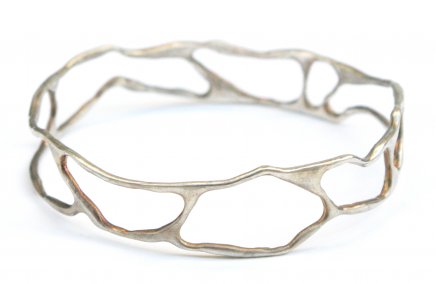
They also seem to be melting down and reusing metals, as in this gorgeous organic bracelet:

Rust Belt Jewellry - Gale
Rust Belt Alluvial Collection: Gale

It's particularly great to see artists working with recycled materials who also have a very contemporary style - a lot of objects made with recycled or re-purposed materials can be a bit 'worthy' and 'clunky' for my taste but while reusing existing metal is absolutely central to this work, I like that it doesn't completely dominate the aesthetic.

So, a useful resource for metalworkers and environmentalists and they make beautiful work - what's not to like?

4 Comments

Despite the heat, I managed to get over to Sydney to visit the Museum of Contemporary Art today. There are currently two exhibitions on: Force Field, a retrospective by Australian artist, Fiona Hall and an exhibition of Aboriginal Bark Paintings.

This was the first time that I'd seen Fiona Hall's work and I had mixed feelings about it. The pieces I liked the most were the ones where her technique and obvious skill worked in conjunction with her ideas rather than being overwhelmed by them.

I found the pieces made from tupperware consistently witty and engaging. My favourite installation in the show was Cell Culture, a vitrine containing abstract animal forms made from tupperware and thousands of beads. Being able to recognise many specifically Australian birds and animals added an extra dimension to the work for me and I'm sure I enjoyed it more than I would have before I visited Australia.

Fiona Hall: Cell Culture

This image was too wide and I'm working on an unfamiliar laptop and don't fancy hunting for editing software, so just click on it for the bigger version.

Fiona Hall: Cell Culture, detail

I also enjoyed an installation that featured a wall of tupperware containing lights that blinked on and off in sequence - simple, yet strangely hypnotic.

Paradisus Terestris, her large series of sardine tins containing metal reliefs of human body parts that blossom out into intricately cut metal plants was also enticing.

Fiona Hall: Paradisus Terestris

This work reminded me of The Song of Songs in the Bible - using plants to describe the human figure or vice versa is an ancient story but one that Hall manages to make refreshing here through sheer audacity of technique; you can hardly believe the detail and the fineness of cutting involved in the plants, while the parts of human figures are breathtaking in their minimalist assurance.

Two large installations containing multiples cast in yellow soap also caught my attention, as did the nests made from shredded bank notes and some very beautiful goache paintings of trade plants on bank notes. For me, Hall is at her best when making sculpture, although I also enjoyed her etchings, drawings and some of the photograph and video pieces.

Unfortunately, her work didn't always quite hit the mark and although there was much that engaged and amused me, there was nothing that absolutely knocked me dead. Her work was often just a little bit too obvious for my tastes; I felt that she often spoilt the work by over-egging the pudding. For example, a set of figurative sculptures made from knitted video tape seemed fairly effective until I noticed that the images related far too directly to the film they'd been made from - i.e. a foot coming out of the box for the film, They Died With Their Boots On. I prefer work to be a little more mysterious and I don't mind having to work at understanding art - generally, I'm far more tolerant of ambiguity than I am of being preached at and I felt that Hall's work fell into the didactic far too often. She is clearly an artist who is strongly engaged with her subject matter - colonialism; sexuality and the interaction between people and the environment - but I personally believe that it's a mistake to let your politics overwhelm your art.

There are a couple of interesting articles about the artist here and here. This quote made me laugh:

"I'm just relieved that I live in an era where, particularly for women, it's easy to have a life as an artist. Otherwise I don't know what I would be good for," Hall says.

Boy can I relate to that!

The exhibition runs until 1st June 2008 and despite my reservations, I do think it's well worth a visit if you're in the Sydney area. This post is already quite long and it's late here, so I'll save the review of the other exhibition for another day.