Blog

22 Comments

Having seen the Paying It Forward idea on Artist, Emerging, I immediately wanted to join in, so I headed over to the people Deanna was making things for and was delighted to discover that Kaija from Paperiaarre still had one space. So I'm her third person and I consider myself very lucky because wow, just look at the gorgeous books she makes!

Kaija

Kaija

I've done a little bit of very simple book binding and it's a lot of fun but I've certainly not made any as luscious as this. She also makes very beautiful handmade brooches.

Anyway, it's now my turn to pass it on.

Pay It Forward (via Kaija, via Deanna, via Mrs Eliot and so on)*

Here are the rules:

I will send a handmade gift to the first 3 people who leave a comment on my blog requesting to join this PIF exchange. I don’t know what that gift will be yet and you may not receive it tomorrow or next week, but you will receive it within 365 days, that is my promise! The only thing you have to do in return is pay it forward by making the same promise on your blog.

Pretty straightforward huh, I agree to make and send something to the first three people to comment, who then make things for their first three commenters and so on. OK, have at it, people...

EDIT: Even though it looks like I've got three responders, one of them is my partner and he doesn't actually want to take part - he was just responding to the question of who came up with the term 'paying it forward' - so, there's still one spot available.

* I've tried to find out who originally started this idea but haven't been able to follow the thread of connections back far enough. Does anyone know who should get the credit?

Wow, I didn't mean to be away for so long - sorry about that. Despite my policy of trying to post most days, the last two weeks have been completely hopeless. Last week I had the cold from hell, on top of an existing illness and it just knocked me flat. I'm still sneezing explosively but at least I've got my voice back and I'm thankful that I'm no longer violently coughing quite so frequently. Ah well, at least it's taught me is that I need to store a backlog of extra posts to use when I'm not well - so I guess it was useful for something!

Needless to say, not much art has been happening around here lately - I've been managing to do my daily envelope for The Diary Project and that's been about it. However, in between doses of cough medicine and Lemsip, I have been getting plenty of knitting and reading done - so here, for your delectation and delight, is a book review.

Following Katherine's positive review of The Drawing Book by Dr. Sarah Simblet, I ordered a copy from the local library (don't you just love interlibrary loans!) and it's been my late night reading for the past week or so.

I can safely say that The Drawing Book will definitely be going on my Christmas wish list because it's absolutely chock full of good stuff, including one of the clearest explanations of traditional perspective that I've read.

The book is split into short, well written chapters on a variety of subjects including landscape drawing portraiture, nature drawing and even abstract drawing. I particularly liked that drawing from the imagination wasn't ignored - so many drawing instruction books focus solely on realism, which often puts me off since that's not my primary interest. Simblet introduces each topic with relevant drawings, both her own and other artists, before going on to detail a drawing exercise that the reader can attempt. However, even if you don't try any of the exercises - and I haven't yet - you'll still get a lot out of this book.

I was particularly struck by the way she looks at drawing with a fresh eye and how she's able to communicate that to the reader. The book is full of a wide range of great drawings and she has included some more unusual artists alongside the usual subjects such as Picasso, Goya and Rembrandt. The range of drawings is pleasingly global and stretches from neolithic cave painting right through to contemporary artists who are taking drawing in new directions. It was actually a little odd that I'd met three of the people whose work she showed but since she used to teach at my college and they also had links there, I guess it's not so very strange - the British art scene is staggeringly small at times!

The information about materials is also very solid. Apart from focusing on the usual things like paper, pencils, ink and charcoal - which all have handy, nicely illustrated, double page spreads scattered throughout the book - Simblet also highlights some more unusual drawing materials like silverpoint, which I've never considered using before and am now very keen to try. Her explanations of drawing materials are straightforward and easy to understand without being overly simplistic. Indeed, the same can be said for all the language throughout the book, which makes it pleasingly accessible - frankly, this is an absolute blessing since far too many art books are heavy-going to say the least.

I'd say this book would be good both for relative beginners and more experienced artists who are looking to expand or develop their drawing skills. Older children who are keen on art might also benefit from this book, not least because of the potted tour of art history. That said, I don't think it's a book that I'd give to a complete beginner because I think they might find it a bit daunting. But if you've been drawing for a little while and have got past the absolute basics, then I'd definitely recommend it - I've been drawing for years and I still learnt loads. Plus, it's beautifully laid out with high production values, reasonably priced, well edited and best of all, it doesn't make drawing seem boring!

8 Comments

Joanne B Kaar is a Scottish artist who works with fibre and bookmaking. In 2006 she completed a three month residency in Durness in Sutherland, which she documented in a fascinating blog.

Joanne B Kaar - Sango Sands
Joanne B Kaar - Sango Sands Seapapers

During the residency she made a series of books from handmade paper, often using local materials. Some of these books were subjected to pretty harsh treatment like being buried or thrown in the sea! It's amazing that they've survived as well as they have - it's easy to forget how robust paper can be as a medium.

Sutherland is a place that is very dear to my heart. Most of my childhood holidays were spent in Achnahaird in Ross and Cromarty and every holiday included a day trip to Lochinver in the neighbouring Sutherland. Although it was very close as the crow flies, it was an hour-long drive on a narrow, twisting and often terrifying road. I've just checked and according to the AA it's 16 miles yet takes an hour and 8 minutes - that should give you an idea of just how bad the road is! It was worth it though - not least for the annual visit to Achins Bookshop in Inverkirkaig - apparently the most remote bookshop in the British Isles. I always saved most of my holiday money so that I could splurge on books and I still remember the feeling of deep contentment that walking out with a bag of carefully chosen books gave me. I also have fond memories of standing on the pier in Lochinver watching the fishing boats unloading and sitting on the seafront eating homemade pies from the incredibly good local bakery.

Durness is a lot further up the coast and not somewhere I've visited but Joanne's photographs of the area, with all their Highland familiarity, certainly brought up plenty of nostalgia. I love living in Bristol and feel very at home here, but so many of my creative roots lie in those summer holidays in the Highlands - long days spent damming little streams with my brothers and cousins, building complex sand sculptures with my Dad, riding invisible horses, grinding down sandstone in an attempt to make pigment (I used to pretend I was a neolithic cave painter!), patiently drawing for hours in the caravan on rainy days and writing bad poetry once I was a teenager. For several years now I've been needing to reconnect with those roots and I know that I absolutely must make a trip to the Highlands soon because the feeling is getting quite desperate. While I don't really subscribe to the idea of a 'muse', I have learnt over the years that it's not a good idea to ignore particularly persistent creative cravings.

Where do your creative roots lie? Is it a place? A feeling? A particular smell? A certain kind of pencil or the feel of a fresh sketchbook?

3 Comments

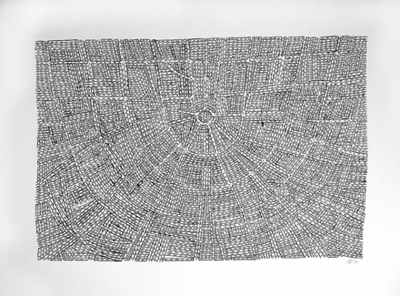
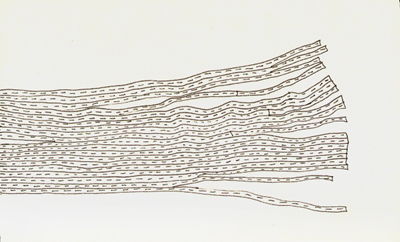
Unfortunately, I haven't been able to find out all that much about Dutch artist, Anita Groener but I like the way her work alternates between spareness and complexity.

Anita Groener - Labyrinth IX
Anita Groener: Labyrinth IX

Anita Groener - Freeway

These two works form part of the Crossing series. Over the space of three years Groener drove about 12,000 kilometers between The Netherlands (her homeland) and Ireland (her adopted country) and these regular road trips became a huge influence on her studio practice. She describes this series in the following way:

The verb Crossing signifies movement, a movement which is not uniform but which is drawn back and forth. In my drawings I try to capture the delineation of movements of thought processes occurring in space and time, between here and there, between the point of departure and arrival. The journey of the line marks the surface turning it into visual patterns. What you see is a physical manifestation of the layers of routes and directions taken in this process, revealing its manifold meanings.

10 Comments

I've found so many stories and links that I'd slung into the folders on my desktop, that the only way to get through them is to do a bit of a round-up. Maybe I'll make this a weekly feature since I always seem to find far more than will comfortably fit into my regular blogging schedule.

Links

Nick from The Boat Lullabies blog found a fascinating photographic history in a thrift store.

Bob collects pencils - lots and lots of brand name pencils. Now, I like pencils as much as the next artist but this strikes even me as a tad odd. It is a well done site though - I like the regularity of the design and you know what, Bob's right, these pencils are kind of beautiful when you see them all en masse.

Photographer Helga Steppan, organised all her belongings by colour - the results are stunning.

The Mega Penny Project is a handy way to visualise large numbers.

Such a clever idea - people who've matched their screensavers to the background behind their computer so that it looks as though their computer screen is transparent.

I adored this short animation called Hiccups 101 by Jessica Sances.

Craig Robinson has done a series of what he calls 'lollipops' - abstracted computer drawings of musicians and pop stars. I was fascinated by how little I needed to identify some of them. I listen to a lot of music on my computer but I don't watch MTV particularly, so I was surprised at how often the names of musicians instantly popped into my head - even ones I'd never heard sing. Even when I couldn't remember the name, I'd often still know who it was meant to be - I guess most of us are steeped in celebrity culture whether we want to be or not.

It's not art related but this YouTube video of a small child trying to communicate something important to his increasingly giggly father makes me laugh hysterically every time I see it.

People

Regular commenter, Tina Mammoser from The Cycling Artist has a good post about avoiding scams which was inspired by this post by Alyson Stanfield.

Ulf Nawrot who did the post-it drawings that I linked to back in August, kindly sent the following clarification on his process:

All my post its were drawn while doing something else in an ad agency: phone calls, meetings, brainstormings-if you are looking close you will find lots of valuable information hidden on these notes like phone numbers, comments etc.-but you will also find my different states of mind, anger, distraction, making fun of people...the whole thing started subconscious like the swirls and ornaments a lot of people draw on desks and everything else in reach when they are doing phone calls.I have been collecting my post its since 1993 and at this point there must be around 25.000 of them.

25,000 of them - wow, way to go, Ulf!

20 Comments

I've been in a creative slump lately because I've been unwell. I just haven't had the energy to do much of anything, let alone making art - although of course, I'm still doing my daily envelopes for The Diary Project. But overall, I've just been feeling totally blah about my work - it happens and I know it'll pass but it's still not a fun place to be in.

One of the few things that has been creatively exciting me lately is Camilla Engman's Organized Collection group on Flickr.

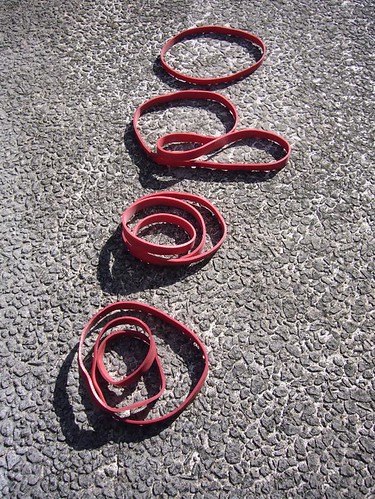
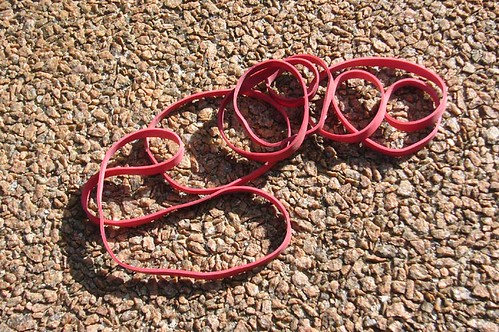
So my art practice for the last few weeks has mostly involved collecting little object on the days when I've been able to get out and about and just taking simple photos of them on walls or paving stones. It's small and it's simple but at least it makes me feel as if I'm still doing something.

Kirsty Hall, photograph of red rubber bands
Kirsty Hall, found rubber bands, October 2007

Kirsty Hall, photograph of red rubber bands
Kirsty Hall, found rubber bands, October 2007

One of the things I noticed when I first started joining Flickr groups was how it made me see the world in different ways and how I stretched my photography a little bit because of it. I'd take different photos than usual because I'd think "hey, that would be a good shot for such-and-such a group". If you're feeling the need for a bit of a creative stretch, particularly in relation to your photography, then I'd recommend it.

And having said all that, I'm now going to take myself and my camera outside to the garden to see what I can find, before I need to go for yet another rest.

30 Comments

1: Keep Something Back

You don't have to share your whole process and every piece of art you make. It can be nourishing to keep a private sketchbook or make little test pieces that you don't intend to share. I have a couple of sketchbooks that I don't usually show to anyone. Apart from anything else, we all need a place where we feel emotionally free to make bad art without worrying about an audience!

2: Let Yourself Play

Remember what got you into art in the first place and take some time to reconnect with that joy. This can easily get forgotten when you're a professional artist and bogged down in promotional activities and exhibition schedules, so make sure you also schedule some playing time. Taking classes in a different technique or trying out an exciting new art material can be a good way to access what Buddhists calls 'beginner's mind', that wonderful state where everything is exciting and fresh.

3: Find A Balance

Balance your practice by finding forms that complement each other. For example, if your work takes a long time and involves long and complicated projects, then regularly doing little pieces that can be finished quickly is a good counterbalance. It helps you feel as though you really are getting stuff done. Artists have traditionally done this by using drawing as a complement to painting or sculpture but it's not the only option, performance, photography, writing, music or another form can also fill that need for immediacy.

Conversely, if you tend to complete works quickly, taking on a longer, more involved project can be an interesting challenge. Working in series is often a way of doing this but maybe you can think of other more unusual ways.

4: Love Your Process

I've seen far too many people, particularly at art school, endlessly struggling with a medium or form that they just don't enjoy. Why? Art is hard enough without handicapping yourself with a process that doesn't excite you. You need a certain amount of joy to get through all the bits that you don't like, so don't lumber yourself with a form that just doesn't do it for you - it's not noble, it's just masochistic!

5: Accept The Lows

Anyone who tells you that art is a wonderful, creative thing that always makes you happy is an idiot!

Annoyance, small bursts of depression and large doses of frustration are a normal part of the artistic process. It doesn't mean that you're no good, that you're not cut out to be an artist or that you're doing the wrong thing, it just means that you're engaged with your work. Just make sure that you do have a deep core of love for your process - if you're annoyed all the time then you probably need to reconsider your medium (see number 4).

In my experience, anger and frustration usually happen right before a breakthrough and it's a sign that I need to stick with a piece - although if I'm throwing things around the studio and yelling, I tend to take a day off! Feeling low usually happens when I've just completed something big - I call it The Exhibition Blues - and it's always a sign that I need to step away from art for a while to recharge my batteries, assess what I've just finished and get ready for the next piece.

6: Fill Up The Well

Art doesn't form in a vacuum and it's important to replenish your inspiration on a regular basis. Julia Cameron suggests regular Artist's Dates, where you schedule inspirational treats for yourself and I'd totally agree. This could involve reading art books; going to the theatre or cinema; visiting art galleries or museums; taking photograph's at a farmer's market; going for a walk; taking a day trip or indulging in some new materials at the art shop - the key is that it should be something that nourishes and inspires you. If you're starting to feel a bit stale or low, then try this.

7: Write It Down

Give your brain a helping hand and write down all your ideas, not just the ones that seem immediately good and relevant. You can always edit them later and you never know when a seemingly unimportant thought will develop into a larger project. I often think that I've come up with a brand new idea but invariably I'll find a single sentence in an old notebook that was clearly the original spark. New art takes time to grow, at least several years in my experience. Writing things down is a way of planting your ideas and then letting them develop while you're busy getting on with something else - I call this process 'composting'.

The notebook that I keep by my bed is the most important of the 5 or 6 journals and sketchbooks that I use. I wouldn't want to be without the other notebooks because they all serve different purposes but the majority of my ideas start out in that little bedside book.

Bed is apparently where I think best but it varies from person to person. I know someone who keeps a waterproof board and pencil in her bathroom because she gets her best ideas in the bath. Someone else I know writes ideas on the steamy doors of her shower cubicle and then dashes out to grab some paper before they evaporate! Work out where you think best and make absolutely sure that you keep a way of recording ideas there.

8: Make Art A Priority

You need to make a space for art in your life. If art isn't a priority then it simply won't get done and you'll get to the end of another year wondering why you haven't made any work.

I do know that it's difficult: if you're working another job to pay your bills or raising children, then finding time and energy to make art can be especially tough but you need to keep hold of the idea that you're an artist, that it's central to who you are and that you're going to keep making work somehow.

You may need to work in the margins of the day - on your lunch break, on public transport, as you're waiting for a meeting to start, while the kids are napping or when the rest of the household is asleep. When I worked in a hospital, I used to sketch the visitors to the canteen on my lunchbreak. I didn't do it every day but I did it enough that it noticeably improved my drawing at a time when I had no access to life drawing classes. I know several writers who've written zines and even novels in spare minutes at work. Other artists find ways to incorporate their paid work into their art, perhaps by using it as the subject of their work.

It's easy to think that you need vast swathes of time in order to be an artist but that's not always the case: what you need is a steady and regular commitment. Yes, having lots of time can be great but it can also make you freeze. When I was at college I used to spend most of the day talking to people, pottering around the studio and drinking endless cups of tea and then in the last hour I'd finally get myself in gear and do some work. I've learnt that I tend to do much better with a limited amount of time and a deadline.

If you've got serious limitations to contend with, then another option is to temporarily alter your practice. If you can't make sculpture because you don't have the space, then maybe you can draw, if you can't get access to printmaking equipment, then maybe you can do monoprints instead, if your oil paints are toxic to your toddler then switch to gouache. Don't be afraid to explore the options - you're an artist, you can surely come up with a creative solution.

When my son was small, I couldn't even draw because if he woke up and threw me out of that creative zone, then I wanted to throw him out of the window! I decided this wasn't an ideal frame of mind for parenting, so I switched to photography and writing - both forms I was able to pick up and put down much more easily - until he was older and I had more mental space. And let me tell you, I came out of that restricted period like a bat out of hell, I had so much stored up creative energy that it powered me for years.

9: Create A Supportive Space

It's vital for artists to have support, particularly from the people that they live with. The importance of having people in your life who understand your need to make art can't be overstated. They don't need to like or understand your work, although it helps, but they do need to understand what it means to you.

Again, I know it isn't always possible to have this support - you may be in an existing relationship with a partner who doesn't quite get it or have a birth family who are firmly opposed to you being an artist. You can still make art in these circumstances but you'll have to be prepared to fight your corner and that's draining and takes energy away from your work. Sadly, I have noticed that people who end up quitting art often have families who undermine their choice to be an artist, either directly or more subtly.

I'm incredibly lucky, my family of choice are totally supportive - bemused sometimes, but always supportive. Of course, I say luck but really it was a choice - I put art at the centre of my life and deliberately picked people who support me. When I was single, the two fundamental things that anyone getting involved with me had to accept were:
1) I was a parent and my kid came first
2) I was an artist and I had no intention of giving that up for anyone.

It was always an absolute deal-breaker for me - I can be quite hard-nosed and selfish about my art when I have to be and I just wasn't prepared to trade art for 'love'.

10: Don't Quit!

Ah, the most important tip of all!

David Bayles and Ted Orland talk extensively in Art and Fear: Observations on the Perils (and Rewards) of Artmaking about the importance of not quitting and give a host of reasons why people do, plus ways to avoid it. It's an excellent book and one that I reread most years - every artist should own a copy.

If you want to be an artist then quite simply you have to find ways to keep making art and not stop, no matter what life throws at you. Good luck! And don't forgot to have a bit of fun along the way...

9 Comments

Last night, my son had his 15th birthday 'sleepover' (why do they call them sleepovers when no sleep ever happens?), so I was in nominal charge of 8 teenage boys. This morning, as my son and I cleared up the quite considerable mess, I found myself musing over the similarities between parenting and art.

Art is an everyday thing. Like parenting, it is made up of lots of little moments, a thousand little decisions and a hundred thousand moments of just showing up - what Alison Lee of Craftcast calls "getting your butt in the chair".

Art is usually not the heroic struggle of Romanticism or the epic machismo of the 1950's Action Painters, although those big dramatic moments do sometimes occur, most often in the run up to an exhibition. Instead art - for me at least - is rooted in the everyday; in the daily ritual of the Diary Project envelopes, in the way I sit in my computer chair listening to podcasts while I do another couple of rows on a Thread Drawing canvas, in the slowly changing pile of art books that are permanently in residence under my bed.

Although it is not usually about domesticity, my art is firmly rooted in the home. I am fortunate enough to have a studio at home and like Virginia Woolf, I recognise the importance of having a room of my own. However, my art also takes place in other rooms in the house: in the living room while I'm watching TV with my family, in my bed where I often draw, in our library/dining room where I sit at the big table and stick photos into my sketchbook, in my study as I make work in front of the computer, in the shower where I think up ideas, in the kitchen when I get distracted from cooking by the sudden overwhelming need to photograph the ingredients.

Art permeates my whole life - it isn't confined to a set time or a set place.

In the myths about art, this everyday quality is often omitted. For some reason, it suits people to imagine dramatic moments of crazed genius, a life lived on the bohemian edge and a slow descent into madness, drugs and suicide. We seem to want our artists to be very different from everyone else. Perhaps the reality of getting your butt in the chair, like the daily grind and pleasure of parenting, seems too mundane to most people? Was this great art really made in front of the TV or with radio 4 playing in the background while the artist drank cups of tea and pottered around the studio - how dull! We wanted death threats and overdoses, tortured homosexual love affairs, rats and cockroaches in the studio, drunken pissing in the fireplace, body parts cut off and maybe a couple of tragic stabbings!

But art - like parenting - is not something you do once in one grand and shocking gesture and then never again. Instead, it's a constant trickle, a constant reiteration that this tiny thing, this moment of awareness, this quiet, everyday dedication is the really important thing.

9 Comments

Sheree Rensel commented on this post:

I totally agree with comments presented. I too realize that blogging is very beneficial for aspects related to motivation and building an audience. However, I want to know how blogging has helped your INCOME. How has blogging increased your sales or increased the money you get to support your art?
That is the topic for which I am REALLY interested.

Sheree Rensel - Blue
Sheree Rensel: Blue

Ah Sheree, the answer to that would be 'not at all' since I'm not currently set up to make money off my art. I am slowly coming to terms with the idea that maybe I should try to make some money from my work but it's something that I'm still internally struggling with. For a long time I believed that my work was completely unsaleable because of the fragile and often temporary nature of the things that I made. That's no longer as true as it once was but I'm still trying to reprogramme my brain on this issue. I plan to write more about the issue of money and artists in the future.

That's a long-winded way of saying that I'm probably not the best person to answer your question!

Fortunately, Katherine from Making A Mark left a long and detailed comment, some of which addressed this issue. I'm reprinting the relevant bits here:

Kirsty - I absolutely agree a blog should be for yourself. I personally am less on reading 'commercial' blogs where people are blogging for a business which is not their own or because they think it's 'what you have to do' to sell art. These blogs often seem to run out of steam after a bit.

Blogs which just present work for sale (as one e-bay) are fine by me - but IMO they work so much better with a few details about why the artist chose to paint the picture...

...Re. last comment, here's my observation. The people who appear to sell consistently using their blogs as part of their marketing are those who do good quality work. (By which I mean good quality work will find a buyer if you market effectively). What a blog maybe does for them is speed up the process of increasing awareness - and then once you've attracted people who like watching what you produce then you have a ready market of people who are more likely to buy.

I would agree with this, personally I prefer blogs where the artist is not solely focused on selling, although I have no objections to being gently reminded that they've updated their Etsy shop or that a particular piece is available in a commercial gallery. In fact, I definitely think that artists should do that, where applicable.

However, the artists who seem to have the most success online usually seem to take the long view. For example, Camilla Engman is an artist who's had a lot of success online and she seems to have built up her sales in a gentle and organic way. She cultivates an audience for her work by having relationships with the readers of her chatty and informal blog and maintaining an active Flickr presence including starting a new group called Organised Collection recently. And of course, she makes excellent and consistent work that she offers at a range of prices from affordable calendars and prints to the more expensive original paintings.

Camilla Engman - Collection 2
Camilla Engman: Collection 2

Engman is a lovely example of how to operate as an artist in the offline world too. We had a show of her work at the Here Gallery and she included a couple of packs of her little prints as a thank-you gift for those of us who'd helped with the show. She's the only artist I can recall who did something like this and it was certainly appreciated by those of us who unpacked and hung her show, since we were all volunteers and none of us were getting paid. Getting curators and gallery people on your side never hurts!

Get more help
If you'd like more information about building your online presence, check out the free resources section.

I am also available for online consulting if you need one-on-one help.


4 Comments

Paul Catanese, Assistant Professor of New Media at San Francisco State University kindly sent me info about a panel on art blogging that he's chairing at the College Art Association Conference in Dallas in February 2008.

He brings up some interesting questions in the panel blurb:

An explosion of new blogs from artists, collectors, galleries, residency programs and museums are reshaping notions of professional practice within the arts. Though promotion is certainly a major driver in this arena, sites such as Art.Blogging.LA, Walker Blogs, Art Fever and PORT are especially good at projecting a local arts scene into a broader context. Other models investigate blog as sketchbook, establishing a new format for the open atelier. Does art blogging indicate the emergence of a dislocated, yet thoroughly local arts scene? Can blogs shift the space of studio practice while retaining its capability to be unstructured? Is the quest for site traffic inherently at odds with healthy periods of gestation and dormancy? What models exist for balancing these forces? What are the implications for establishing or maintaining an art practice for those who remain virtually present, yet physically distant?

This jumped out at me: Is the quest for site traffic inherently at odds with healthy periods of gestation and dormancy? This is a particularly interesting question to me right now since I'm currently not at my best health-wise and I'm trying to balance regular updating here with a need for large amounts of sleep and cold medicine (could make for some funky blogging this week!) It's great to see someone recognising that art practice does require these dormant periods where you're cooking up new work and aren't ready to talk about it yet and I can certainly see how that could make keeping a sketchbook type blog difficult. Indeed, I've noticed that it's not uncommon for artists who're doing a blog that's focused on their own work to go a bit quiet on occasion.

Anyway, if you're interested, Paul's currently looking for panel members and the deadline for abstracts is the November 9, 2007.