Blog

10 Comments

I spent some time in my local yarn store today. Sure, I needed yarn for my next couple of projects but much more than that, I needed an hour to soak up some colour and texture. I could have ordered the yarn from the shop's website and saved myself a trip in appalling traffic but I knew that I needed to go: something in me was craving that experience. I wanted to wander around, picking up the yarns and squashing the skeins in my fingers. I needed to feel the softness, the springiness and the resistance of the different fibres. But most of all, I needed to marvel at the myriad of colours. I needed to see the ways in which different dyers had married shades together, to notice how some tones zinged and jumped, while others were muted and subtle. I spent some time holding balls of yarn next to each other, testing to see which would go well together and which were jarring or unpleasant. I didn't have a particular project in mind, I just wanted to see what worked and what didn't. You can learn a lot this way - maybe art teachers should stop bothering with boring old colour wheels and just take their students to a fantastic yarn store instead!

I've never been brilliant at colour, I don't have the instinct for it that some artists do, but I still occasionally need a bit of colour therapy. Sometimes my muse (for want of a better word) craves time spent in art galleries, libraries, parks or beautiful buildings - and sometimes it just needs to smoosh some yarn!

I left with the yarn I'd planned to buy and only one extra thing (a bargain skein of very beautiful sock yarn) but more importantly, with my heart contented and my inspiration levels rising.

We all need to spend some time inspiring ourselves, otherwise our art will eventually run dry. What have you done to inspire yourself lately? Do you take yourself out on regular 'artists' dates', as Julia Cameron recommends? I often forget and only realise that I need to once it becomes a desperate craving. If you're in the same boat, then I hope you can take some time over the next few days or weeks to recharge those artistic batteries by doing something that's just for you. It's especially important to do this if you're caught up in the seasonal madness. It doesn't need to be much and it doesn't need to take long but I think it's vital to remind ourselves that our art is every bit as important as buying presents, baking cookies, decorating trees, placating relatives and all the other traditions that we may have encumbered ourselves with.

And if you don't celebrate anything at this time of year, then maybe you can indulge in your own personal art hibernation while all around are drowning in festivities? Get a pile of good art books from the library, stock up on some exciting new materials, shut the door and spend a few days just losing yourself in play. Mmm, sounds good to me!

4 Comments

The Decorated Journal by Gwen Diehn is a book that focuses on art journalling.

Gwen Diehn book

The book is divided into sections, the first is an extensive exploration of the different materials used in art journalling including paper, pencils, paints, pens, glue and other commonly used materials. This section is, to my mind, the strongest in the book. It contains handy tables that show the advantages and disadvantages of different types of glue, a section on the paint colours you'll need to be able to mix a good palette, lots of information about the different grades of paper, explanations of the properties of various different materials and clear advice on what to buy and why. There's even a page on making your own ink and paint from naturally occurring pigments that you've gathered! I also like the way she emphasises investing in a few well chosen, quality materials rather than getting suckered into buying endless new products that are actually quite limited in scope.

In the second section of the book, Diehn describes different types of journalling. She categorises journals into 7 different types and provides techniques that she thinks are particularly appropriate for each. I wasn't totally convinced by her categories and most of the stuff I objected to occurred in this section.

The third section of the book is called 'Pages In Stages' and Diehn splits the working process into 'starters, middles and toppings'.explores how to work with the different levels of the page through techniques like layering, collage and using text. This is one of the shorter sections in the book since it's basically reprising things that have already been described in earlier sections.

The final section of the book deals with some basic bookbinding - Diehn is a big fan of making your own journals so that you can control the size and type of paper and she demonstrates how to make several simple handmade books plus how to customise existing journals and reuse the covers from old hardback books. I have several other bookbinding books already so there wasn't a whole lot here that was new to me but the information seemed clear and competent and it's obvious that it's something she's passionate about.

Although there is undoubtedly much of value here, this is not a book that I can wholeheartedly recommend. The main problem I had with this book was Diehn's tone, which I found overly lecturing and didactic. It's very clear that she feels there's a right and a wrong way to do things - for example, she assumes that paper buckling is always to be avoided but personally, I've found that buckled paper can be an interesting design element on a journal page rather than a problem.

Sure, it's important to learn 'the correct way' to do things and I can understand her desire for 'good practice' but I also felt she could have recognised that art journalling is an expressive, experimental and free space for the artist, where the rules don't always need to apply. It's not that what she says is necessarily wrong - I agree with many of her opinions - but the way she says them invariably seemed to get my back up. Reading her words made me feel as though I was back at art college again. This isn't surprising since Diehn is a tutor at an art college but I didn't find it at all helpful or inspiring. Since I'm currently trying to unlearn quite a few of those art school conventions, I don't need this approach. I took particular exception to her saying things like "you have to earn the right to draw the details": I think that's a staggeringly unhelpful thing to say to anyone, whatever stage of drawing they're at.

In addition, I wasn't particularly blown away by the journal pages shown; they often seemed to fall into a particular style and I felt there could have been a lot more variety. There also frequently seemed to be a disconnect between the illustrations and the text and it was sometimes hard to work out why a journal page had been selected to show a particular technique or idea.

However, many people might find her 'voice of authority' reassuring and comforting rather than invasive and irritating, as I did. If you want a book that tells you to 'buy this colour' and 'don't do that', then this would be a good book to invest in because, despite my personal reservations, there is a huge amount of good information in here. In particular, if you're new to art or art journalling and want to know about different materials and to be talked through the basics, then this book has a lot to recommend it. I just didn't like the feeling of being talked down to but I'm well aware that this may be my personal hang-up. Certainly the book gets generally positive reviews on Amazon.com and elsewhere.

I borrowed this book from the library and while I'm glad that I've read it because I did learn some interesting new stuff, I was even more glad that I hadn't bought it or added it to my Christmas list because personally I would have been disappointed. That said, I'm sure that many people would find it invaluable but I'd advise getting it from the library or checking it out in a bookshop before you buy to make sure it's right for you.

7 Comments

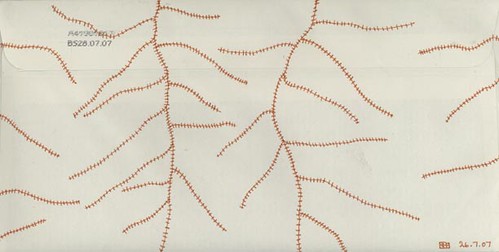
Sometimes correspondences in your work surprise you. me-jade recently added these two photos of mine as 'favourites' on Flickr.

DP 207
Kirsty Hall: Diary Project envelope from the 26th July 2007

Kirsty Hall - photograph of a red thread drawing entitled Parse
Kirsty Hall: Parse, January 2007

Although I wasn't conscious of it when I was drawing the envelope, when I saw the two images next to each other, I was struck by how very similar the shapes are.

I've been concentrating on updating The Diary Project blog this week: I'm woefully behind on it and it's getting embarrassing. I've been updating the blog in small chunks because that's all I can manage right now - writing the little musings is getting to be almost impossible. I've pretty much run out of things to say about my work: I didn't know this was possible but apparently it is!

I did an update on Sunday and another one this morning plus I'm about halfway through scanning more than a month's worth of envelopes. I scanned to the end of October yesterday and felt very pleased with myself before realising that hey, we're already half way through November.

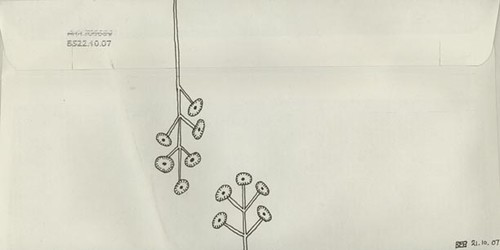
Here's my favourite drawing from the latest update:
DP 294
Kirsty Hall: Diary Project envelope from the 21st October 2007

Hopefully I'll get another chunk done tomorrow - although frankly, if I never have to write another word about my damn drawings, it'll be way too soon! In the meantime, I'm off to scan envelopes, which is time consuming but thankfully a lot less mentally taxing and I can catch up on podcasts while I'm doing it.

10 Comments

Apparently my muse really needed pens today!

pens

A visit to both the craft store and the art shop this morning - conveniently but rather dangerously located a couple of minutes away from each other - resulted in rather more shopping than I had originally planned.

I bought 2 bottles of liquid acrylic (the only kind of acrylic I can stand the smell of), some varnish, some small metal brads and some stamps for the Diary Project - so far, so good. Unfortunately I then went a bit bananas with the pens and got 10 different ones that do a variety of exciting things. I've been doing lots of pages in my new art journal and need pens that will write over difficult surfaces such as soluble oil pastels; I'm hoping that at least some of these will.

For any fellow pen geeks out there, here's what I got:

A waterproof black Faber-Castell Pitt Artist pen - I have some of their sepia ones but I haven't tried the black before. I'm always on the look-out for good quality black pens for The Diary Project - at this point, I've probably tried most of the ones on the market.
Two Copic Ciao double-ended markers - I've never tried these before but I've heard good things about their ability to draw on almost every surface.
A Staedtler Triplus gel-liner in silver - because everyone needs a silver pen
A Sakura Gold Shadow pen in grey - these make a sort of two-tone metallic outline.
A Sakura Souffle pen in dark grey - these give a slightly embossed 3-D line, so they should be good when I want colour to stay contained within a certain area.
A Sakura Glaze pen in black - these dry to a nice glossy finish and can be used on all sorts of surfaces. I'm a bit excited by the idea of the clear one that you can write with and then layer colour over so it magically appears but I'll see how I do with this one first.
A Sakura waterproof and archival Micron 01 black ink pen - again, to test out for The Diary Project.
A Sakura fine point gold marker - see silver pen comment!
A Sakura White extra fine marker - surprisingly the most expensive pen at £3.10. I do already have a white ink gel pen that I use in the Diary Project but it sticks a lot, the one seems to give a much smoother line.

You know, I wasn't doing too badly until I saw that Sakura display in the craft shop - I've never seen this brand before and they were so alluring that I lost all sense of reason! What's truly scary is that I could easily have spent a lot more. I was actually pretty restrained: I didn't buy any sets and I didn't get every kind of Sakura pen they had, I could have added another 4 or 5 to my basket but chose not to. Instead I deliberately got a selection of different things to test out, with the idea that if I like any particular kind, then I can add a set or two to my birthday/Christmas list.

We all have things we find hard to resist - for some people it's magazines, clothes or electronics; with me it's art materials. It used to be books as well but I've managed to get into the habit of mostly ordering those from the library instead of from Amazon.

I can mostly control my addiction to art materials - I often go for months without buying anything at all but every so often I just need a bit of a splurge. My wallet is definitely a lot lighter - altogether I spent just under £40 and about half of that was on the pens. I came out feeling that I probably ought to feel guilty but really I just felt utterly gleeful and still do. I guess sometimes you just need to do these things.

Well, I guess I'll see you later - I've got a hot date with some pens!

3 Comments

Last week, I was lucky enough to be a recipient of a beautiful hand-bound book by Kaija as part of the Paying It Forward exchange. I've been putting off blogging about it because a) I haven't been able to get a decent photo of the book and b) I wasn't sure if any of Kaija's other recipient's read my blog and I didn't want to spoil anyone else's surprise.

However, since Kaija has just blogged about it, I guess it's OK to go public about it now.

My book was beautifully wrapped...

Book 01

And unsurprisingly, there was much squealing when I undid the ribbon to discover this...

Book 02

Kaija took much better pictures than me, you can see the stitching and the image properly on her photograph.

My book from Kaija
Handbound book by Kaija, photograph by Kaija

Isn't that stunning! The book opens completely flat, which is very helpful in an art journal and I love the image of the bare tree and the way the stitching goes into the cover. What you can't see in the photos is that the pages inside are also brown paper - Kaija somehow miraculously knew without being told that I adore notebooks with brown pages. I may be visiting Australia in the spring for my brother's wedding, so I have decided to save this very special book to use as a travel diary.

I can't even begin to describe how fantastically well-made this book is and how wonderful it feels and looks in real life. It's way beyond my own very limited book-binding skills and I'm quite in awe of her talents. I can only suggest that you all head over to her Etsy shop and indulge in one of her very reasonably priced treasures.

Now I just need to get my own exchange items out to my three Paying It Forward recipients; Kim, Liz and Tina. I have started work on my items but it'll probably be at least another couple of weeks before I get them in the post; I'm never quick about these sort of things.

21 Comments

I have always been fascinated by artists' studios, to the extent that I even wrote my BA dissertation on them. One of the things I find so compelling about them is their very distinct aura: well-loved and much-used studios have a powerful sense of place. I'm sure it's one reason why art trails and open studio events are so popular; being allowed into the spaces where other people create has a seductive allure and the strong suggestion of intimate secrets revealed. Personally, I can never resist having a peek at other artists' storage systems. Is there an order that I can discern and do I understand it? Would I have arranged things differently and what does their system tell me about them? How have they organised their tools - are they a neat or a messy worker? And do they clean their brushes!

You can often get a strong sense of the artist's personality from their studio. When I visited Barbara Hepworth's studio in St Ives, I was struck by how very present she was: even though she was dead, it truly felt as though she'd just popped out to do a bit of drawing on the beach and she'd be back to finish off that stone carving any second now.

Artists are usually well aware that their studio is almost a person in its own right - at the very least, it has a definite genius loci or 'spirit of place'. But in order to keep this spirit happy, a studio needs to be inhabited, it needs to be worked in. I've often heard artists describe their studios as 'dead' or 'stale' when they haven't been working in them enough and I'm sure most artists are familiar with the need to tidy the studio after an absence or when they're getting ready for a new series of work.

I've been having that discontented 'I need to start something new' art itch lately and have even been questioning the direction that my work has taken in past years - in short, I feel on the cusp of change. So it's no coincidence that my studio has been undergoing a redesign in the last couple of months. In the summer I acquired some much-needed shelving and moved the desk to a better position and it instantly became a much more inviting creative space.

A studio is a working space and consequently it needs to work - things have to be accessible and easy to find, you need to know where your materials are and to have power, heat and light where you want them. Your studio also needs to be right for you and your working pattern, which is why artists' studios are so very individual and revealing. While I'm absolutely enthralled by Francis Bacon's re-created studio, I know I couldn't create a single thing in it - I need more order and much more visual simplicity than that. Your studio should fit you like a pair of comfortable shoes - if it doesn't, then you simply won't want to spend time there. I hadn't consciously realised how draining and unappealing I'd been finding my own studio until I started the overhaul.

It's also important not to get hung up on romantic images of what you think an artists' studio should look like or where it should be - spend some time exploring what your studio needs to look and feel like. When I first graduated, I paid for three months of studio time in a cold, noisy building on the other side of town because I thought that 'a real artist needs a proper studio' and I thought that meant a building with other artists in it. Then a conversation with a friend made me realise that I did all my best work at home and always had done - when I was in college, I used to work in the evenings on the dining room table and then take my work into college and install it in my space. My days at college weren't usually spent making - instead they were spent researching in the library, updating my sketchbook, pottering around seeing what everyone else was up to, drinking endless cups of tea and gossiping!

Recognising this fact made it apparent why dragging myself over to the cold, expensive studio had been so very hard - there were no friends, no communal cups of tea and no nice library books!

We're fortunate enough to have a large house, so I promptly cancelled the studio, happily put the rent money towards materials and got on with working from home. For a while I worked downstairs in our basement before discovering that it was wrong for the kind of work I make - everything got damp or dirty and I didn't like going down there because it was too dark and gloomy. Eventually I moved up to a spare room in the top floor of the house where I have cream walls, lots of natural light, plenty of warmth and carpeting - apparently I am an artist who needs a lot of home comforts in order to create! Yet even when I was finally installed in the right space, it took me until this year to get my studio working properly and it's still not quite how I want it.

So this afternoon - bone tired after a bad night of insomnia and with all my creative wells dry - I once again found myself tending to The Spirit Of My Studio. My son helped me carry up boxes of materials from the appropriately named Cupboard Of Doom. I then spent an hour sorting through them, getting rid of some things, rehoming misplaced items and then labelling the boxes with my beloved Dymo labeller before stacking them neatly on the shelves.

It's still not quite right in there but each time I organise my studio, it gets a little bit clearer. And I feel that space inside, the space where the new work is beginning to grow, getting just that little bit bigger and I breathe a little more easily.

4 Comments

I think I just fell a little bit in love. Suzi Blu is a cute young art goddess who makes short videos about art journalling that she puts up on YouTube.

I just love her quirkiness and her passion. She's done lots of videos - there's a list here - and I'm having a happy evening working my way through them.

OK, I have a BIG confession to make. All through college, I kept immaculate, beautifully presented and very professional A4 sketchbooks. Looking up at the shelves above me, I see fifteen of them in an ordered line, their spines labelled with the dates. They're almost identical - always portrait style and usually black, with a couple of patterned ones when I couldn't find black ones.

Not for me the messy, spilling out at the seams, arty sketchbook barely held together with bits of string or rubber bands. Although I adore that style when I look at other people's journals, at the time I just couldn't bring myself to be that messy. Instead, my sketchbooks closed tidily on pages filled with perfectly aligned, neatly trimmed images and printed or carefully handwritten thoughts on my art. It's slightly odd because I'm certainly not a naturally tidy person - maybe I was searching for a safe space within the chaos?

I spent a lot of time on those sketchbooks. I kept huge boxes of trimmed photos that I regularly culled from magazines and I would spend happy hours sorting through them looking for just the right combination of images that would show where my inspiration was coming from. I patiently selected the photos that showed my work to its best advantage, as well as the 'during' shots that documented the process and lined them up and taped them in. I added documentation from exhibitions I was involved in and analysed what I could have done better. I went through hundreds of rolls of my beloved double-sided sticky tape. I thought of my sketchbooks as works of art in their own right and they truly are. When I reread them, I can see that they are wonderful objects, as well as being useful documents that accurately chart my artistic process through the years. I'm justifiably proud of them and I love to look up at that neat line of them on my bookshelf.

But... but... but...

I got out of college and my sketchbooks sort of ground to a halt and then stopped almost completely. Every so often I'll pick up the current one, write an 'it's been far too long since I've written anything in here' entry, post in a couple of pictures, write down a few ideas and then guiltily ignore it for another six months. I think I've filled nearly two in the last five years - me, an artist who once went through a sketchbook every three months or so! It's pitiful and it's been weighing on me a lot recently.

I'm sure it's no coincidence that my sketchbook use tailed off when I started blogging - a lot of my writing energy undoubtedly went into my online journalling instead. In addition, no longer being in college seemed to take a lot of the 'people judging me' energy out of it. There just wasn't the same drive to do my sketchbooks that there had once been.

Don't get me wrong, I've never stopped writing down my ideas - I have a little notebook by my bed where most of my art pieces start and another notebook in my handbag to catch the ideas that happen when I'm out of the house and I treasure both of those. I also write ideas on my computer if that's where I happen to be, keep a card index box of 'art ideas' on my desk and for the last two years I've been doing a series of ink drawings in an ever increasing pile of A5 cartridge pads.

But those well documented, bright, shiny and oh-so-acceptable sketchbooks - er, not so much! I'm kind of embarrassed about it and I feel guilty and cross with myself. But when I think about sitting down and taping in photos, writing about what I've been doing, trimming photocopies and images to fit the pages and lining everything up perfectly - well, my heart just sinks. It feels overwhelming and impossible and it's time to admit it; something that once brought me genuine joy and satisfaction, now just fills me with dread.

After watching Suzi's videos, I thought 'enough already, I've got to do something about this situation'. So I picked up the mostly unused moleskine sketchbook sitting next to my computer and let rip with some black goache, white ink pen and a couple of my beloved Inktense pencils. Wham, two pages of art journalling done in about half an hour and boy, do I feel better. No, it's definitely not my perfect and pristine sketchbook but it's obvious that the old way isn't working any more, so I need to try something new.

Our 'shoulds' can really inhibit our art; they stifle the flow of creativity within us. Yes, it would be nice if I could keep making those beautiful ordered sketchbooks and I probably 'should' but it's far more important that I keep my art going. On the first page of my new journal I wrote in coloured pencil "It's time to get messy" and it is. Perhaps one day those pristine sketchbooks will be right for me again but for now, it's time to let them go.

4 Comments

Last night I pottered over to my friend Camilla's private view at the Here Gallery. Unfortunately I got there quite late, which meant that I missed seeing some friends but there was a silver lining because I got to go to the pub with Camilla and a few people afterwards.

The show is called Abracadabra and features work by three different artists - Cindy Jaswal, Claire Platt and of course, Camilla Stacey. It's a fun little show and well worth a look if you're in the Bristol area. Interestingly, the show came about after the artists met through the internet - yet another example of how artists can find and develop art opportunities online.

Camilla is showing some of her series of reglazed found porcelain figures against a background of hand made wallpaper. She hunts for little figures in charity shops and then re-paints them with gold lustre glaze and then re-fires them. The glaze seems to make the figures heavy and sometimes slightly melancholic because it's not a bright gold but more of a dull, thick colour that seems to pull the light into the figures rather than reflecting it. She also had a set of white figures in varying states of decrepitude that she'd cast in plaster. She gave me a little head with a missing nose, which I'll be putting in my cabinet of curiosities. I hadn't seen this work before, so I was interested in how it was coming along but I was sad that Camilla hadn't shown any of her excellent drawings.

Camilla Stacey
Camilla Stacey - Virgin Mary

Claire Platt trained in Bristol but now lives and works in London. She's showing a large group of her embroideries, drawings and ceramics based on human anatomy. I liked these a great deal, they're shown in a big group and I love the way they work together. A lot of the pieces have gold thread, are encrusted with sequins or are shown in mirrored or gilt frames - it could be tacky but somehow it really works.

Claire Platt
Claire Platt - Installation View

I was a bit naughty and bought myself an early birthday present - one of the most abstract drawings (you can't see it clearly but it's the little blue rectangle on the bottom left). Claire, if you happen to read this, I'm thrilled to have got one of your pieces but both Camilla and I think you're drastically underpricing your work!

If I'd had the money, I would definitely have bought one of Cindy Jarwal's exquisite ink drawings too. Sadly, although they were very fairly priced at £100, they were just a bit out of my reach - one of the downsides of being an artist is that although you'd happily buy art, you don't usually have much of a budget for it. I'm not showing Cindy's work in this post because she asks that people don't reproduce it without permission but you can see more of it on her Flickr or her website and it's gorgeous so I strongly encourage you to hop over and have a look. Her style reminded me quite strongly of my own Diary Project drawings, so it's not surprisingly that I liked them so much. They were my favourite things in the exhibition and I may just have to go back and see if I can buy a piece in instalments. I don't buy that much art - usually just one or two pieces a year - but I know that I'll absolutely kick myself if I don't get one of these.

Here's a little something for Halloween!

Luke Chueh's paintings astound me. Glancing at the thumbnails, I thought they might be overly sweet and sentimental - ha, nothing could be further from the truth!

Luke Chueh - 15 Minutes of Fame

Obviously many of his paintings - with their cast of sad bunnies, worried chickens, disturbed monkeys and world-weary teddy bears - explore horror and the darker side of childhood. However, what takes his work up to the next level for me is the expressions on his characters faces; there's such pathos there but described with such precise and retrained economy. There's always been something a little tragic about cuddly toys and he exploits this to the full, but his twisted, and often very silly, sense of humour usually stops his work from becoming maudlin. On a technical level, I love his pared-down palette of sombre colours.

Luke Chueh - Monkey Grinder

His work is sometimes available as prints from Munky King and he's definitely on my list of 'artists whose work I want to own'.

Luke Chueh - Squid
Luke Chueh - Squid