Blog

4 Comments

Jill Rumoshosky Werner writes an interesting blog over at Redefined.

I discovered her blog when Alyson Stanfield of Art Biz Blog linked to her very funny post, Top Ten Reasons For Becoming An Artist. Too true!

I particularly agree with her latest post about knowing when to get outside help as an artist.

"When I started, I never thought I'd need to know web design, digital imaging, search engine optimization and mass marketing techniques to become successful, but unlike most artists, I have a heavy marketing, computer and writing background...Even with all that experience, there are things I can't do by myself and for those, I look for outside help."

This is such a key realisation for any artist. I had a conversation with another artist last year when she told me that she always budgets for someone else to do the documentation of her work because she hates to do it. That moment was very instrumental in me deciding to pay someone else to design my website. I'd been trying to do it myself for years but just didn't have enough design or technical skills. I'd been coming to the realisation that I needed to pay someone else for quite a while but like most artists, I was used to doing everything myself on a shoestring budget so I was quite resistant to the idea of paying for something that I thought I ought to be able to do myself. However, while it's useful for artists to learn stuff like marketing and publicity, there comes a point when you have to say 'I can't do this as well as another professional and it's false economy for me to try'.

Do this today: Make a list of the art things you know you suck at or really hate to do and work out ways in which you can delegate that responsibility.

Can you pay someone else to do it for you?
Can you share or swap hated tasks with another artist?
Can you find creative ways to make it more interesting?
If you think you could do it but just lack confidence or knowledge, can you take a workshop or learn from someone who does know how to do it?

Remember to do the maths - if something is going to take you ages to learn and you'll never need to do it again, then it might be a false economy. Unless you actively enjoy it and it feeds into your art, it might also be an excuse for not working on your art. Remember that while you may be a 'starving artist', your time and energy are also important and worth valuing.
2 Comments

I first came across Solveigh Gott's excellent textile work when I showed one of her knitted pieces in the Knit1, Build 1 exhibition at the Here Gallery two years ago.

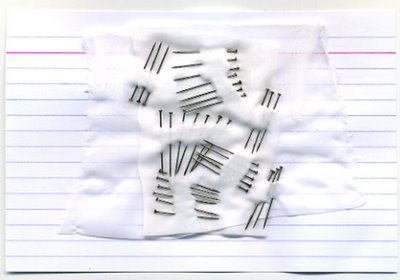
I'm a big fan of her project, The Textile Files. It's a simple but very evocative project: she collects bits of fabric, attaches them to a file card and then blogs the picture with a piece of related text. I was just checking her blog and saw this picture of pins, which immediately got me excited.

Solveigh Gott - The Textile Files
Solveigh Gott: Pins from The Textile Files

I started reading the text and thought "hey great, someone else is working with pins!" - and then promptly realised that the reason the text sounded so familiar was because it was written by me! Yep, she was quoting text from this very website - thanks, for the mention, Solveigh, I'm very flattered to have been included in The Textile Files.

But really, fancy not recognising my own writing - I am such a doofus sometimes! Still, it's not quite as bad as the time I started reading a list of livejournal interests and thought "wow, this sounds like someone I would get on with, I should friend them" before realising that I'd accidentally backpaged and was reading my own interest list. Still, I suppose it's positive that I instantly liked myself...

I got a box of Moo cards made about a month ago to help promote The Diary Project and they're the cutest things ever. They're smaller than ordinary business cards, about half as deep but they're really high quality - they've got a nice heavy feel and a good glossiness to them. But the best thing is that you can get up to 100 different designs per box of 100 cards, which lends itself to all sorts of creative ideas. I got 25 different Diary Project drawings printed up, with the Diary Project info on the back and they look completely stunning. I've been carrying them around in my handbag and handing them out to people and they've been pretty popular - artists, in particular, are usually instantly enamoured with the idea.

All fired up with Moo enthusiasm, I signed up for Where In The World Is Moo?

I was third in the list of 100 people for the second journey. Basically it's a sort of mail art project, you add your Moo card to the box and then mail it on to the next person on the list. The box arrived last week from the States with two very cute cards in it and I finally sent it on its way this afternoon. It's heading over to Northern Ireland next and after that, who knows? Well, the organiser obviously, but the rest of us don't.

I put this Diary Project Moo card in the box:

Kirsty Hall - The Diary Project

I believe there's still time to take part in Where In The World Is Moo?: all you need is your own Moo card and the ability to get to the post office, the rest of it is just doing a little bit of documentation and even that is pretty simple. It's a fun, easy project and I recommend it.

2 Comments

I like to listen to podcasts while I work. I can't read, write or do anything too complicated whilst I listen but I do often scan and edit photos, knit or work on pieces of art that require fingers and time but not too much thinking. Quite a lot of Pelt - the latest pin piece - has been done to the accompaniment of podcasts.

Kirsty Hall - art, Pelt, Pin Sculpture
Kirsty Hall: Pelt, April 2007

Pelt in progress - photographed in April, back when the weather was nice enough that I could make art out in the garden, sigh.

One of my favourite creativity podcasts is Craftcast by Alison Lee. I just listened to the episode with arts business coach, Bruce Baker. I laughed out loud in several places when he touched on issues that have been repeatedly coming up for me recently. I love when the Universe gives you really obvious messages like this. OK Universe, I get it, I'm meant to be thinking about money, selling and learning to give up control of the bits that I'm not so good at!

As I say, I'd already been thinking about these things and I feel that I'm making some pretty big internal leaps in relation to how I feel about my art practice. For example, getting the website up has been a big thing: after years of failed attempts and dithering, I finally recognised that I needed to employ someone to design it or it just wasn't going to happen.

In a similar vein, I recently joined the Spike Island Associates Programme as a way of networking with other artists and overcoming the invariable isolation that comes with having a studio at home. I went to a private view there on Friday and then to an interesting talk yesterday by Lucy Skaer & Rosalind Nashashibi, who'd collaborated on a film together. The bit where they were talking about getting permission to film in the Metropolitan Museum in New York particularly resonated with me and it forcibly struck me last night that I'm now in the position where I should also be applying for funding and working with institutions who can give me more support than I've had previously. I suddenly feel that I'm ready for that and I know that my work is too. Inevitably perhaps, my own perception of my success as an artist is as much about these sudden internal jumps in confidence, as it is about external markers of success.

From the Behance website.

When you complete a list of action steps, your instinct might be to throw the list away. After all, the work is completed! However, some creative professional teams take a different approach; they relish their progress. Some go so far as surrounding themselves with it.

to-do

As a compulsive list maker, this photo made me laugh. I don't need to do this because I end up with finished pieces of art to remind me that I've completed things but I can certainly appreciate the motivation. I have been known to sneak things onto my to-do list after I've already done them just so I can have the reward of ticking them off. And for very special occasions - like launching the website - I use gold stars on my lists. The website was the first of my ten goals for 2007 to be completed so I crossed it off and put a gold star next to it. I'm so mature.

9 Reasons Why Every Artist Should Have Their Own Art Blog - a good article from the Empty Easel blog that covers all the bases. Link found on the always excellent ArtBizBlog. I hadn't come across the Empty Easel site before, I'm looking forward to reading the archives, it looks like there's lots of well thought-out stuff on there - I'm currently engrossed in the many articles about selling online.

2 Comments

Since I'm not in America, I haven't seen the reality dance show in question, but I found this NY Times article* about what happens when someone who's a professionally trained dancer goes on one of these shows very thought-provoking.

"Even more disturbing is the idea that “So You Think You Can Dance” has emerged as a viable option for real dancers, including Mr. Tidwell, who don’t have to look far to see that career options have been greatly depleted. At its best, the show provides a kind of kicky fun, the good side of cheesy. But it’s also outdated and perpetuates many stereotypes about what constitutes good dance (speed is in, subtlety is out), what language is used to describe it and how training makes boring dancers...

...In one episode, Mr. Lythgoe declared: “What I dislike are dance snobs, and those are people who think you need a formal training with years and years of experience before you can be called a dancer.” He continued: “You don’t just need a formal training. It’s because you have a great feel for dance."

This anti-training stance bothers me. Yes, you can be a talented amateur in any field and you can choose to step outside formal training but the fact remains that you still need to practice if you're ever going to develop. No artist, in whatever medium, will get far without learning some relevant skills. Just as important is learning the language used in your field, especially if you want to be a professional. I'm not saying that everyone should go to college, but I do think that you need to get some input from someone who's further on than you, whether that's by taking classes, reading books or just going and looking at what they do and thinking about it a lot.

I do understand that there can be a problem with formal training - people sometimes get stuck just repeating what their tutor does and never finding their own voice. Sometimes this is because of bad teaching, sometimes it's because people get afraid to take their training wheels off, sometimes it's because they've genuinely gone as far as they're going to. But usually you can get beyond that point by continuing to work and practice, practice, practice. When you do, you'll usually find that you do eventually start to make some leaps on your own. There is a hideous part of learning when you've lost what Zen Buddhism calls 'beginner's mind' - that state where everything is new, exciting and wonderful and you sometimes make good stuff simply because you're fresh and innocent and don't know enough about the rules to be bound by them. But once you've learnt a little bit, you can get stuck, stilted and panicked because you can suddenly see just how crap you really are - the trick at that point is to doggedly keep going, keeping the faith that eventually, through practice, you'll get good again.

* You may need to register to read this article.