
In my early twenties I was terrified of my art. Absolutely terrified. I was afraid to look at it sideways in case it ran away.
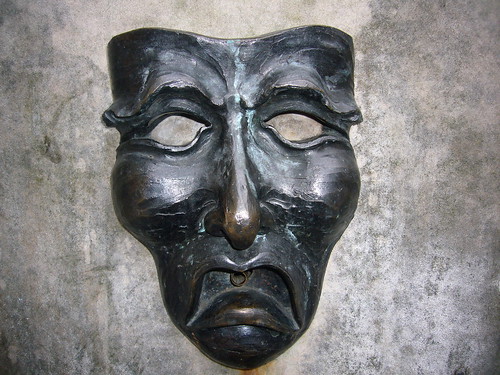
Kirsty Hall: Sad mask in Edinburgh, Feb 2010
Unsurprisingly, I didn’t make much work. It’s hard to make art when you’re scared that your inspiration will jump up and leave at any moment: muses don’t like clinginess.
In my thirties I went back to college after a break to care for my son. While at art college, I became obsessed with understanding my own process. I wrote about it endlessly, trying to understand the mystery. I mined my memories of childhood to find out where my art came from. I analysed what worked for me and what didn’t. I was searching for patterns.
To my surprise, instead of causing the mystery to evaporate, shining a light on my creativity made it even more magical.
Like a mature relationship, a more intimate familiarity with my own creative process bred endless joy. I had been afraid that understanding my process would kill it. Would take the spark away. Would result in my work becoming boring and mundane. Instead, it made me fall more deeply in love. My process became more accessible, understandable and controllable, yet ever more rich and fascinating to me.
And I learnt to trust it. I learnt to trust that the ‘post-exhibition blues’ would only last a few days. I began to recognise that research phases were different from ‘not working’. I started to understand the need for putting work aside to give time for my editor head to emerge.
The power of metaphors
If you’ve just started to explore your own creative process, here’s a simple technique that I found helpful: come up with metaphors for it. Although metaphors are not literally true, they are a powerful way to understand a process.
Here are three of the metaphors that I have for my own creative process:
Composting
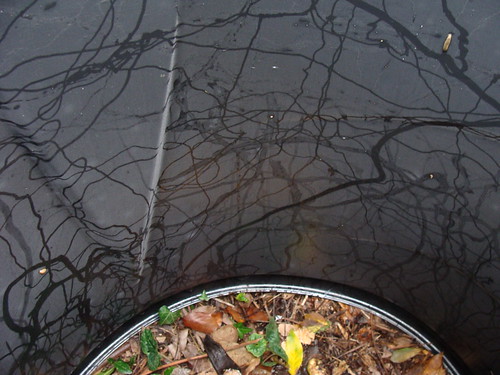
Kirsty Hall: compost bin with slug trail drawings, Dec 2008
The composting metaphor speaks fondly to the deeply organic nature of my process. It also refers to the rather random nature of my ADD brain, which has a habit of tossing up the indigestible things to the top of the pile every now and then - like about once every five minutes!
As any gardener knows, composting doesn’t happen instantly. Similarly, I need to digest ideas: I cannot go from initial idea to finished product in a few weeks. The idea has to steep first, it has to rot down, it has to be invisibly worked on by all the little idea microbes in my head. Looking back over my sketchbooks, I invariably discover that what I think is a ‘new’ idea, will be lightly referred to years before – there will be a throwaway sentence that says something like, ‘there’s something compelling about aprons’ and three years later I'm sewing sequins on a apron.
Perhaps other artists can work on a fast time-scale but my process is glacially slow: by using the composting metaphor, I began to acknowledge and honour that.
Knitting


For years I beat myself up for picking up ideas and abandoning them before they were completely finished. That’s not to say that I didn’t make finished work: I did. However, I didn't make finished series of work - at least not in a linear and timely fashion.
Because working in series is very important to me, I felt this to be a wrongness within me. Then one day it occurred to me that perhaps my work was like a very complicated jumper and I just hadn’t done enough to be able to see the whole pattern yet. Maybe if I looked back at it, I would be able to see where the different threads had woven in and out, sometimes blue; sometimes complicated stitches of white on white; sometimes little flashes of red. Sometimes sequins; sometimes matches; sometimes pins.
I came to see that there was a method to the way my jittery brain worked. Certainly I'm easily distracted but perhaps I can find a strength in that if I trust to my obscured pattern. I began to accept that I was working in entirely the right way for me.
Now when I’m ready to return to an older series, I think about picking up stitches. Right now the pins are on a stitch marker while I complete the sequin apron but I know that I will return to pins. They are resting and when they are ready to return to my greater pattern, they will.
The Cooking Pot
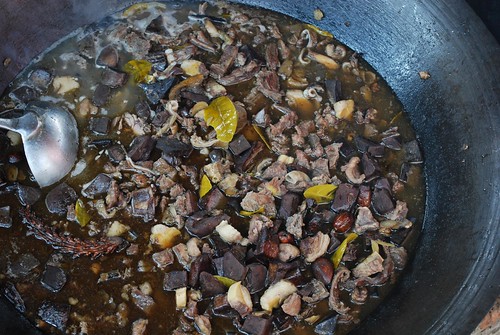
Similar to the compost metaphor but a little more edible. Imagine a big gumbo: you throw in everything you’ve got, add lots of garlic and then you leave it to cook down. Mmm, delicious!
Time is the connecting thread in all three of my metaphors. Time changes our raw ingredients into something more mysterious than we could possibly have imagined. Time ensures that the whole can be greater than the sum of parts. Time is vitally important to any artistic process but particularly to mine, which is all about slow art so it's unsurprising that my metaphors revolve around it. By employing metaphors I was able to articulate that relationship.
Process
I've written before about the need to love your process. It needs to be something that you enjoy doing or you simply won’t do it: end of story. But of course, it’s not always that easy, otherwise we would all create perfectly day-in day-out and clearly we don’t.
However, having a metaphor that resonates with you can help strengthen your creative resolve. And when you’re stuck, you can console yourself that you’re just composting.
Resources
Normally I link to other blog posts but today, I'm going to recommend books. There are a ton of books about the creative process, these are my three favourites:
The Creative Habit by Twyla Tharp
Art & Fear by David Bayles & Ted Orland
Everyday Sacred by Sue Bender
Please Comment
What metaphors do you use for your own creativity process? Let me know in the comments…