Tag Archives: My Art

9 Comments

Simple things make me happy - like the form and colour of this faded old towel against the bathroom door.

Draped Towel 01
Kirsty Hall: Draped Towel, Dec 2008

This reminds me of 17th century Dutch paintings but I'm not sure why since as far as I'm aware they didn't often paint towels. Perhaps it's the 'still life' feeling of the image that I'm responding to?

Draped towel 02
Kirsty Hall: Draped Towel, Dec 2008

The history of painting is filled with fine renditions of drapery but most of it is incidental. However, occasionally a painter gets so carried away with depicting fabric that it becomes the central focus of the work, as in this painting of Cardinal Richelieu, who seems quite swamped and overwhelmed by his fine robes. His face looks like a bit of an afterthought to me!


Philippe de Champaigne: Cardinal Richelieu, 1640

I am endlessly fascinated by the way fabric drapes, which is why I love these huge contemporary paintings of fabric that Alison Watt created after a two year residency at The National Gallery. I love the plainness, the folds, the monochrome grey and white tones and the sheer scale of these. I've never seen them in the flesh but I'd love to.

Needless to say, I particularly like the knotted one.


Alison Watt: Pulse, 2006
© The National Gallery, London

This is an interesting 10 minute video about the work and Watt's relationship with the act of seeing. She talks very intelligently about looking and thinking. I got a real sense of the way that making art is a slow, deep and intense process - something artists don't always manage to convey to people because it's such a difficult thing to talk about.

Draped fabric has played an increasing important role in my own work in the last few years. Recently I've been researching linen and acquiring a collection of antique bedlinen that I plan to start working with in the new year. I am particularly fascinated by the idea of worn and torn fabric; I've been playing around with it since I made and photographed this test piece back in 2006.

sheet 01
Kirsty Hall: Torn Sheet, 2006

This is the origin of the work that I'm about to start making - two to three years is about average for an idea to ferment in my head. It's a cotton sheet that I deliberately tore into strips and then knotted together. I was thinking about the literary cliché of imprisoned women climbing out of windows after making a rope from the bedsheets. I've been trying to track down the origin of this trope; so far the only definite example I have is a scene in Terry Pratchett's The Fifth Elephant. If anyone knows of any other instances, I'd love to hear about them as I'm starting to wonder if I've made it up. But I suspect that I just haven't read enough 18th century Gothic novels!

23 Comments

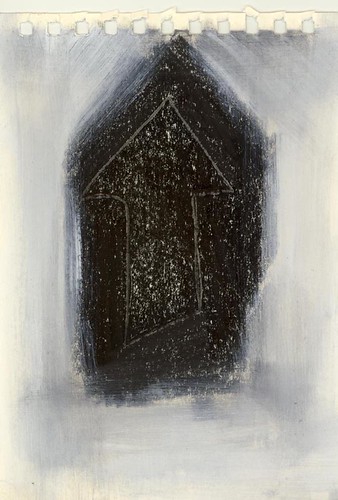
Katherine asked to see some of the little drawings that I talked about in my last post. Here are a few of my favourites...

Pencil + gesso 15
Kirsty Hall: Drawing, Nov 08

Pencil + gesso 05
Kirsty Hall: Drawing, Nov 08

Pencil + gesso 07
Kirsty Hall: Drawing, Nov 08

Pencil + gesso 06
Kirsty Hall: Drawing, Nov 08

Pencil + gesso 04
Kirsty Hall: Drawing, Nov 08

Pencil + gesso 03
Kirsty Hall: Drawing, Nov 08

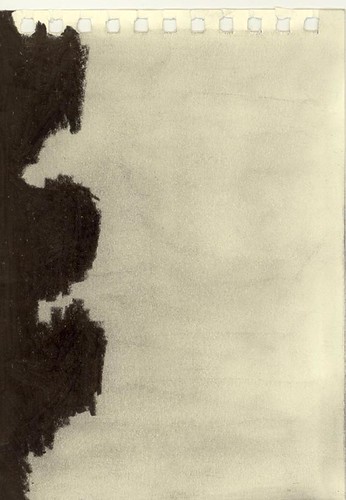
The torn edges are an important part of these drawings and I'm considering framing some onto larger sheets of watercolour paper so that the edges are retained. These are drawn on A6 cartridge paper (105 × 148mm) with a deliberately restricted palette: I'm ONLY allowing myself to use two pencils (a 2B and a 9B) and acrylic gesso. The greys are formed when the gesso mixes with the very soft 9B pencil. Working on this small scale and with such a limited choice of materials really frees me up to work quickly in an uninhibited fashion, which is absolutely what I need right now.

If you want to see more of these, check out my flickr pages.

When I was scanning these, I was thinking about the way that pencil is often regarded as a 'neutral' art material because it's so ubiquitous and considered fundamental to art. Yet actually, graphite is a very particular material with its own distinct properties. The scans don't capture the incredible, shiny, dense, silvery greyness of the 9B pencil but when I'm applying it so thickly, its status as a mineral becomes quite apparent. I've also been playing around in the studio with graphite powder on gessoed panels but it makes a much softer and more fragile mark than pencils, which contain clay and binder for strength and ease of use. I've been wondering what it would be like to densely coat an object with pencil marks or layered graphite? The idea of making sculptures that leave 'drawings' on their surroundings is very appealing to me.

Oh, and if you want to know how those 'simple' and ubiquitous pencils are made, then check out this series of videos from Derwent. It's a surprisingly complex process but certainly a lot quicker and easier than the way it used to be done!

17 Comments

One of the advantages of going to art college is that it teaches you to think deeply about your work.

Unfortunately one of the downsides of going to art college is that it teaches you to think deeply about your work!

In art college you learn to be critical of what you make and you learn a language with which to talk about your work. These are valuable skills and I'm glad I was taught them. However, thinking deeply about my work can become a handicap on occasion. I've found it can inhibit me and prevent me from starting work or make me constantly question the worth of an idea when it's in that delicate beginning stage. Six years out of college, I still hear the sceptical voice of my tutor rattling around inside my brain asking me if the work is really meaningful and well-considered.

Of course, it's important to be able to think and talk about our work; being an artist today requires those skills. But it's also important that analysing and talking about the work doesn't impede the actual making of the work. Analysing and making are two very particular skill sets that require different sorts of vision and attention. I run into trouble when I get the order muddled up: letting the analytical side out too early to run riot through half-formed ideas can be fatal to my productivity. Right now I need to make art without second-guessing myself all the time, something I've been doing a lot lately.

This has been a hard year for me - I've been weighed down with illness, both my own and that of my son. Thankfully he is much better and is back at school now but the strain of caring for him during the first half of this year has left me drained and unwell. Consequently it's been a pretty hopeless year for art and I am currently in the tricky position of emotionally needing to make art but having very little physical energy to do so.

This tension is expressing itself in a hypercritical over-awareness of what little I am making, constant worrying about what I'm not making, fretting over whether my art is any good and all the rest of the neurotic behaviour to which artists are prone. I consider myself to be fairly level-headed as artists go, yet I still fall prey to these fears and anxieties, most especially when I'm not making art at the pace and level that I need to. I don't think of my art as therapy but let's just say that my family have been known to beg me to go to my studio if I've gone too long without making!

But although I clearly need to work, I don't have the energy to do so in any consistent way at the moment. So instead I'm concentrating on improving my health and consoling myself by making little drawings that don't take too much time or energy. And when my inner art tutor starts muttering that the drawings 'look a bit Foundation-y', well, I just grit my teeth and try to ignore him. I'm also a) considering hiding the work from myself until I can look at it with a clearer and calmer eye and b) telling myself that it doesn't have to be good anyway. Those inner critics can be persistent buggers - sometimes tricking them is the only way to get anything done!

1 Comment

"If you've done all your own mending, there's a heap of socks to be
looked over. Then I'll show you about darning the tablecloths. I do
hate to have a stitch of work left over till Monday," said Mrs.
Grant, who never took naps, and prided herself on sitting down to
her needle at 3 P.M. every day.

from Jack And Jill by Louisa May Alcott

I should be sitting down to my needle at 3pm every day but sadly I'm still unwell so apart from a tiny bit of drawing, I've not had the energy to make any art. I certainly haven't been able to start the new series of work I'm planning, which involves a lot of sewing. However, I have been researching mending and darning in preparation and I've come across a couple of artists who use darning as an intrinsic part of their work.

...............

San Francisco artist, Michael Swaine trundles around with a handmade sewing cart mending people's clothes and engaging them in conversation.


Michael Swaine: Sewing For The People

There's an interesting video showcasing his projects here. He was recently in Britain undertaking a new project where he documented and darned people's socks.


Michael Swaine: Darning Socks

That little box of thread and tools just makes me drool with longing - the neatness and particularity of it is very appealing to me.

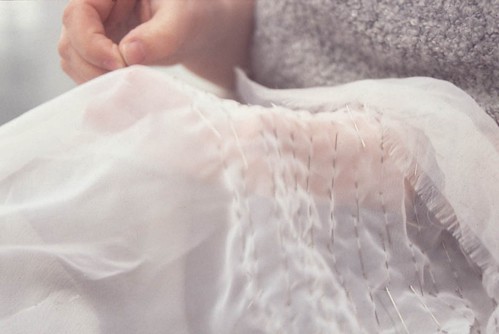
His way of working instantly reminded me of my own Pin Ritual which uses pinning as a conduit for conversations about subjects like domesticity, repetitive labour and, almost invariably, people's grandmothers.

pin ritual 01
Kirsty Hall: Pin Ritual

Celia Pym is a British artist who spent a year darning holes in clothes for her degree show at the Royal College of Art.


Celia Pym: Mend

Unfortunately Celia doesn't seem to have a website, so I can't tell you much more about her although you can see more of her work, including some very lovely little ink drawings, here.

Both these artists were found on Treehugger, an interesting site focused on green issues. Although they don't have a specific art section, they do cover some contemporary art.

Other Darning Links

Prick Your Finger is an alternative haberdashery/knitting shop in London who have a fun blog that often mentions darning. They recently hosted Michael Swaine.

Jerry Barney from Fergus Falls in Minnesota recently wrote a charming post about finding a pair of socks that his mother had darned.

My Front Porch has been darning a sweater, while Kate from Needled repaired some jeans with the help of a vintage book.

I found the diagrams on this 'how to' page about Pueblo darning and mending quite delightful.

...........................

If anyone knows of any other artists who are working with mending or darning, do let me know because I'd love to hear about them.

18 Comments

The blog has been quite text-heavy in the last few days, so here's an image-based post for a bit of balance.

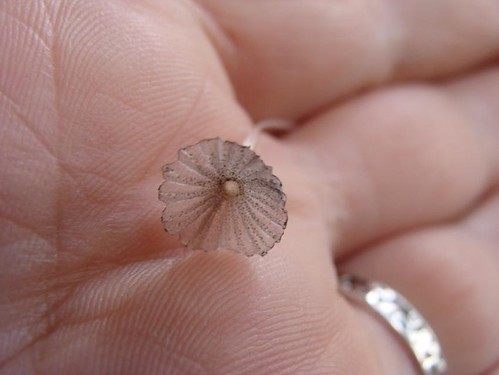
A couple of weeks ago I planted some coriander seeds that I'd harvested from the plant in my window box. The plan was to have some growing inside over the winter but I don't think it's working since all I seem to be getting is a fine crop of admittedly inspirational mushrooms!

The compost was obviously shot through with mycelium. These come up in little clumps of two or three mushrooms and they only last a day or two at most before they crumple into nothingness.

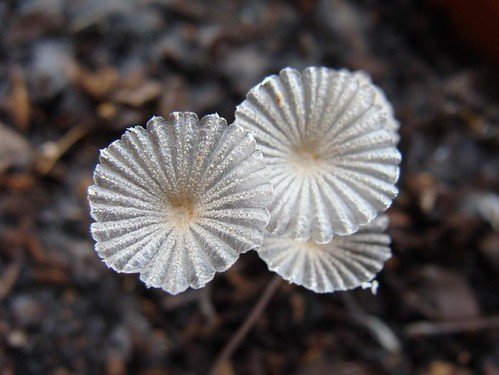
Kirsty Hall, photograph of 3 tiny translucent fungi
Kirsty Hall: Fungi, Sept 08

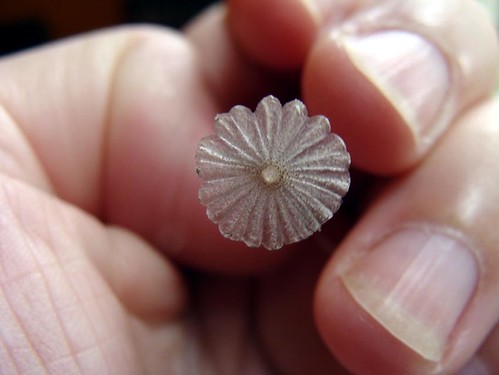
In these two shots, you can see how tiny and translucent they are. I was sure this would disintegrate as soon as I picked it up but although it was fragile, it was stronger than it looked and I was able to delicately hold it while I photographed it.

Kirsty Hall, photograph of tiny translucent fungi on palm of hand
Kirsty Hall: Fungi, Sept 08

Kirsty Hall, photograph of tiny translucent fungi on palm of hand
Kirsty Hall: Fungi, Sept 08

Looking at these I was reminded of the incredible mushroom drawings by Chris Drury.

Here is his description of how he makes them:

If you cut off the stem of a mushroom and place it on a piece of paper overnight, covered with a bowl, it will drop its spores onto the paper in the pattern of the gills. The spore print here is digitally scanned and printed in three versions and altered by changing the contrast in Photoshop. The prints are glued and ironed onto the canvas which is built up in layers of gesso to form a surface for writing.
This radiating pattern of spore lines draws you in as a mandala would, but if you take a magnifying glass and follow one line from the centre out to the periphery then you will notice that each line branches and branches again like the limb of a tree. In making these densely written works this is in fact what I do: I follow the principle of the line that branches, only in densely hand-written words, in inks of different tones, with reed pens of different thickness, gathered from the banks of the river (everything flows here) and which have to be constantly sharpened and dried. The written words are repeated and hypnotic, like a mantra. The words cease to have meaning, the concentration is on the sound. A word that has a good sound is easy to write. It flows on to the canvas. The concentration is on the sound, the shape, the size, the colour, the tone, the branches. The words are the mantra that shape the mandala.


Chris Drury: Destroying Angel – Trinity

Chris Drury, Destroying Angel, mushroom spore print and drawing
Chris Drury: Destroying Angel – Trinity
White printed spore prints and radiating lines of text in white ink and pencil on black prepared canvas. Text reads: 'Amanita virosa- Destroying angel'

Needless to say, I adore the obsessiveness and repetitiveness of this process! Imagine doing all that writing, and these aren't small pieces - each canvas is 187cm square. I wonder if he ever makes spelling mistakes? If I was writing something over and over like that, I know I would start losing all sense of the words and I would start getting them wrong. It reminds me of the sort of obsessive use of writing that you sometimes see in Outsider Art.

I've been a fan of Drury's work since I saw his 'Medicine Wheel' piece in Leeds City Art Gallery. That piece - a circular collection of natural objects collected daily for a year - was a definite influence on my Diary Project.

Chris Drury, medicine wheel, circular sculpture of natural objects collected over a year
Chris Drury: Medicine Wheel

Unusually for a well-known artist, Drury not only has his own web site but he even writes a blog. A recent exhibition at the Nevada Museum of Art also has an associated blog by the gallery staff and they even have sets on Flickr.

I'm quite delighted by this. I constantly meet artists who don't have any web presence and don't grasp why this is a problem: I often end up doing five minute impromptu versions of my articles about how artists can use the web. Many famous artists don't even seem to have their own dedicated sites. Seriously, what's up with that? Surely they can afford to pay someone to do it. Hell, if I can do it, surely Damien Hirst can manage it! What's the matter, Damien, did someone pinch 'damienhirst.org' out from under you? I can only assume that they think it's unimportant or perhaps it's seen as a bit too democratic or something - I don't know why it happens but I find it very odd.

So it's fantastic to see an established artist and a big institution using blogging and the net to directly engage with their audience and I hope other mainstream members of the art world will eventually follow suit. I know lots of galleries have websites but I often get the sense that they don't quite 'get' the web; I think many of them still think in terms of the old models of top-down publishing. Hmm, something else to research and think about...

12 Comments

Autumn is suddenly very much here (hey, what happened to our non-existent summer?) and I have been gleaning.


Jean-François Millet: The Gleaners, 1857

OK, not literally gleaning from the fields but definitely harvesting.

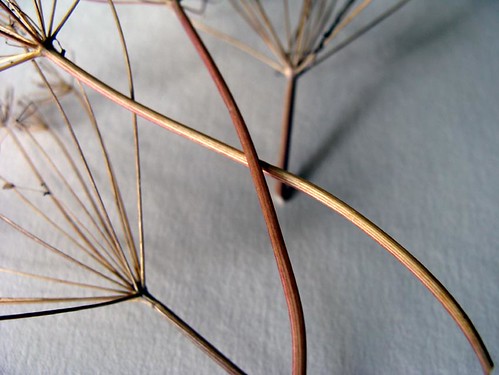
Several days ago I pulled up the dying dill plant in my windowbox of herbs, cut off the fragile seed heads and sat them in a bowl to dry.

Dill Seedheads
Kirsty Hall: Dill Seedheads, Sept 2008

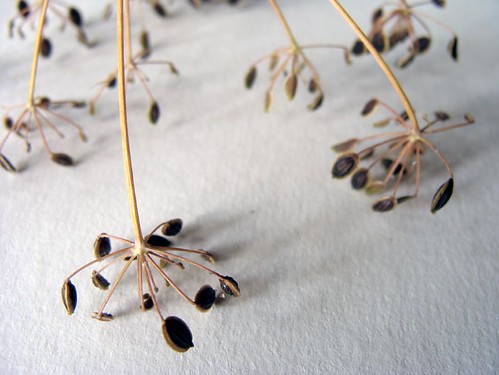
Dill Seedheads
Kirsty Hall: Dill Seedheads, Sept 2008

Yesterday morning I sat, half asleep, and gently plucked aromatic seeds from tousled umbels. The ripe ones fell off easily, any that felt silky under my fingers I left to dry out further.

Dill Seedheads
Kirsty Hall: Dill Seedheads, Sept 2008

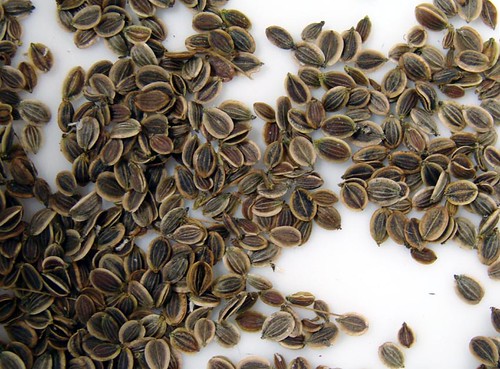
I ate one at the end of the task and the taste exploded in my mouth - one small seed so much stronger than a handful of the leaves.

Dill Seeds
Kirsty Hall: Dill Seeds In Bowl, Sept 2008

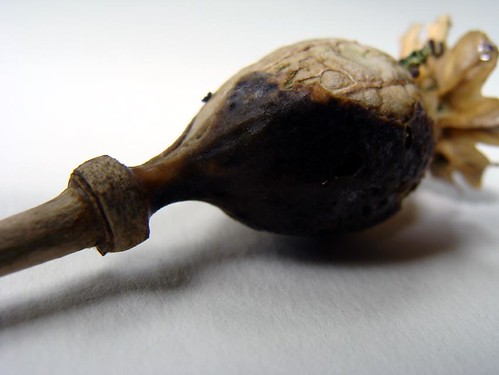
This morning I collected seedheads from the two poppy plants that arrived unannounced in my garden - in entirely the wrong place naturally! I cut them over a bowl to catch the tiny black seeds that spill everywhere with the slightest provocation.

Poppy Seedhead

I have been gleaning in my art as well. I am in a research phase so I've been reading a lot, using tiny scraps of paper to mark pages and then transcribing found words, phrases and ideas into my sketchbook. I've been searching through my boxes of images looking for just the right combination of visual information and trawling through ebay for the materials I need to start my next project. All seeds that will grow into something new.

Everywhere in my life; gleaning, gathering, hunting, harvesting, searching and storing.

6 Comments

Sometimes I come across an artist who's ploughing very similar ground to me and occasionally I find someone who's working with the same materials as me. However, I think that Bird Ross and I may actually be sharing a single brain!

I was looking through old copies of Fiberarts Magazine to see if there was anything I needed to photocopy for my sketchbook, when I spotted a small photograph of a ball of knotted string by Ross.


Bird Ross: 6000 Knots

Anxious that I might have accidentally copied her string work when I came up with the idea for 3 Score & 10, I checked the front of the magazine, but it dated from 2005 and a quick search through my sketchbooks revealed that I was already making 3 Score in Jan 2003.

3 score & 10 02
Kirsty Hall: 3 Score & 10

Rather oddly, Ross' 6000 Project using knotted string was about 9/11, which of course, I've also done a series about. Here's what Ross wrote about her project:

From the four airplanes (266), the confirmed dead (201), the 5422 people still missing and those that died at the Pentagon (188). It equals a little over 6000. As of today 6077. I wanted to know what 6000 looked like. How can anyone possibly imagine what 6000 of anything looks like, let alone people. What would 6000 names struck from the pages of a phonebook look like? What would it look like in terms of their handprints, their footprints, in terms of the number of people that miss them? It's like nothing we can imagine. This was my attempt to imagine.
18 September 2001

And here's what I wrote about my 3,533 (Requiem) piece:

I sat in the space and burnt 3,533 matches over the space of four days. This number is the current estimated number of victims of the terrorist attacks. The matches were then laid out so that both the scale of the numbers and the individuality of each match could be seen. The thing that I really couldn’t grasp about the attacks was the sheer scale. I needed to make work that encompassed those numbers and I thought if I could see objects laid out then I might begin to understand the loss involved.

Of course, I've never imagined that I was the only artist who took this approach, I've seen other 9/11 counting projects; it's a pretty natural response for visual people trying to get their heads around the scale of something like this. Still, when I went onto Ross' website and found that as part of her 'counting the dead' project she'd also used burnt matches, I was slightly spooked.


Bird Ross: 6000 Matches

requiem 06
Kirsty Hall: 3,533 (Requiem) in progress

Then I spotted her time clock piece and just started laughing because several days ago I wrote in my notebook, "I should get one of those old fashioned work clocks so that I can punch in and out when I'm pinning".

Oh, and I've also had ideas about using layers of sellotape - guess what, so has Ross!


Bird Ross: Wounded

How crazy is this! Bird Ross and I have never met, I wasn't aware of her work before this and I don't imagine for one minute that she was aware of mine but we're clearly tuned into the same art wavelength! I'm sitting here just giggling because it's so weird.

My favourite piece of hers is this beautiful little folded paper piece called It All Adds Up. It's clearly a till receipt and since it's part of the 6000 series, I'm guessing that it's folded 6000 times.


Bird Ross: It All Adds Up

Isn't that lovely. I like the way it's encased in the narrow glass or perspex vitrine, it sets off the piece so well.

Right, I'm just off to check one more time that there are no pins on Ross' website!

6 Comments

This would have been posted yesterday but I stupidly spilt tea on my keyboard last night and promptly killed it. Oops. One trip to PC World later and I now have a gorgeous flat aluminium keyboard that's quieter and easier on my hands and most importantly, not full of tea!

................

I've started drawing again. Since the start of the year it's been an on/off kind of thing but I've drawn so much in the last three days that I ran out of my preferred heavy duty cartridge paper and had to switch to a lighter weight pad. I went to the art shop but they'd run out too, so I had to order it online. I didn't come away empty-handed though; I was delighted to discover that Derwent has expanded its range of my beloved Inktense pencils so I bought five new ones to try out and two pads of other paper because being low on paper makes me feel antsy. Of course, I have a drawer full of paper but that was all the wrong size or type. Ha, never underestimate the ability of artists to justify spending money on materials...

I'm still in a bad place with my health so I haven't managed to work in my studio but I have been lying in bed drawing and sitting at the computer listening to podcasts while I work on the embroidery piece. Like many artists, I have an almost mystical attachment to the idea of 'the studio' and I have to keep reminding myself that it doesn't matter where I make art as long as I get it done.

This is why I don't have a studio outside my home. I feel bad that I don't spend enough time in my studio when it's just up the stairs, imagine how guilty I'd feel if I was paying for the privilege of never getting to the studio. Some artists need the routine of getting out of the house and going to a special place to make art. I understand and respect that but for me, art needs to be rooted in my domestic surroundings or it's just never going to happen.

Hey, if making art in bed was good enough for Frida Kahlo, it's good enough for me!

And on days when I can't make art at all, I can still take photos.

Photograph of blue Forget-me-nots by Kirsty Hall
Kirsty Hall: Forget-Me-Nots, June 2008

Photograph of clematis seedhead by Kirsty Hall
Kirsty Hall: Clematis Seedhead, June 2008

Photograph of a squirrel on a garden post by Kirsty Hall
Kirsty Hall: Garden Visitor, June 2008

2 Comments

Tina Mammoser over at The Cycling Artist has been doing a fascinating series of podcasts about her artistic process. Last night, I listened to the latest one and I was very struck by something she said about how artists are either good finishers or good starters.

I'm definitely much better at starting things than finishing. Truth be told, I often dither over starting things too - I like to get everything sorted out in my head first and then I'll suddenly dive in and get going. So when I say that I'm better at starting than finishing, it's all relative: it's just that I truly suck at finishing.

I'm currently at the stage with the red embroidery (yes, the one I said I was going to finish weeks ago) where it's very hard to work on it because it's getting towards an end point. I know it isn't finished yet but I'm having a lot of trouble deciding where the next lines go. It's stopped being filled with infinite beautiful potential every time I drop the thread onto the canvas and the narrowing options are making me increasingly uncomfortable.

My instinct is to rush off and start a new one. A better one. One that will somehow miraculously instantly work without all this tedious humming and hawing.

But I'm plugging away trying to finish this one because I know how I am: new work tends to push old work aside and then the old work doesn't get finished. You wouldn't believe how much unfinished work I have in my studio. One of the things I loved about The Diary Project was that I had a daily deadline so I had to finish; there just wasn't the option to sit around being indecisive for weeks on end.

I wonder how I can incorporate that lesson, that discipline, into my regular practice? I've noticed that I often do better when the rules or limits of a project are clearly laid out at the beginning. Do I need to make all my work that way though? Surely there needs to be a place in my practice for freeform creativity too?

Sigh, you see how I am - these are the sort of knots I endlessly tie myself in. How odd that sometimes the work flows out of me almost effortlessly and at other times, it's this tortured, labyrinthine process. My mother says that I always have to make things difficult for myself; sometimes I think she has a point!

If you feel that you need a creative boost this summer, the lovely Camilla is running an online summer school. I'm still swithering about whether to sign up or not; it looks like fun but I don't know how much energy and time I'm going to have. But I'm certainly going to be dropping in regularly to see how they're getting on.

2 Comments

I am in a place of struggle with my art right now (as indeed, I often am).

I am second-guessing myself all the time. Is this embroidery good? Is there any point to it? Does it mean anything? Is it derivative and boring?

Bah, and indeed, humbug.

The chief enemy of creativity is "good" sense.
Pablo Picasso

I often have to trick my analytical side into letting me make art because my art is essentially nonsensical. It's a daft thing to do. Putting thousands of pins in a piece of fabric or tying thousands of knots in bits of string is loopy, I've always understood that, whilst at the same time (mostly) believing that it still has value. Yet holding those two opposing beliefs (this is daft/ this is worthwhile) in balance is not always an easy thing to do.

It's hard to make art when your mind is tied up in knots like this. Often it seems that we artists spend most of our time clearing out the junk in our heads that stops us making, instead of actually making. Hmmm, perhaps it's time to read one of my favourite books, Art & Fear by David Bayles and Ted Orland, which is all about how not to quit. I reread it at least once a year, it helps get me through times of doubt like this.

All children are artists. The problem is how to remain an artist once he grows up.
Pablo Picasso

I want to get back to uncomplicated creating, making without thinking, joyful making. I miss it. Perhaps I will drag out my pens this afternoon, lie in bed and just draw and draw and draw. I know when I feel like this - dissatisfied, antsy and annoyed with myself and my art - that work is the only cure. I might not make anything good but even lousy art usually moves things along.

One final note: I'm not looking for sympathy here. I am not in crisis, despair or needing reassurance that my art is good: I've been through this many, many times before and I know that I will pull out of it and start making again, usually with renewed vigour and enthusiasm. I am well aware that this is a natural part of the artistic process that most artists periodically go through. I'm putting this out there in the hope that other people will learn that this is just part of making art and so that they don't despair when it happens to them.

And now I'm going to go and take a walk with my camera to get some fresh air, buy something yummy for dinner and hopefully clear my head.