Tag Archives: My Art

Hmm, apparently I did something weird this morning and this post vanished into the ether even though I'm sure I published it. Even more annoying, it didn't save most of it, so I've had to rewrite it. Fortunately most of it is based on an old piece of writing from way back in 2001, so it wasn't too much work. I've even managed to put in a couple of pictures - if I'm very patient, I can link to photos that are already on Flickr, I just can't upload any new ones. Using dial-up is like wading through treacle and I can't wait to get back to the 21st century and a fast broadband connection although I am enjoying hearing the old modem sound again, it's quite the nostalgia trip.

Anyway, it's time to raid the vaults... this has been edited slightly to tighten up the language and grammar but is more or less unchanged from the original.

Still Life
1/7/01

I have come to realise that much of what I make is actually Still Life. My photographs, in particular, have a Still Life sensibility. I am looking at small things - like hot raspberries on the beach or the reflection in a bowl of water - and saying that they are small yet important. It seems to me that that is what most Still Lives do: they take everyday things and set them apart so we can truly see them.

blue bowl 02
Kirsty Hall: Blue Bowl Reflection, circa 1999

Still Life demands that we really look at the flagon of wine and the apple; the bowl of cherries; the lifeless carcasses. It ponders the flowers, the glass and the tablecloth. It shows us the texture of everyday life and forces the realisation that actually these things are amazing: the bread we eat, the soft cheese, the pile of fruit, the luscious cakes, the humble or grand spread. This is what keeps us alive after all. This is what nourishes us. Of course we also need vast epic pictures of the imagination and portraits that force us to look at our frail human bodies. We need art to consider many things but it seems odd that Still Life should so often have been considered the least important subject matter in art, when it deals so intimately with life and death.
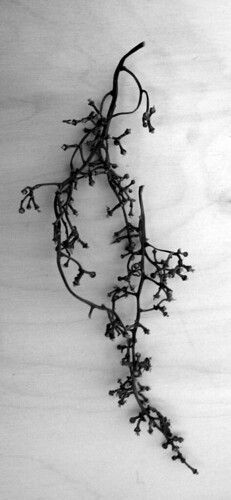
Grape stem 01
Kirsty Hall: Grape Stem, May 2003

Mortality is a vital component of many Still Lives. Those flowers will soon be dead: they are just caught for a moment in time. Caught at the point of perfection? Or perhaps already weeping their petals onto the rough-hewn table or perfect lace. That food will spoil or be devoured by a hoard of hungry mouths. Even that fine glass goblet will eventually be broken or lost. The table itself will be consumed by history. Who knows what happened to the musical instruments, the sheet music or the pile of books? They are lost to us except for this captured image.

It is that quality of stillness that I love most about Still Lives. More and more my work has been edging towards stillness and quiet, not actual silence but definitely quietness. I think I am looking for contemplation and the mysterious void. Stillness is a quality that I associate strongly with the colour white, which is why I think my work has contained so much white in the last two years. I am searching for that perfect moment perhaps, that moment of clarity and stillness?

1 Comment

Sigh, I'm not sure where this week went. Do you have weeks like that? One minute it's Monday, the next it's Sunday and you're not sure what happened to the in-between bit. I seem to be having more and more of them - maybe it's true that time speeds up as you get older.

I have been working fairly consistently on my embroidery piece this week and I hope to get it finished later today or tomorrow. I've decided to set myself an informal target of finishing a piece of art a week because I need a bit of a push.

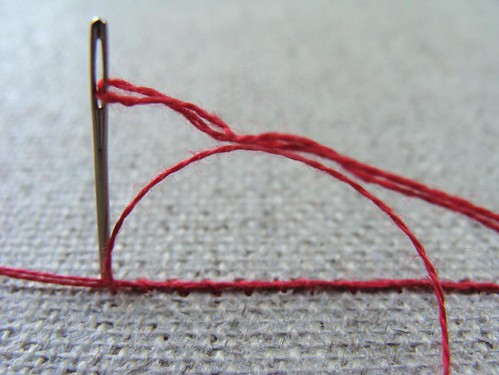
Kirsty Hall, photograph of red thread drawing in progress
Kirsty Hall: Red Thread Drawing In Progress, June 2008

It's been very interesting watching this evolve because I've been doing it freehand, so it's been at least a hundred different temporary drawings so far. It's impossible to keep things in place, the loose thread spills across the surface and moves with every stitch I make. I find it a very meditative way to work; accepting that perfect arrangements of thread will come and go each time I pick up the canvas.

I once read a quote from a writer who said that as soon as you'd written the first line, your novel was committed to a certain path but before that first sentence, anything was possible. That's not the case with this work. Certainly as I sew the loose thread into place, the number of ways the remaining thread can fall on the canvas become less and less. Yet until the last few stitches are in place, the possibility of change is still there.

I enjoy knowing that I could do a million of these and they would never be the same. I wish I'd photographed every single variation as I went along - hmm, that might make an intriguing little artists' book.

Kirsty Hall, photograph of red thread drawing in progress
Kirsty Hall: Red Thread Drawing In Progress, June 2008

We had tons of rain this week, so I didn't get as much done in the garden as I'd hoped.

Rain on dill 01
Kirsty Hall: Rain on dill, May 2008

But I managed to get more of the left hand bed planted up and it's nearing completion, although I need to go back to the gardening centre for yet more plants and some sand to dig into the annoying patch of clay.

Rain on dill 03
Kirsty Hall: Rain on dill, May 2008

I'm learning to accept that gardening - like art - is a process and there will probably never be a time when my garden is 'finished'. I certainly won't get everything done this year but that's OK; any improvement is better than none. At least that's what I keep telling myself.

Rain on coriander
Kirsty Hall: Rain on coriander, May 2008

I guess that's where my week went - lost in creativity, both indoors and out. Ah well, there are far worse ways to spend your time. I hope you all managed to carve out some creative time this week.

22 Comments

I have a problem with categories. Basically, I'm just not very good at them. I find it difficult to choose tags for blog posts. I have too many sets on my Flickr account. I have too many email folders. I struggle with organising my filing cabinet. I desperately need to go through and rationalise all these things but it doesn't come easily to me.

In terms of organisation, this is obviously A Very Bad Thing. I constantly lose things and I sometimes avoid tidying up because I simply can't decide where stuff should go. And then I end up with this sort of thing!

Messy study
Kirsty Hall: Messy Study, May 2008

[I've tidied my desk since this was taken because the photo appalled me so much. If you have problems keeping your desk clear, check out Inspired Home Office for resources that may give you the push you need. Since tidying up this disaster zone, I've been noticeably more motivated and I'm feeling more on top of things.]

I do have systems but things still stump me. I've got a box that's been sitting in my study unsorted and neglected for 6 months because it's full of the sort of random objects that I find almost impossible to categorise. The pile of papers to be sorted into my filing cabinet is so large that it's developed geographical layers and may actually have started to fossilise down at the bottom.

Since I'm so visual, I sometimes wonder if I should simply file things by colour - but I know that I'd just end up spending ages trying to decide if objects were blue or green instead because having trouble with categories is a global failure in my brain.

TIME TO LOOK ON THE BRIGHT SIDE...

However, while it's a problem in terms of organisation, being bad at categories can be a distinct advantage for an artist because you can see across boundaries to make associative leaps than non-artists often don't. Leaps of logic that make perfect sense in KirstyLand often seem innovative and original to others.

For example, this piece called Lost was made for an exhibition in a church. To make the piece, I carefully broke an unglazed bowl, then mended it with glue, leaving deliberate holes. For the exhibition, the bowl was placed on linen and filled with salt water, which gradually evaporated through the porous clay.

lost 08
Kirsty Hall: Lost, 2003

Lot's Wife was the inspiration for the piece and I combined her familiar story with the Japanese tradition of mending broken bowl with gold to make them more valuable than when they were whole. I'd read about this several years before and had been utterly captivated by the idea of regarding a mended object as beautiful and powerful instead of flawed and damaged. Somehow in my head, this linked with my sympathy for Lot's Wife, who was forced to leave not only her home but two of her adult children. In that situation, what mother wouldn't turn back to see what had happened? Isn't it interesting that she's usually held up as an example of female disobedience but if you turn it around, her story can just as easily be interpreted as being about the power of maternal love.

lost04.bmp
Kirsty Hall: Lost, 2003

As artists, we need to turn things around. We have to learn to look at our problems and disadvantages to see if they also contain power and wisdom for us. It's time to recognise that the things that make us bad at fitting into the 'real world' are sometimes the exact same things that keep us making our art.

8 Comments

I sometimes think I was dreadfully scarred by growing up in the 70's. I look at the things I make and I can see the legacy of string pictures and macramé.

3 Score & 10 vs crazy 70's macramé birdcage.

3 score & 10 01
Kirsty Hall: 3 Score & 10, Jan 2006


Random Macrame found on internet but unfortunately I've lost the link

I rest my case!

Well, what can I say? Apart from reproduction prints of paintings or images in books, string pictures and macramé were the primary examples of art that I saw as a child. My parents aren't big art people plus I had three noisy younger brothers so although I'm sure I must have seen paintings in museums, I don't remember visiting an actual art gallery until I was in my teens. By the time I was 15, I had started taking myself off to galleries at every opportunity and had broadened my art horizons a little but before then, pins and string had featured highly in my formative visual experiences.

Ha, you should think yourselves lucky that I don't feel an overwhelming urge to make all my art in shades of orange and brown!

I started a new piece on Wednesday and to my eyes it's got a distinctly 70's look, probably because it's on brown linen. It's another thread drawing but from a brand new series. I've been contemplating this particular series for a while now; it's all to do with pithy phrases, emotional tension, domesticity and lots and lots of red thread. For ages I've been collecting strange trite sayings that people use - things like "well, I suppose it could be worse" or "but apart from that, how are you". I'm fascinated by the emotional gaps in language, the way we use clichés and meaningless phrases, especially in Britain, to cover a vastness of things unsaid. For some reason, this is connected in my mind with endless images of red thread.

red drawing 02
Kirsty Hall: Red Drawing, May 2008

I had an image in my head of a red thread drawing on raw linen that I wanted to test out. I found a natural framed linen canvas that may work although I'm not entirely sure about it because it's sized with clear primer and I think it might be too glossy and stiff. For some reason, I'm a lot more comfortable sewing on framed canvases meant for painting than on loose fabric and when I was in the craft shop, I got scared by the proper linen embroidery fabric and coped out and bought a sized canvas instead. This one is my test piece to see if I can live with the sized surface or if I need to make that intellectual leap and do 'proper embroidery' on 'real fabric'.

It's odd: intellectually I know that what I'm doing is probably embroidery but I don't think of it as sewing. Instead, I always think of it as a very slow and laborious way of drawing.

With little bits of thread.

On fabric.

I mean, obviously I know it is sewing. Except that in my head, it isn't. I cannot explain this.

red drawing 01
Kirsty Hall: Red Drawing, May 2008

I don't know why I feel this way about using cloth. A couple of years ago, I started doing sewn drawings on felt and that didn't bother me so it's clearly something to do with the fabric. When I was about 7 or 8, I had a scary primary school teacher who endlessly criticising the sloppiness of my stitches and I suspect this has a lot to do with my fear of using 'real fabric' and doing 'real sewing'. I did like threading shoelaces through pictures with holes in them though (did anyone else do that, what was it supposed to teach us?) and I don't think it's a coincidence that I now pierce holes in my canvases before threading my needle through. Actually, you have to when using sized canvas because if you make a mistake, the hole doesn't close up again but I also think it takes me to a safer, happier place than the word 'embroidery' does.

8 Comments

I've been working my way through Alyson B. Stanfield's fantastic new book, I'd Rather Be In The Studio.

Instead of reading the book from cover to cover, Stanfield encourages her readers to dive in and read and then act on the chapters that relate to where they are right now. The one that immediately leaped out at me was the chapter on writing an artist's statement.

I wrote my current statement in the final year of my degree - six years ago this summer! Sure, I've tweaked it a bit since then but when I put up my website last year, I realised that it read like something an art student would write to impress a tutor. Obviously that was appropriate at the time but it isn't so helpful now. However, I needed to get the website up and I knew that I would noodle around until the end of time if given half an excuse, so I decided to let it stand and change it at a later date. That later date has finally arrived. Alyson's system for writing a statement, based around a series of helpful writing prompts, has inspired me to start writing a statement that's a bit friendlier and more accessible with much less 'art wank' (what, it's a technical term!).

I thought I'd share some of the process with you, so here's my answer to the question,
"How do you begin an artwork?"

I usually begin with an idea, often a single sentence written in the notebook that I keep by my bed. My ideas can take a long time to come to the surface and even longer for me to act on them. I'm not a quick artist - I often think about pieces for several years before I make them! A lot of working out happens in my head first and then I usually wait until I'm absolutely compelled to make a piece before I start. It often feels like a jigsaw puzzle where the pieces have to be slowly swirled around in my mind before I can start the actual making.

Next the idea enters the test piece stage, at which point it might stall because it just doesn't work. I'll noodle around with the test piece for a while, rethinking things, trying other approaches and fitting more pieces of the puzzle together until I eventually find a solution or discard the idea altogether on the basis that it was shallow, pointless or just a bit crappy.

I absolutely love the problem solving aspect of making art. My art needs to work on three different but related levels: the practical level (will it fall down?), the aesthetic level (does it look right?) and finally, the intellectual level (does it convey the right meaning?). All three things must be in balance for me to consider it a successful piece and I constantly look for elegant solutions to all three problems. I like simplicity in my art, it's good when something is 'just so'. It's important that I don't say too much or too little and I know a piece is right when the solution works precisely and completely.

.....

I don't know how much, if any, of this piece of writing will make it into the final statement but just being nudged to think about my process again has already proved inspiring and useful. I'm feeling less stuck and more connected to my art than I have for a couple of months.

José Leonilson was a Brazilian artist who died tragically young in 1993. He was only 36 when he died from AIDS, part of that generation of male artists that we lost far too soon.

His work has the sort of quiet melancholy that I always admire.


José Leonilson: 34 with Scars, 1991

I love this piece, especially the indelicate, puckered, slightly haphazard embroidery and the way the fabric is not stretched taut but instead is just hanging loosely on the wall. It's pretty obvious why I like his work, since it relates quite strongly to my own, particularly my thread drawings:

Kirsty Hall, 'Parse', red thread drawing
Kirsty Hall: Parse, 2007

There are correspondences between our respective drawings too - although this small watercolour and ink drawing is more figurative than my style, I could easily imagine it on a Diary Project envelope.


José Leonilson: Desire is a Blue Lake, 1989

I like the emptiness in this drawing, it takes a certain amount of artistic nerve to leave a lot of white space on the page.

2 Comments

I'm delighted to announce that several of my drawings are now available for sale at The Shiny Squirrel.

The drawings were inspired by The Diary Project drawings but they're done on nice paper instead of envelopes! They come mounted but not framed to keep postage costs down and so that you can choose your own frame. The drawing with the blue ovals is particularly beautiful in real life - it's my personal favourite from this set. You can't see it clearly from the photograph but the blue background of the ovals are covered in tiny circles of white ink.

OK, enough sales talk, I need to put some clothes on, dry my hair and then get on the Manley ferry to go and visit the Art Gallery Of New South Wales and the botanical gardens, which are conveniently located next door to each other.

14 Comments

Kirsty Hall - photograph of drawings in progress
Kirsty Hall: Drawings in progress, Feb 2008

Starting a drawing can be scary. Drawing on crappy paper (that's a technical term!) can be one way to overcome the fear of the blank page.

When I was first learning to draw, my dad would bring home piles of A3 computer paper from his office for me. It was the large thin folded stuff with perforations down the side. Apparently it sometimes used to spool through the printers and couldn't be re-used - at least that's what he told me!

It was great paper to draw on because there was never any fear of wasting expensive cartridge paper: it was already waste, so it didn't matter if I ruined it. I used to sit in front of the TV drawing actors, newsreaders and the like. Documentaries and interviews were the best because they featured a lot of fairly stationary head shots. For a teenager living out in the country with no access to life classes, it was a surprisingly effective way to practice portraiture and speed drawing.

Drawing the envelopes for The Diary Project was similar - if I messed up an envelope it didn't matter and I felt no guilt about tossing it in the recycling. In fact, I sometimes used to draw on the front and back of a couple of envelopes just to loosen up or to test out new techniques or materials. Now my envelopes are all finished and I want to take what I've learnt into making drawings on 'real' paper with the idea of making a series of drawings that could be sold. Yet even after a year of daily drawing, it's still surprisingly intimidating to sit down in my studio and look at those empty sheets of good paper. Maybe I just need to take a stack of envelopes upstairs to comfort myself with...

4 Comments

Welcome to the Cheat's Guide To Blogging - find an old piece of writing, edit slightly, add pictures and serve!

I was just looking up some writing from my degree course for an unrelated reason and found this piece from 1999 that I thought was worth posting

.....

Abstract art has always had a very different role than representational art. Representational art is very much tied to how well the representation works. Is it “a likeness”: by its faithful representation of nature does it somehow capture the soul of the person, animal or place depicted? We usually judge representational art on how well it convinces us of the reality of the image.

Our response to representational art is also determined by sentimental factors. Is it a portrait of someone we love or a place that is special to us? Can we sense a little piece of the person’s soul as we gaze into their unseeing eyes? Do we even like cats or eagles or horses? These things affect how a piece of representational art is perceived by the person who looks at it. Something that may seem kitsch, unappealing or simply bad to one person will be cherished by another because of whom or what it represents.

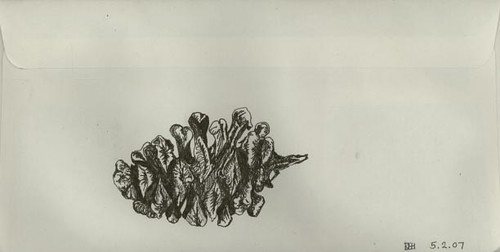
Kirsty Hall: Diary Project Envelope from 5th February 2007

Abstract art is somewhat different. There is less to hold onto. It is a Rorschach blot, a screen onto which the viewer can project their own desires and hidden thoughts. Abstract art opens up the unconscious mind, it forces people to think about what they are seeing.

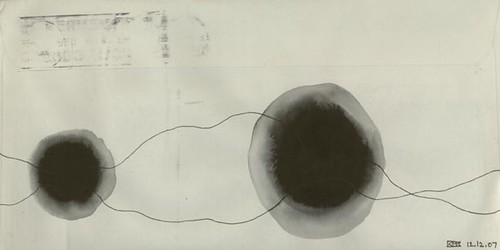
Many people resist this. After all, it is hard to know what to say when faced with something that doesn’t fall into simple categories like “dog” or “cat” or “child”. We are so deeply used to seeing in symbols and categories that images which do not fall into pre-conceived patterns can be hard to look at. Literally not knowing what we are looking at can make it hard to see at all. Yet it can also challenge our brain to new leaps into the unknown. It can open up places in our mind where poetry might begin. It can inspire us, scare us or anger us.

Kirsty Hall: Diary Project Envelope from 12th December 2007

Historically, abstract art and representational art are often pitted against each other. Personally I don’t see them as being in conflict. I think that people make art and look at art for many different reasons and I think that art needs to be broad enough to encompass many different viewpoints and many different ideas.

Many of the problems that people have with contemporary art stem from the fact that they are afraid of it. I think that people are often afraid of looking stupid if they don’t understand art.

But art shouldn’t be a test.

Hey, half the time I don’t understand art and I’ve looked at a lot of it! I’ve also read extensively on the subject and it’s my opinion that most people who write about art don’t understand how artists think and work. So don't look at those words first, just look at the piece and think about how it makes you feel. You might not know as much about art as an art historian or critic but how a piece of art makes you feel is every bit as relevant, worthy and important.

14 Comments

Unsurprisingly, there's plenty to read about goals and resolutions in the blogosphere right now.

iHanna has a good post with lots of inspiring (and occasionally daunting!) links.

Sister Diane from the Craftypod makes the very smart suggestion that you only pick one thing that you really want to do. I don't think I can quite manage that but it's something that I'm bearing in mind as I continue to very s-l-o-w-l-y refine my list of goals.

After being in a funk the other day, I did a whole load of journalling on the subject of goals and discovered that part of my problem is that I often confuse my goals and desires with the things that I feel I ought to be doing.

Pelt 02
For example, I know I should be getting on with making Pelt...

Now this hasn't been a problem in previous years, I've just stuck those 'shoulds' right on my goal list and felt damn virtuous about it too. However, in the last couple of months I've been following a conscious 'no guilt' policy. So if something makes me feel guilty then I do something to get rid of that guilt; this can include finishing things, getting rid of them or paying someone else to deal with it. The 'no guilt' policy is working well for me, except that it's apparently scuppered my usual goal setting, which was firmly based around the concept of guilt.

So often our goals and resolutions are negative - lose weight; quit smoking; get fit in the next five minutes, you lazy person; become a better friend; live life more fully; read more intellectual books; do this 'good' thing; don't do that other 'bad' thing. We often seem to start with the idea that who we are right now just isn't enough and we're flawed somehow, so the focus always seems to be on making ourselves into a 'better' person. Sometimes this can be a good thing - making positive changes in our lives can be very empowering. However, there's a big difference between making a change because we genuinely want to and punishing ourselves for not being perfect yet.

Guess what, you're never going to be perfect and neither am I!

What would it feel like if everything on your goal list was completely and unambiguously POSITIVE?

I don't know either but this year I want to give it a try.

Since I was still struggling with my very insistent 'shoulds', I did a mind map in my art journal about what I want from the year. Writing out a list of 18 things - some small, some large - that I genuinely want felt very powerful. When was the last time you let yourself think about the things that you desire? And not the things you think you 'should' want either but the things you honestly want.

Of course, I'm also very task orientated and I love to set myself very defined projects and tick things off lists. So writing things like 'spend more time in the library with the lights off and the candles on' seemed a little silly at first. How do I quantify that? How can I make that into a proper achievable goal with a definite target? Hmmm, should I start a database to count the days when I manage to sit down and properly relax? Ha, you probably think I'm joking... but many a true word was spoken in jest, says the girl who keeps a database of all the books she reads each year!

My mind map of desires isn't a goal list yet - the other thing I discovered whilst journalling was that the goals I did best in reaching last year were the ones that were very specific and had quantifiable targets (yay, there is a need for those databases!) - but it is a start in a new, and slightly scary, direction for me.