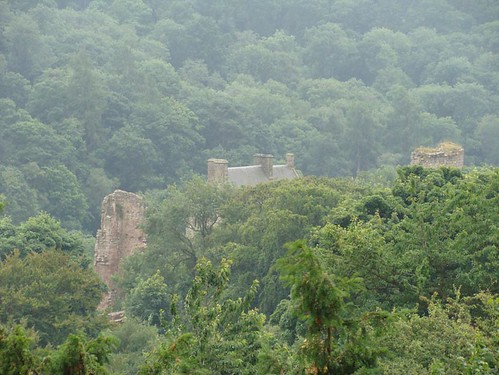
Last week was awash with celebrations - a birthday, an anniversary, a day out, a tie-dye party and BBQ and a good friend staying for the weekend. Between all that and the inevitable exhaustion, I had no time or energy for blogging but I've been itching to tell you about the day out.
Last Tuesday, for my partner's birthday, we visited the gorgeous Virtuous Well over in Trellech.
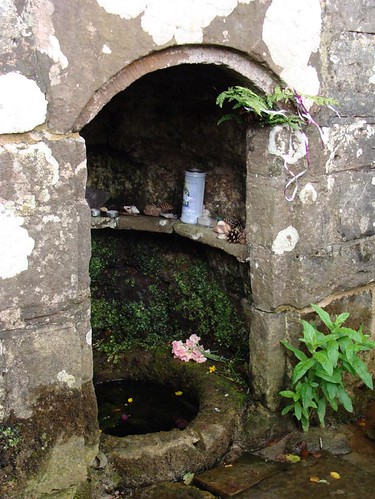
Kirsty Hall: The Virtuous Well, August 2008
Once one of the major towns in medieval Wales, Trellech is now a small but archaelogically fascinating village about a 45 minute drive from us. We'd discovered the well quite by accident the previous week after a visit to Tintern Abbey and we decided to go back with a picnic because we'd fallen in love with the place and we wanted to find the standing stones that had eluded us the week before.
The Virtuous Well or St Anne's Well is a Christianised well almost certainly built over a Celtic sacred spring. It's a lovely place; it's in a field just off a country road but it feels about a million miles from anywhere. You can walk down into the well and sit on little stone seats while you soak up the atmosphere. There are little alcoves where you can leave offerings - on the first visit I picked buttercups from the field, this time we brought sweet peas from our garden.
The water contains iron, which may be responsible for its reputed medicinal qualities. The water was thought to be especially good for 'complaints particular to women', which would make sense if the woman in question was anaemic from endless pregnancies and breastfeeding.
Above the well, people have festooned a tree with fabric offerings.
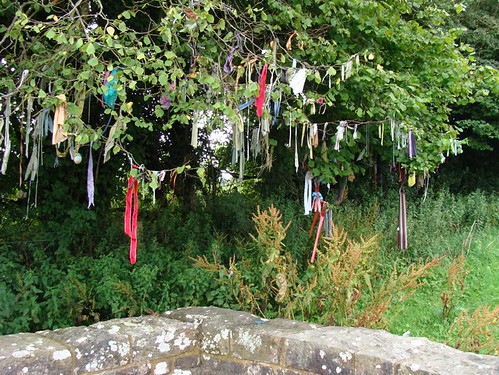
Kirsty Hall: Offerings at The Virtuous Well, August 2008
This is a very old British custom: tying pieces of cloth called clooties or clouties onto trees beside sacred wells is believed to have Celtic origins.
Originally people would leave pieces of clothing that had been soaked in the well water in the belief that their ailment would pass from them as the cloth rotted. These days, a more eclectic variety of (mostly) fabric offerings are left. I noted a plethora of ribbons and strips of torn cloth interspersed with more unusual items including scarves; a pair of underpants; socks; a martial arts belt; a ceramic medallion; hollow blown eggs; a hand-crocheted flower; numerous hair decorations; strings of beads; shoelaces; knotted plastic bags; the remnants of a balloon; bright yellow fruit netting; a Tibetan prayer flag and even a cuddly toy. They were all knotted and tied together in what I felt was a genuine outpouring of decorative and sacred expression.
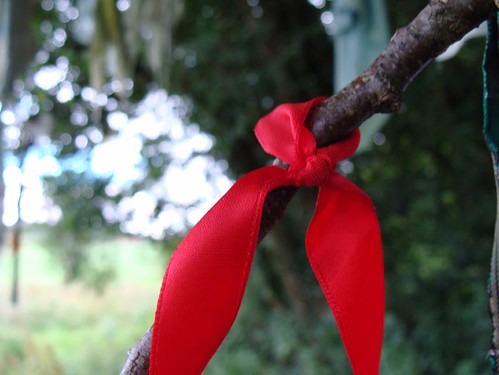
Kirsty Hall: Offerings at The Virtuous Well, August 2008
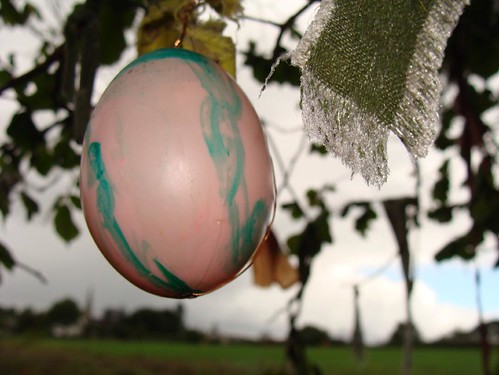
Kirsty Hall: Offerings at The Virtuous Well, August 2008
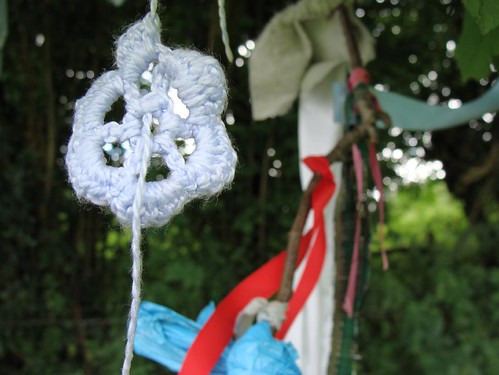
Kirsty Hall: Offerings at The Virtuous Well, August 2008
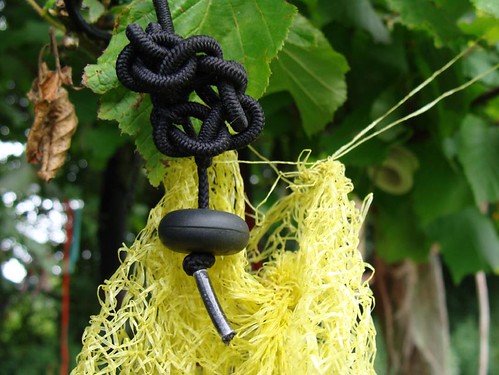
Kirsty Hall: Offerings at The Virtuous Well, August 2008
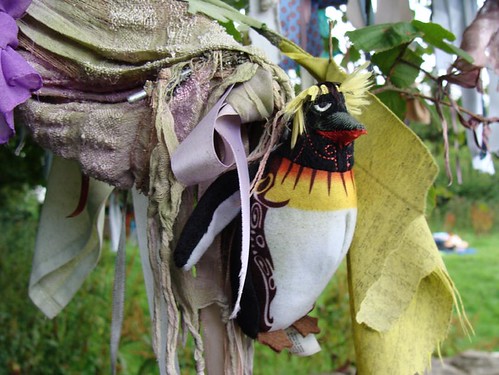
Kirsty Hall: Offerings at The Virtuous Well, August 2008
I read one review of the well that decried the modern cloutie rags because some of the fabric is man-made. But I loved them all. There's a raw honesty to this sort of spontaneous folk installation that I find very appealing.
While it might be better if people thought ahead and brought biodegradable offerings, I love that people aren't constrained by what might be thought as proper but instead offer the item that they are moved to leave. While many of the offerings have obviously been deliberately chosen, I suspect that many people find the well by accident and leave what they have on them in an instinctive response to the existing offerings. It certainly explains the hair ties and beads.
And really, who cares if it isn't 'authentic'? It's far more important to me that this place is still in ceremonial use. And who gets to define authenticity anyway? Perhaps the person leaving a sock was genuinely trying to heal their foot? Perhaps the grimy, slowly rotting underpants were originally part of a fertility ritual! There was no graffiti on or near the well and there was no rubbish lying around. Everything that had been left had been done so neatly, carefully and reverently. Sure, some of the offerings could be seen as irreverent but the way they were placed suggested that they weren't. Surely authenticity isn't something that's set in stone but is, instead, a reflection of what people actually do.
Should I have gone and removed all the artificial objects from the tree in a futile longing for some sort of sacred or environmental purity? I don't have that right. And I simply don't want to. If folk customs such as leaving rags at wells are not to fade into obscurity then I think we need to accept that they will change and that some people will leave cotton Tibetan prayer flags while others will leave neatly tied plastic bags. And taking the long view, perhaps one day future archaeologists will unearth 'inauthentic' plastic beads and fragments of polyester ribbon that have fallen from the tree and been buried in the earth and they will know that this was once a sacred well. For all its wonderful qualities, cloth made from natural fibres is in pretty short supply in archaeology, especially in somewhere as damp as Britain.
The well, in all its splendidly inauthentic authenticity, is a very special place and one we plan to return to regularly. On our first visit - when we couldn't find the very large, extremely phallic and quite hard to miss Harold's Stones - it really felt as though we were meant to find the well instead. If we'd visited the stones as we'd planned, we wouldn't have had time to visit the well and might never have returned to discover this little gem.
Oh, and one last funny thing - when I was checking on Flickr to see if there were any other photos of the well, the first image to appear on my screen happened to be this photograph of my friend Ally, taken by another friend, Camilla. Having found the well by sheer coincidence in the first place, I laughed and laughed...