4 Comments

Ah, the grottoes...

Dewstow Grottoes 01
Kirsty Hall: Dewstow Grottoes, Aug 2009

We found these utterly magical. We were constantly seduced by the cool shade; the sudden dancing shafts of sunlight from skylights; the incredible jungle greens of the ferns and mosses and the constant soothing sound of water.

Dewstow Grottoes 03
Kirsty Hall: Dewstow Grottoes, Aug 2009

There are several different grottoes at Dewstow, all connected with tunnels. Some are shady and cave-like...

Dewstow Grottoes 02
Kirsty Hall: Dewstow Grottoes, Aug 2009

...while others are far more open and tropical in feel.

Dewstow Grottoes 05
Kirsty Hall: Dewstow Grottoes, Aug 2009

And having fallen in love with this Victorian madness, I immediately decided that we should have a grotto at home! Just, you know, a small one...

Dewstow Grottoes 04
Kirsty Hall: Dewstow Grottoes, Aug 2009

But even if I don't manage to acquire a grotto of my own, I can certainly take inspiration from Dewstow and plant more ferns.

Dewstow Ferns 01

Dewstow Ferns 02

10 Comments

Last week we took a 3 day trip to Wales to celebrate my partner's birthday.

A definite highlight of the trip was our visit to Dewstow Gardens on the Tuesday afternoon.

Dewstow Gardens 02
Kirsty Hall: Dewstow Gardens, Aug 2009

Dewstow Gardens 03
Kirsty Hall: Dewstow Gardens, Aug 2009

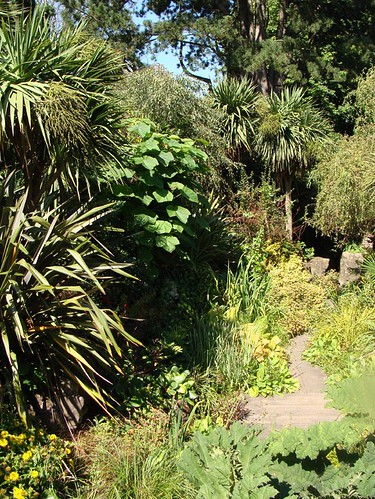
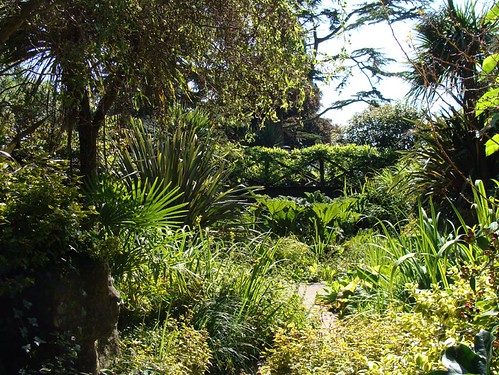
The gardens are notable for their amazing restored Victorian grottoes and tunnels. I got so many good photos of the gardens that I'm going to split them into several posts: the grottoes are so delicious that they deserve a whole post all to themselves.

Dewstow Gardens 01
Kirsty Hall: Dewstow Gardens, Aug 2009

Dewstow Gardens 04
Kirsty Hall: Dewstow Gardens, Aug 2009

As a gardener, I thought the fern areas, the lush tropical planting and the wonderful use of water were far more successful than the more traditional border areas but that's a small quibble, it's still an absolutely gorgeous garden that's well worth a visit if you're in the area.

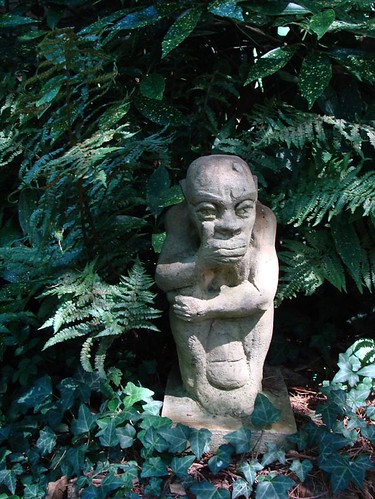
I'll post the grotto pictures tomorrow. In the meantime, I'll leave you with this little chap...

Dewstow Gargoyle
Kirsty Hall: Dewstow Gargoyle, Aug 2009

44 Comments

The excellent book, Advice To Young Artists In A Postmodern Era by William V. Dunning is one that I think every artist should own. At one point, Dunning talks about the value of immersing oneself in art. This is what I'm doing at the moment. With the exception of a little bit of knitting and gardening to keep me grounded, I've spent the last few days immersing myself in thinking, reading, viewing and writing about contemporary art.

And I've come to a conclusion.

The denizens of the contemporary art world desperately need to drop what I refer to as 'art wank'.

Enough already. Enough dull academic shows that no one but a tiny elite care about. Enough 'clever' critical writing that says nothing. Enough postering. Enough big words. Enough drowning art in philosophy. Enough bullshit.

I know that art is often hard to write about - I'm currently trying to bash my artists' statement into shape and it's resisting furiously! - but the way most critics talk about art is just ridiculous.

I am tired of it. I am tired of feeling like an idiot when I try to plough my way through it. I've been making, looking at and reading about art for years. I studied it intensively in college and wrote essays on it. I still read about art constantly.

So if I can't understand what most art writers are on about, what chance does someone whose art education ended in high school have? On Friday I read an 'explanatory' pamphlet at the Arnolfini gallery that managed to make an already boring show even more dry, academic and obscure. I left the gallery wondering what the point of my visit had been. If I'd been visiting a contemporary gallery for the first time, I certainly would have felt no desire to go back. After this sort of experience it's easy to see why people think that modern art is rubbish.

In my 30's, I returned to art college after a break of about six years spent raising my son. It was my third shot at getting my degree. Having been thrown out of an English course at the age of 18 and then having left a Fine Art degree when I accidentally got pregnant at the end of my first year, I was understandably quite nervous about my ability to do the work.

I vividly remember being set a reading list that included the art historian, Rosalind Krauss. All summer I struggled valiantly with it, trying to comprehend her points and getting more and more disheartened. Her words seemed to have nothing at all to do with my own experience of being an artist and the concerns and ideas that were floating around my head when I was making sculpture. I ended up wondering how I was going to cope at art college? If I couldn't understand this set text, surely I was FAR too stupid to go.

On the first day, we sat in a large circle and the tutors asked us how we'd got on with the reading list. Someone confessed to finding Krauss impenetrable. 'Ah yes,' said the Head of Sculpture, "she is very difficult, isn't she. I don't really understand her myself, to be honest." The entire group let out an audible sigh of relief and I sat there thinking, "well if YOU don't even understand it, why the hell did you assign it?"

I never had to refer to Krauss again and at the end of my degree, I took great joy in turfing the damn woman off my bookshelves.

Don't get me wrong. I'm not saying, 'don't read'. I love to read and always have. I especially love non-fiction and I read widely and voraciously both inside and outside my field. A lot of my ideas come from my reading. What I'm saying is, when we write about art, can we try to sound as if it matters, as if it's alive, vibrant and important and as if the writer is actually interested in what they're discussing.

I do understand that art historians and those who analyse art, experience it in a very different way to those who actually make it. And I also know that every artist needs to find a way to talk about their work. Many artists look at it as a necessary evil but I've always found it both helpful and vital to define my practice in the right words.

What I don't think is helpful and vital is when the convoluted language of the historians, critics and philosophers infects the language of artists. I don't think we're doing our work any favours if we cloak it in fancy buzz words and arcane concepts. I know that every profession has its jargon and I know that some concepts are very difficult to explain but the art world needs to stop pretending to be smarter than it is because really, I don't think we're fooling anyone!

Still, on the plus side, 'art wank' is an excellent cure for insomnia...

4 Comments

I've been doing some housekeeping on the blog this week. My lovely web designer, Steve, taught me how to play with widgets. If you cast your eyes over to the right you'll see that I've been shuffling things around on the sidebar. I've added an interviews section and some copyright information and there may be a few more additions and changes to come. I've now moved on to exploring plugins. If anyone else is using WordPress, I'd love to hear which plugins you find effective on your site.

Oh, and I've been sorting out the comments too.

Confession time: I had unanswered comments from November of last year. Oh, the embarrassment!

I've been replying to the most recent comments but I've decided not to reply to most of the older ones. Sorry about that. I do love that people take the time to comment here and I promise that I read and appreciate every single one; I'm just really, really bad at replying to them. If it's any consolation, I'm a bit rubbish with email too. Wait, that's no consolation at all, is it!

One change we've made that should hopefully speed up the way I answer comments is by adding a button at the end of your comment that lets you decide if you want to see follow ups. This means I'll just be able to reply on the website instead of having to copy and paste my replies into email, which is what I have been doing. I know it sounds like a very small change but I've learnt that I am easily defeated by very small things, especially when it comes to admin.

I'm currently working on this issue. I plan to start blocking in some time every week to reply to comments and I'm experimenting with ways to make email less overwhelming, including unsubscribing to things and improving my email folders. I also want to get into the habit of only checking my email if I'm mentally prepared to answer at least some of the stuff that comes in.

.......................................

I don't know about anyone else but I find the amount of information in modern life very overwhelming. It seems like we're all constantly running to catch up, doesn't it...

Here's a few good articles about the overwhelm problem:

A good general overview of what overwhelm is and how to tackle it.

An excellent article from Christine Kane, whose blog I recently discovered through Twitter.

6 tips for organizing your email - short and to the point.

10 Tips for Organizing Your Email - some very useful information on the different ways people organise themselves. Are you a searcher or a filer?

19 Comments

So, I reckon it's time to show you what I've been working on for the last couple of months. I'd have blogged about this sooner but it's an absolute pain to photograph and I had to do four or five different photo shoots before I got anything I could bear to publish.

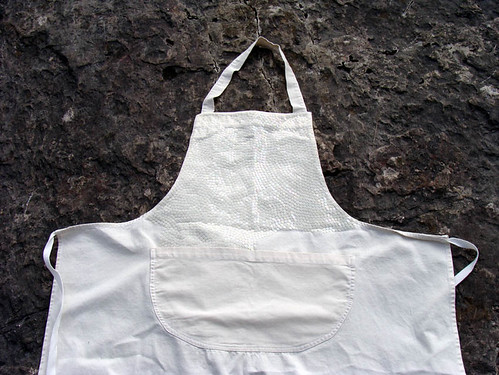
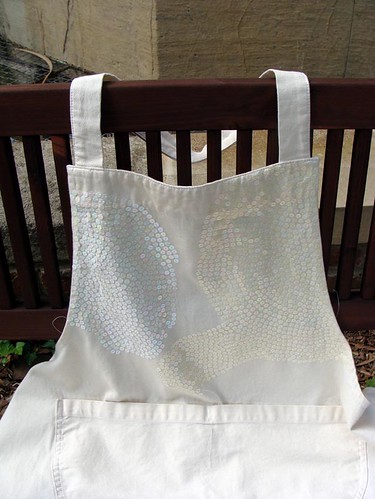
Meet my sequin apron!

Sequin Apron 07
Kirsty Hall, Sequin Apron, July 2009

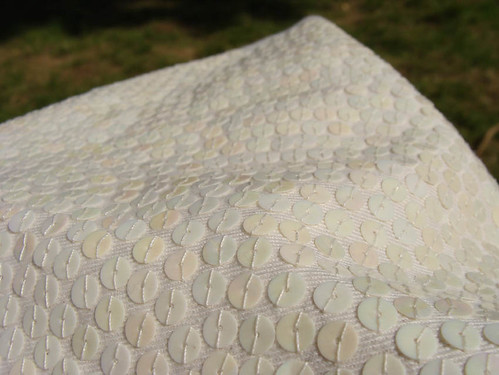
Yep, in my infinite wisdom, I am covering the whole of this apron in sequins.

It's part of a triptych of apron pieces about motherhood. I've had the three aprons for several years but it took me a while to decide exactly what to do with them. This one represents the 'yummy mummy' aspect of motherhood; all the good, precious and wonderful parts. The other two aprons will be much more conflicted and darker in tone.

Sequin Apron 09
Kirsty Hall, Sequin Apron, June 2009

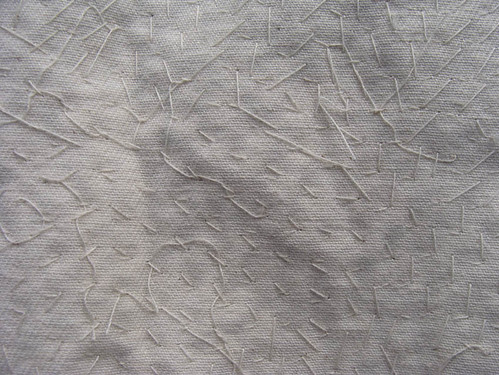
The back of the apron: I'm being very good and sewing in all my ends as I go along.

Sequin Apron 06
Kirsty Hall, Sequin Apron, July 2009

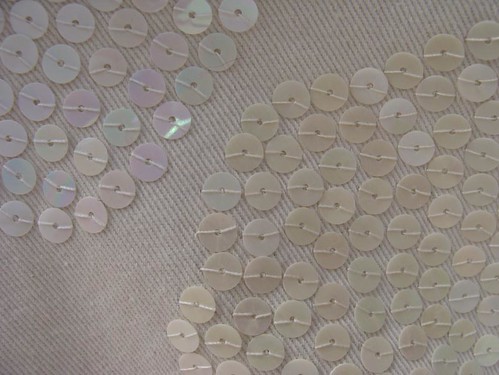
This piece had a bit of a rocky start. In February I bought samples of different kinds in creams, white and translucent sequins and after some thought, I decided on the ones on the left.

Sequin Apron 01
Kirsty Hall, Sequin Apron, June 2009

Unfortunately, when I'd used up the small test amount I'd bought, I discovered to my horror that the shop where I'd bought them had replaced them with a very similar but slightly brighter version that Just Didn't Work. I then spent about two months trying to find the correct ones before finding the cream ones on the right and deciding to completely start over with them. As you can probably imagine, I bought lots of this replacement colour choice!

Sequin Apron 02
Kirsty Hall, Sequin Apron, June 2009

It was annoying at the time - especially since I had to unpick that large section on the left - but I think the cream ones are a better fit for the piece. They're a closer match to the colour of the apron whilst still being iridescent from certain angles, which is what I'd originally been aiming for. I wanted a subtle hint of bling but nothing too over the top.

Sequin Apron 08
Kirsty Hall, Sequin Apron, July 2009

Now that I've got over that bump, the apron is coming on well although it's a slow piece to make. I've been working on it for at least an hour most days for the last six weeks but I'm expecting it to take me at least another two months. A couple of days ago, I was feeling very pleased with myself for filling in an area of about 6 square inches over a period of three hours. Then I hung it up, held it out and realised just how much there was still to go and I just started laughing hysterically at how utterly mad I am.

7 Comments

You know that internet joke that goes:
1. Set up online business
2. ???
3. Profit!

Um yeah, that kind of IS my business plan!

I mean, it's slightly more sophisticated than that. It actually goes:
1. Make lots of work
2. Show work online and in exhibitions
3. Build up reputation
4. ???
5. Make lots of money, er well, some money anyway

Seven years after graduating, I have come to the conclusion that it's not the world's most efficient business plan. Steps 1 to 3 are coming along nicely but unsurprisingly, steps 4 and 5 continue to elude me.

I have been struggling a lot with the money thing lately, most particularly with how it relates to my art. Recently I came to the conclusion that I'm just not comfortable with money.

Don't get me wrong, I have no problem spending it - although actually I'm usually pretty sensible with that side of things. My problem is more with the concept of getting paid for what I do.

I think on some level my image of myself just doesn't include the idea, 'earns lots of money'. Certainly I'm much more mentally comfortable in the voluntary/low income sector. I have no idea why this is. Some misplaced notion of bohemianism, perhaps? Some basic insecurity or lack of self belief? I suspect both these things come into play but looking back, I can see that I've never been motivated by money. I don't care about status symbols like fancy cars and designer clothes and as long as I have enough money to get by, I'm perfectly content.

My motivation has always been internal rather than external. I had a hard time when I was at school because I hated what I saw as all the 'jumping through hoops'. I've become somewhat better at that over the years but I'm still the sort of person who will work my fingers to the bone if I'm interested in something but if I'm not interested then it's like pulling teeth, no matter how much money you offer me.

Naturally I understand that everyone has to do things that they dislike and I'm not so spoilt that I'll refuse to do boring things. I've done my share of mind-numbing paid jobs in the past and if my health was better, I probably still would be. There are also plenty of art tasks that don't fill me with joy: I dislike documenting my work, writing exhibition proposals and doing graphics for posters but I crack on and do them because they are part of being an artist. However, I'm doing these things because getting my work out there matters to me; again it's self motivation rather than the external motivation of money. I don't want to get the work out there to make money, I want to get the work out there so that the work is out there. I find this makes quite a fundamental difference when it comes to the 'getting paid' part of the equation.

One of the most obvious ways that my conflicted relationship with money manifests is the difficulty I have with the idea of selling my art. I have wavered back and forth on this for years. There are some real practical issues - most of what I make doesn't lend itself easily to selling. For example, because of the length of time my work takes, most of it would not be economically viable unless I charged astronomical prices.

However, I've noticed that I'm also extraordinarily resistant to the thought of selling my drawings, even though they're a much easier and more realistic prospect. Oh sure, I have a ton of excuses for that one - "they're not good enough", "I don't know how to sell", "I just don't feel ready" and "I don't like putting a value on things that I make" - but I can see that it all comes down to my fundamental unease with money.

Another example: before today, it had never once occurred to me that my photographs might have a market. Because I don't think of them as 'art', attempting to sell them had never even crossed my mind. And now that I have thought about it, I want to run away really fast! I am formulating new excuses in my head already. It's abundantly clear that the true problem is not with the kind of work I make; it's with the very idea of selling.

It often feels as though money is a strange language that I don't speak. In fact, it's as though my brain is wired in such a way that it doesn't even recognise that it IS a language. I think I have 'earning money blindness', in the same way as I have 'pass blindness' - you could be showing very obvious interest in buying my work and I simply wouldn't notice. Yes, this has actually happened to me - the person in question had to spell it out to me and when she did, I was completely floored and didn't know what to do.

You see the problem - I truly suck at this stuff. Plus I clearly have ISSUES.

Expect more posts on this subject, as I work my way through this money thing. Yes, internet, you are my therapy. Aren't you lucky!

10 Comments

    'I don’t know what you're thinking of doing,' said Pippi, 'but as for me, I'm not one who can take things easy. I happen to be a turnupstuffer, so of course I never have a free moment.'
    'What did you say you were?' asked Annika.
    'A turnupstuffer.'
    'What's that?' asked Tommy.
    'Somebody who finds the stuff that turns up if only you look, of course. What else would it be?' said Pippi...'The whole world is filled with things that are just waiting for someone to come along and find them, and that's just what a turnupstuffer does.'
    Pippi Longstocking by Astrid Lindgren, translation by Edna Hurup

Isn't that just the perfect description of what an artist does - I knew there was a reason that Pippi was one of my childhood heroines.

    'What sort of things?' asked Annika.
    'Oh all sorts,' said Pippi. 'Gold nuggets and ostrich feathers and dead mice and rubber bands and tiny little grouse and that kind of thing.'

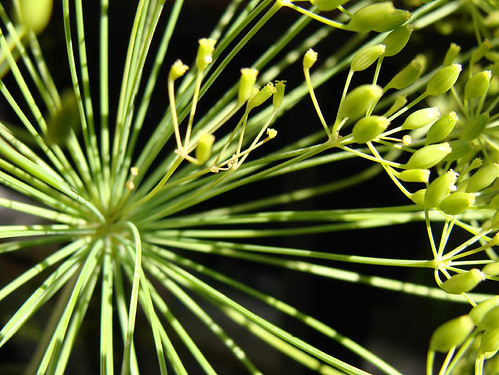
Yesterday, I turned up these images of my dill plant.

Dill 02
Kirsty Hall: Dill, July 2009

Dill 03
Kirsty Hall: Dill, July 2009

Dill 04
Kirsty Hall: Dill, July 2009

Today I turned up: several hours of art time, some thoughts that turned into art journal pages, my original Puffin copy of Pippi Longstocking, the first hint of ripening on one of my tomatoes and a quite unseemly amount of chocolate. No tiny little grouse though.

What small wonders have you turned up today?

4 Comments

I was reading this post about titles over at The Painter's Keys.

Here's the original question:

"What are your thoughts on changing the names of artwork to fit a venue, exhibit, or buyer? For example, is it okay to modify my often generic titles to more specific places, particularly when sending things off to shows? Is this wrong or deceitful? And, if changed, should new titles stay that way?"

In my opinion, if you need to change the title, then you just didn't get it right in the first place!

Of course, this doesn't apply to 'working titles', which are merely placeholders until you have a proper title but I think that there is a point at which the title is set in stone. For a book, this is when it goes to the printers or when the advance publicity goes out. For a work of art, it's usually when the work is exhibited.

There are exceptions, of course. If you're constantly remaking a piece in different places, then altering the title for each remake can be an appropriate way to differentiate them. Antony Gormley does this with his well known piece, The Field but they all still contain the word 'field' in the title. Repeatedly changing a title could conceivably also be an important conceptual part of a work - for example, if your actual subject matter is the way that perceptions of the art change depending on how the work is 'framed' by the title. But I see a big difference between both these examples and changing the title just to suit other people or to try and score a sale.

I know that titles aren't important to all artists but for me, they're a vital part of the work. I don't consider a piece properly finished until it has a title and I think about them a lot. I keep lists of possible words or phrases in my sketchbooks and often find scraps of paper scattered randomly around the house with prospective titles written on them.

The only time I've ever changed a title is when the title I've given it didn't 'stick' for some reason.

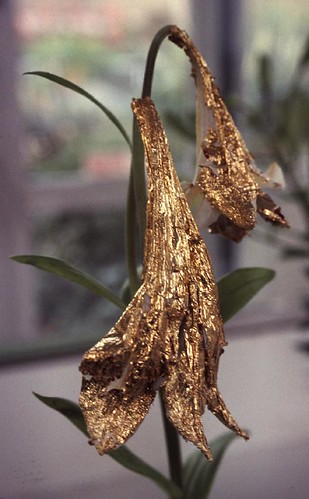
For example, this piece was originally called Do More With Less. The whole piece was my sarcastic riposte to my college tutor telling me to 'do more with less' - because naturally, when accused of 'gilding the lily' my response was to do exactly that!

gilded lily 01
Kirsty Hall: Gilded Lilies, 2001

But the original title was clunky and I could never remember exactly how it went, so it was discarded in favour of the more prosaic Gilded Lilies. And in retrospect, I can see that the more fanciful title was, er... gilding the lily.

gilded lily 02
Kirsty Hall: Gilded Lilies, 2001

I've also accidentally named things twice when I've forgotten that I'd already titled a work. When this happens, it's obvious to me that the original title wasn't quite right or I would have remembered it. When I name my work, I'm trying to find a title that so precisely and elegantly captures the essence of the piece that a name change would be utterly inconceivable.

I try never to change a name once the piece has been formally exhibited (although I couldn't swear that this has never happened). Changing a title in order to make the work more palatable (something I've been asked to do only once) or simply in order to try and sell the work, makes me very uncomfortable. Certainly, I think that changing titles multiple times simply in order to suit the audience, venue or exhibition is confusing and dubious: the work needs to have integrity.

So what do you think? Is titling important to you? Would you re-title a work in order to sell it?

6 Comments

I was VERY flattered to make it into the 'Best Artists Blog' section of the 100 Best Scholarly Art Blogs list this week.

Congrats to Katherine from Making A Mark, who also made it into the Best Artists Blog section and to Dion from the Art News Blog, who very deservedly made it into the Art News section. I was also pleased to see the New Curator blog mentioned - I only discovered this blog fairly recently through Twitter but it's rapidly becoming a favourite.

I haven't checked out all the other blogs mentioned yet but it looks like there's plenty of good stuff to get your teeth into.

5 Comments

Britain is in the midst of a heatwave (well, what we call a heatwave) and it's too hot to write properly. So instead here's a quick look at the work of Liza Lou, whose obsessive work with beads naturally appeals to me.

Liza Lou first came to prominence with her beaded kitchen - a work that took her five years to make and involved her covering an entire kitchen in beads.

lizalou_sink
Liza Lou: Beaded Kitchen (Sink Detail)

Her more recent work has taken a more overtly political turn with beaded wire fences and prison cells that are partly inspired by her move to South Africa, where she now works with skilled local artisans to produce her sculptures. I find it intriguing that she's scaled up her production in this way. Originally she did all her beading herself but she was finding it impossible to continue working that way after developing acute tendinitis in her hands.

684.x600.art.lou.Install11
Liza Lou: Security Fence

artwork_images_424046260_199279_liza-lou
Liza Lou: Security Fence

liza-lou-security-fence
Liza Lou: Security Fence

Make sure you check out this interview with her - I love what she has to say about artists using their powers for good. The rest of that online textile magazine, HandEye, is well worth a look.

And here's another article that explores the deeper motivations for her work.