22 Comments

Last week was awash with celebrations - a birthday, an anniversary, a day out, a tie-dye party and BBQ and a good friend staying for the weekend. Between all that and the inevitable exhaustion, I had no time or energy for blogging but I've been itching to tell you about the day out.

Last Tuesday, for my partner's birthday, we visited the gorgeous Virtuous Well over in Trellech.
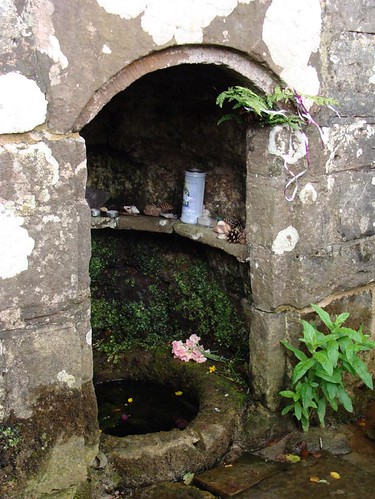
Kirsty Hall, photograph of The Virtuous Well, Trellech
Kirsty Hall: The Virtuous Well, August 2008

Once one of the major towns in medieval Wales, Trellech is now a small but archaelogically fascinating village about a 45 minute drive from us. We'd discovered the well quite by accident the previous week after a visit to Tintern Abbey and we decided to go back with a picnic because we'd fallen in love with the place and we wanted to find the standing stones that had eluded us the week before.

The Virtuous Well or St Anne's Well is a Christianised well almost certainly built over a Celtic sacred spring. It's a lovely place; it's in a field just off a country road but it feels about a million miles from anywhere. You can walk down into the well and sit on little stone seats while you soak up the atmosphere. There are little alcoves where you can leave offerings - on the first visit I picked buttercups from the field, this time we brought sweet peas from our garden.

The water contains iron, which may be responsible for its reputed medicinal qualities. The water was thought to be especially good for 'complaints particular to women', which would make sense if the woman in question was anaemic from endless pregnancies and breastfeeding.

Above the well, people have festooned a tree with fabric offerings.
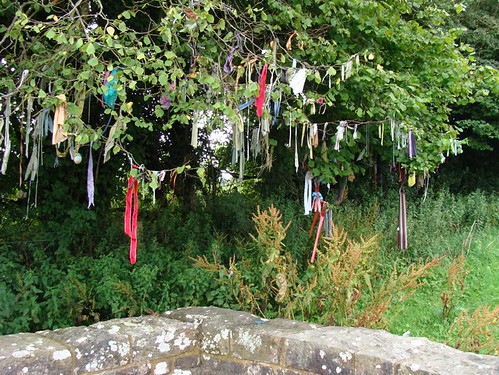
Kirsty Hall, photograph of fabric offerings at The Virtuous Well, Trellech
Kirsty Hall: Offerings at The Virtuous Well, August 2008

This is a very old British custom: tying pieces of cloth called clooties or clouties onto trees beside sacred wells is believed to have Celtic origins.

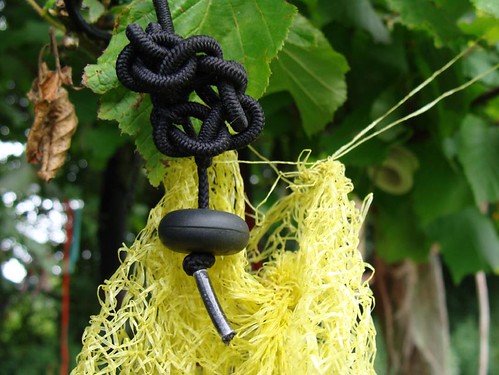
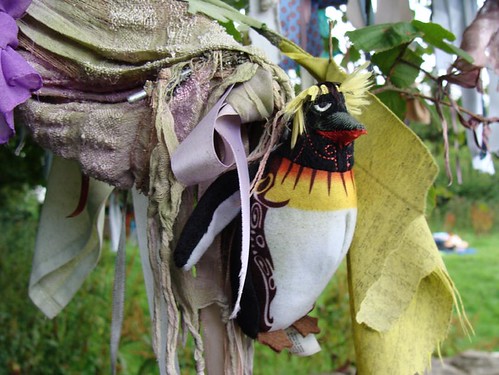
Originally people would leave pieces of clothing that had been soaked in the well water in the belief that their ailment would pass from them as the cloth rotted. These days, a more eclectic variety of (mostly) fabric offerings are left. I noted a plethora of ribbons and strips of torn cloth interspersed with more unusual items including scarves; a pair of underpants; socks; a martial arts belt; a ceramic medallion; hollow blown eggs; a hand-crocheted flower; numerous hair decorations; strings of beads; shoelaces; knotted plastic bags; the remnants of a balloon; bright yellow fruit netting; a Tibetan prayer flag and even a cuddly toy. They were all knotted and tied together in what I felt was a genuine outpouring of decorative and sacred expression.
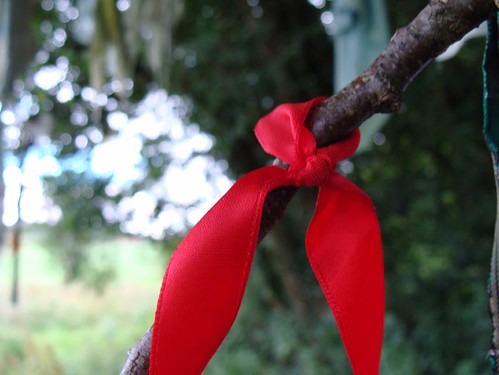
Kirsty Hall, photograph of fabric offerings at The Virtuous Well, Trellech
Kirsty Hall: Offerings at The Virtuous Well, August 2008
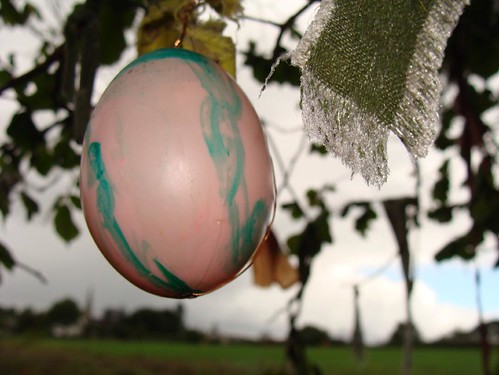
Kirsty Hall, photograph of fabric offerings at The Virtuous Well, Trellech
Kirsty Hall: Offerings at The Virtuous Well, August 2008
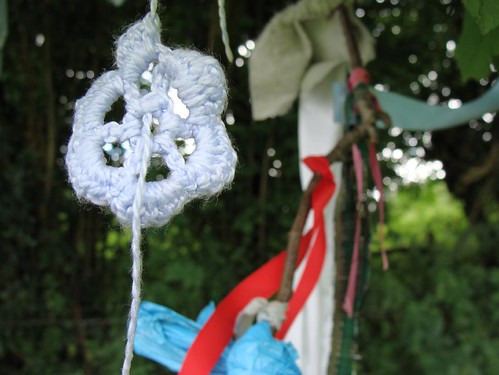
Kirsty Hall, photograph of fabric offerings at The Virtuous Well, Trellech
Kirsty Hall: Offerings at The Virtuous Well, August 2008
Kirsty Hall, photograph of fabric offerings at The Virtuous Well, Trellech
Kirsty Hall: Offerings at The Virtuous Well, August 2008
Kirsty Hall, photograph of fabric offerings at The Virtuous Well, Trellech
Kirsty Hall: Offerings at The Virtuous Well, August 2008

I read one review of the well that decried the modern cloutie rags because some of the fabric is man-made. But I loved them all. There's a raw honesty to this sort of spontaneous folk installation that I find very appealing.

While it might be better if people thought ahead and brought biodegradable offerings, I love that people aren't constrained by what might be thought as proper but instead offer the item that they are moved to leave. While many of the offerings have obviously been deliberately chosen, I suspect that many people find the well by accident and leave what they have on them in an instinctive response to the existing offerings. It certainly explains the hair ties and beads.

And really, who cares if it isn't 'authentic'? It's far more important to me that this place is still in ceremonial use. And who gets to define authenticity anyway? Perhaps the person leaving a sock was genuinely trying to heal their foot? Perhaps the grimy, slowly rotting underpants were originally part of a fertility ritual! There was no graffiti on or near the well and there was no rubbish lying around. Everything that had been left had been done so neatly, carefully and reverently. Sure, some of the offerings could be seen as irreverent but the way they were placed suggested that they weren't. Surely authenticity isn't something that's set in stone but is, instead, a reflection of what people actually do.

Should I have gone and removed all the artificial objects from the tree in a futile longing for some sort of sacred or environmental purity? I don't have that right. And I simply don't want to. If folk customs such as leaving rags at wells are not to fade into obscurity then I think we need to accept that they will change and that some people will leave cotton Tibetan prayer flags while others will leave neatly tied plastic bags. And taking the long view, perhaps one day future archaeologists will unearth 'inauthentic' plastic beads and fragments of polyester ribbon that have fallen from the tree and been buried in the earth and they will know that this was once a sacred well. For all its wonderful qualities, cloth made from natural fibres is in pretty short supply in archaeology, especially in somewhere as damp as Britain.

The well, in all its splendidly inauthentic authenticity, is a very special place and one we plan to return to regularly. On our first visit - when we couldn't find the very large, extremely phallic and quite hard to miss Harold's Stones - it really felt as though we were meant to find the well instead. If we'd visited the stones as we'd planned, we wouldn't have had time to visit the well and might never have returned to discover this little gem.

Oh, and one last funny thing - when I was checking on Flickr to see if there were any other photos of the well, the first image to appear on my screen happened to be this photograph of my friend Ally, taken by another friend, Camilla. Having found the well by sheer coincidence in the first place, I laughed and laughed...
5 Comments

I had so many lovely shots from Rosslyn Chapel that I felt the need to do another post about it.

ON THE GROUND

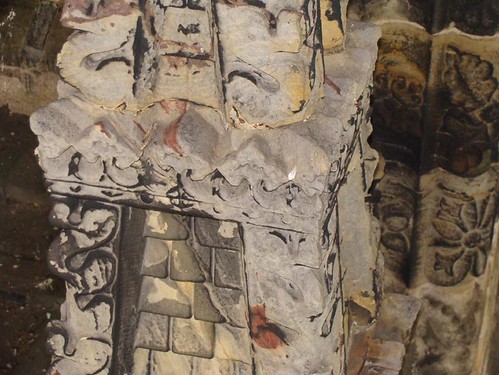
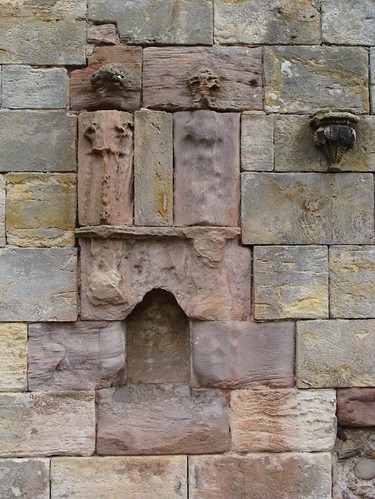
I like this shot because it clearly shows the three different colours of sandstone - grey, pink and yellow - that Rosslyn Chapel is made from. This piebald effect occurred because the stone used to build the church came from three different local quarries.

Rosslyn Chapel
Kirsty Hall: Rosslyn Chapel, July 2008

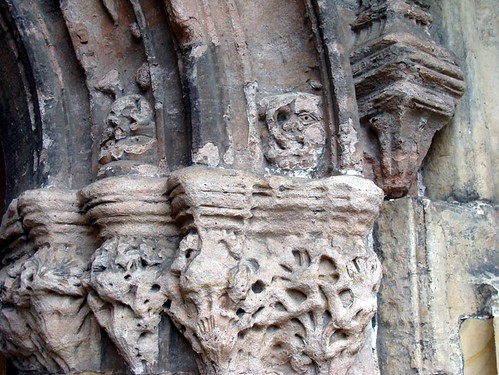
One of Rosslyn's famous 'Green Man' carvings nestling in the archway above some eroded greenery. The Green Man is a traditional symbol thought to represent fertility, so it's a bit of a mystery why so many of them ended up being carved into medieval Christian churches - Rosslyn has more than a hundred of them.

Rosslyn Chapel
Kirsty Hall: Rosslyn Chapel, July 2008

It's impossible to tell if this carving was originally a monkey or a human figure that has slipped down the evolutionary tree in the rain!

Rosslyn Chapel
Kirsty Hall: Rosslyn Chapel, July 2008

FROM THE ROOF

As far as I could tell, each spire on the roof was slightly different. Imagine the artistic passion involved in designing so many different spires even though they'd hardly ever be seen up close.

Of course, at the moment visitors can climb up and see them but the original builders wouldn't have expected that. I found myself wondering if the spires were carved by one very driven man or by a group who were competing to see who could come up with the most unusual design?

Rosslyn Chapel
Kirsty Hall: Rosslyn Chapel, July 2008

Sadly the rain has eroded the soft sandstone on the outside of the chapel but much of the original detail can still be seen.

Rosslyn Chapel
Kirsty Hall: Rosslyn Chapel, July 2008

Rosslyn Chapel
Kirsty Hall: Rosslyn Chapel, July 2008

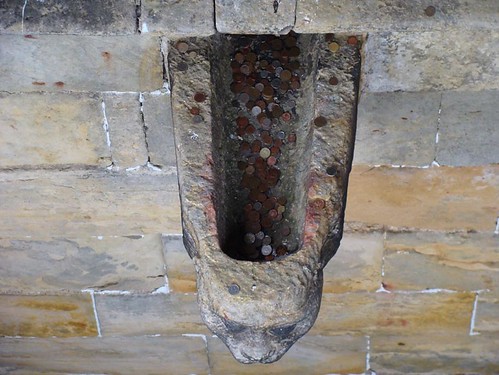
Despite the signs asking them not to, people still seemed compelled to throw money into the gargoyles.

Rosslyn Chapel
Kirsty Hall: Rosslyn Chapel, July 2008

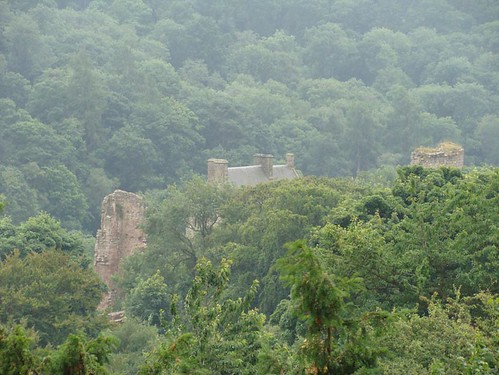
Looking down from the chapel roof onto the ruined Roslin castle. This area had been visited by artists and writers since the 1700's and it was particularly popular with Romantic artists (even Turner painted here); looking at this misty shot, it's easy to see why.

Rosslyn Chapel
Kirsty Hall: Rosslyn Chapel, July 2008

If it had been earlier in the day and a bit drier, I would have taken a walk through the beautiful and historic Roslin Glen. Perhaps next time...

13 Comments

Tracey Emin: 20 Years at the Scottish National Gallery of Modern Art.

Visiting this retrospective was primarily valuable because it confirmed for me that I just don't rate Tracey Emin. When someone's whole shtick is an emotional outpouring, it's a bit of a problem if the viewer doesn't feel anything. I didn't hate the art, I just didn't care about most of it; instead I walked around the exhibition feeling uninvolved and rather bored.

The problem is that Emin's work is so autobiographical that it's like reading someone else's diary or worse, being grabbed by the collar and forced to listen to a drunken rendition of someone else's tedious problems.

I suspect that to be a great artist, you need to transcend the self and tap into something bigger. Emin seems - so far - to be unable to take that leap. I learnt that she loved her gran; that she has a cat; that her dad brings her flowers; that one of her abortions was traumatic; that her bed got messy and that her favourite uncle died in a car crash - but I didn't learn anything new about myself or the human condition. In my opinion, art needs to connect with the viewer, to touch something in them, to resonate, to disturb or to enlighten: apart from one work, Emin's art did none of this for me.

For something that purports to be going deep, her work is remarkably stuck on the surface. I was reading textile pieces that said things like, "I feel so fucking lonely" and thinking, "yeah, we all do sometimes, so what?"

There were a couple of pieces that I responded to, mostly her later work, which suggests that she may be improving. I sort of liked her rickety rollercoaster, the newer white and cream blankets and the little monoprints of birds but even these were nothing to write home about.

That said, I do appreciate the casual and forthright use of stitching on her signature appliquéd blanket pieces. I've always liked the way that Emin uses textiles in such a confident fashion - unlike many other female artists working with stitch (myself included!) she never seems to get hung up on the domestic and feminine history of fabric; she just cracks on and does it with a 'sod anyone who thinks sewing isn't real art' attitude! I am grateful to her for that because I think she makes it easier for the rest of us.


Tracey Emin: Hellter Fucking Skelter

The piece I liked best was a video work from 1995, the well-known, Why I Never Became A Dancer. The story of her early teenage sexuality and how she was punished for it strongly resonated with me. The tattered, grainy images of Margate shot on Super 8 film are very evocative and the ending, where Emin dances her heart out in defiance of those who tormented her, is genuinely filled with hope and joy. There's something more than pure autobiography here and if Emin could access that more often, she might become the talented artist she seems to think she is. But as it stands, it's the only really good piece in the whole retrospective.

For me the major problem is the literalness of Emin's work; if she could take her raw emotions and her autobiographical objects and transform them into something greater than the sum of their parts then it might work. As it is, I'm not sure that what she's doing is even art: most of the time it feels more like art therapy - just an exhibitionist museum to the self. In short, I feel that on leaving an exhibition, my dominant thought should not be, "well hey, at least she has great tits!"

I've always thought that Emin could be good if she could just get the hell over herself. It's interesting to compare her to someone like Louise Bourgeois, who has also extensively and obsessively mined her emotions and her past but to far greater and more lasting effect. I once saw a show of Bourgeois' art at the Serpentine that disturbed me so much that half way through I had to go outside for some fresh air. On the evidence of this show, Emin has a long way to go before she'll have the same effect.

If you want to see it, the exhibition is on at the Scottish National Gallery of Modern Art in Edinburgh until November 9th.

A ROUND UP OF OTHER REVIEWS


Rather damning review
from The Times and a slightly more sympathetic one from The Herald.

Emin talking about the work to The Sunday Herald.

Problematic interview with the artist where she comes across as infuriatingly arrogant. This bit made me particularly loopy!

Some people might find an unmade bed studenty and corny. But Emin is absolutely adamant that "taste cannot get mixed up with what's good and what's bad". There is a definite standard. Quality control. But presumably there are great artists out there, undiscovered? "No. They'd have made it if they were any good." I wonder how she can possibly say that. It shows enormous faith in the establishment for someone supposedly so anarchic. "Why would I be anti-establishment when the establishment is so good to me?" she demands.

This is just so monumentally stupid - being good at playing the art world game is NOT the same as being a good artist.

3 Comments

Well, I've come back from a rather rainy Scotland to a rather rainy Bristol - are we going to get any sort of summer this year, I wonder? I've just been out in the garden between showers to re-stake my tomatoes, which were so battered by the recent winds that one of the bamboo canes had snapped completely. There's still plenty of fruit on my ramshackle three plants although they can't hold a candle to my dad's very impressive crop but then he does have two greenhouses full of them!

Scotland was good fun, despite the rain, and I managed to squeeze in some art stuff between all the family commitments. Unfortunately, despite taking my password with me I couldn't log in to my blog for some reason and had to content myself with taking lots of photos and notes instead.

So here's the edited version of my week:

Last Wednesday, I met Kate from the Needled blog for a delicious lunch at the Fruitmarket gallery. Meeting her was definitely one of the highlights of my trip; she's a fascinating and intelligent woman and two and half hours fairly flew by as we discussed everything under the sun.

On Thursday I visited Rosslyn Chapel (warning: link has music). It's only about 20 miles from my parents' house but I'd never been before.

Rosslyn Chapel
Kirsty Hall: Entrance to Rosslyn Chapel, Aug 2008

It's a stunning medieval church that has been popular for years because of its unusual architecture and disputed Knights Templar associations but interest sky-rocketed after it featured in The Da Vinci Code. Apparently the church used to get about 10,000 visitors a year but got 70,000 visitors in the year the book was published and numbers have remained high since. The Trust that runs the church was initially quite overwhelmed but all the extra visitors mean they can now fund an ambitious conservation programme for this unique and very special building.

Personally I was far more interested in the incredible quality of the ornate carvings than the possibility of the Holy Grail being buried in its crypts! A guide pointed out a lovely little fact to me: the botanical carvings on the outside show the front of leaves, while the carvings on the inside show the backs of leaves - how fantastic is that! Unfortunately you aren't allowed to take photos inside but the outside is almost as highly decorated as the inside and the protective metal structure that keeps rain off the building means that you can climb up to get a closer look at the wonderful flying buttresses, carved spires and large windows.

Photograph by Kirsty Hall   of large stained glass window, Rosslyn Chapel
Kirsty Hall: Large stained glass window, Rosslyn Chapel, Aug 2008

Photograph of flying buttresses, Rosslyn Chapel
Kirsty Hall: Flying buttresses, Rosslyn Chapel, Aug 2008

Rosslyn Chapel
Kirsty Hall: Carvings on spires on Rosslyn Chapel, Aug 2008

The thing that struck me most about the church was the sheer confidence of it. To build such an ornate structure in the war-torn and brutish Scotland of the Middle Ages spoke to me of great power, wealth and artistic vision. I don't suppose that quality stone workers have ever come cheap and the building took 40 years to build and is absolutely covered with carvings, both inside and out. It really is a remarkable achievement and if you get the chance to visit, you should.

.......

Sadly most of the galleries in Edinburgh were in a changeover week so I didn't do my usual round of exhibitions but I did manage to see the Tracey Emin retrospective at the Gallery of Modern Art on the Sunday. I'll do a separate review for that because I have a lot to say about it.

Oh, and my son and I saw The Dark Knight, which we both thought was astounding. All the performances are amazing and although it's a fast paced action movie, it also raises a lot of questions about loyalty and the meaning of morality. On reflection, it doesn't completely hold together on certain plot points but it's well worth seeing.

Right folks, my son and I are off to Yorkshire to visit my brother and his wife for the weekend and then we're heading up to Scotland to see my parents. I'll try to update while I'm away but my parents only have dial-up, so posting is likely to be very low key if it happens at all. I'll be back in ten days.

I won't be checking email but in the unlikely event that anyone desperately needs to get in touch, leave a comment on here and I should see it.

2 Comments

After saying that I wouldn't, I got assimilated into the world of Plurk. It's like a more visual version of Twitter and for some reason the Ravelry knitting crowd have adopted it with great gusto.

I thought I wouldn't like it but I'm finding it surprisingly addictive; for me it's a combination of the best bits of Facebook and instant messaging without the disadvantages. I got bored with Facebook because there's way too much junk on it (as you can tell from this and the last post, I like my internet to be pretty clean and linear) but the 'Kirsty is...' box was always my favourite thing about it. Plurk is basically a whole series of 'Kirsty is...' boxes without all the crazy requests to join this, that and the next thing. I don't use any sort of instant messaging service because I absolutely can't stand being interrupted by little pop-up boxes when I'm working but Plurk feels like an instant messaging service that I control.

If you're on Plurk, feel free to add me.

And don't worry, I promise I won't start writing blog posts in the third person, even though I've been thinking in pithy third person sentences for several days now!

14 Comments

I'm a little disturbed that I haven't posted here since last Tuesday because I could have sworn that I had. I hate it when I start losing time, it usually means that I'm overdoing things a little and falling prey to the brain fog that's common in Chronic Fatigue Syndrome.

...........

So, another Tuesday, another look at the concept of mess. I'm considering it from a slightly different angle this week.

DRAWING A LINE IN THE SAND

I had an interesting experience last week: someone contacted me offering to 'moneterize'* my blog with an advertising link. I politely declined and then got a slightly cheeky email back saying, amongst other things, that 'it's just a link'.

But it isn't just a link.

While I'm flattered to be asked, adding advertising to my site is not something I want to do. One of the reasons my site looks good is because it isn't covered with too much visual information. This is deliberate choice on my part. I loathe the way places like MySpace look, I find them almost nauseating in their visual clutter and one of the first things I said to my web designer was, "I want my site to be clean." My designer did a fantastic job making a sleek, beautiful and functional space for me and I do my part by not messing it up!

My site is an area in my life - one of the few - where mess doesn't randomly proliferate because I have to make a conscious decision to make a mess here; I can't just randomly wander through, put something down and wander off again. Instead, I resist the temptation to put lots of stuff up on my sidebars. I think long and hard about every single item that goes up there and on occasion I've decided not to put up things that might benefit me because I feel that the resulting visual clutter would outweigh the benefits.

Why would I compromise that purity by putting someone else's advertising on here?

I don't need advertising on this site, it's not expensive to run and I consider it part and parcel of the ongoing costs of being an artist. Paying for my hosting once a year is no less important to my art than buying art materials, getting business cards printed or buying art books and magazines for research.

I make no money. In the 5 years since I graduated, I haven't had to pay taxes once because even when I had a part time job, I've never made enough to exceed the personal tax allowance. I survive through the good will of my partner who financially supports me. So you'd think that I'd jump at the chance to get a bit of extra cash.

But there's no such thing as a free lunch. Having advertising on this site would be messy and I feel that it would compromise my art. I'm not saying that it's evil to advertise. Every artist must make the decision about whether to accept advertising for themselves. For some artists it might be the right choice. For me, it's not.

I was trying to pin down exactly why it isn't right for me when I read this spot-on blog post by Seth Godin last night and had an lightbulb moment. He writes:

Here's the essential truth:

This is the first mass marketing medium ever that isn't supported by ads.

If a newspaper, a radio station or a TV station doesn't please advertisers, it disappears. It exists to make you (the marketer) happy.

That's the reason the medium (and its rules) exist. To please the advertisers.

But the Net is different.

It wasn't invented by business people, and it doesn't exist to help your company make money.

That's it exactly! My blog does not exist to make YOU money. Heck, it doesn't even exist to make ME money, although it may well have that effect in the long run. Certainly part of the reason it exists is to increase my profile in the art world and hopefully to garner me real world art opportunities but mostly it exists simply because I like to write, share photos and talk to other interesting artists.

Not everything in the world is for sale and I value having this one clean, controlled space in a mostly messy life far, far more than I'd value a few extra quid in my bank account.

* Incidentally, can we please take the word 'moneterize' out back and have it shot!

6 Comments

In fact, all my days are messy.

Messy altar 01
Kirsty Hall: Messy Altar, July 2008

This is our altar area on the middle floor landing. Spiritual, ain't it!

It can be a beautiful space but it hasn't been for months because we were decorating and moving stuff around and somehow this space became a dumping ground. See the lanterns behind the mattress - that's the remains of the Christmas altar? What month is it again? Oh yes, July...

I suppose I could just leave it there for another 5 months but most years we make a spectacular Halloween altar like this...

2003 Halloween altar
Kirsty Hall: My favourite Halloween altar, October 2003

Or this...

2005 Halloween altar
Kirsty Hall: A witchy Halloween altar, October 2005

Having stuff piled up in front of this gorgeous window always depresses me a little. Come to think of it, it's little wonder that my head feels chaotic right now when I literally have An Altar To Mess in my life. I need a pretty summer altar filled with flowers instead.

messy altar 02

The bedframe is mine. It was in the room that is now my studio, then it was in another room for a while and now it's sitting on the landing in bits. I thought about getting rid of it, it seemed the sensible thing to do but I realised last week that I just don't want to. I want to sleep on it again. It's MY bed: I have perfect grey flannel sheets for it, a beautiful pale blue duvet cover that I love and although it needs a new mattress, I adore the drama of the bed itself. When it comes right down to it, I'm a Victorian cast-iron kind of girl and why shouldn't I have the bed I want in my room? So I've decided that I'm going to dismantle and get rid of the bed I'm currently sleeping on and reassemble mine instead.

I think maybe I'm not quite getting the point of Messy Tuesdays. At the weekend I cleaned the pile that I showed on my last Messy Tuesday post and I want this mess gone by next week. In fact, I'd like to clear it up right now, but since it's the middle of the night, that probably wouldn't make me very popular.

It's hard for me to accept the fact that I have so much mess in my life. I fight against it. When I see pictures of it, I feel guilty and anxious and want to clear it up instantly even when I know it's not possible to do so. Unfortunately I'm a perfectionist and a procrastinator; it's a bad combination! Still, there are plenty more messes to document and I can't imagine there will ever be a time when my house and life are completely tidy.

6 Comments

Sometimes I come across an artist who's ploughing very similar ground to me and occasionally I find someone who's working with the same materials as me. However, I think that Bird Ross and I may actually be sharing a single brain!

I was looking through old copies of Fiberarts Magazine to see if there was anything I needed to photocopy for my sketchbook, when I spotted a small photograph of a ball of knotted string by Ross.


Bird Ross: 6000 Knots

Anxious that I might have accidentally copied her string work when I came up with the idea for 3 Score & 10, I checked the front of the magazine, but it dated from 2005 and a quick search through my sketchbooks revealed that I was already making 3 Score in Jan 2003.

3 score & 10 02
Kirsty Hall: 3 Score & 10

Rather oddly, Ross' 6000 Project using knotted string was about 9/11, which of course, I've also done a series about. Here's what Ross wrote about her project:

From the four airplanes (266), the confirmed dead (201), the 5422 people still missing and those that died at the Pentagon (188). It equals a little over 6000. As of today 6077. I wanted to know what 6000 looked like. How can anyone possibly imagine what 6000 of anything looks like, let alone people. What would 6000 names struck from the pages of a phonebook look like? What would it look like in terms of their handprints, their footprints, in terms of the number of people that miss them? It's like nothing we can imagine. This was my attempt to imagine.
18 September 2001

And here's what I wrote about my 3,533 (Requiem) piece:

I sat in the space and burnt 3,533 matches over the space of four days. This number is the current estimated number of victims of the terrorist attacks. The matches were then laid out so that both the scale of the numbers and the individuality of each match could be seen. The thing that I really couldn’t grasp about the attacks was the sheer scale. I needed to make work that encompassed those numbers and I thought if I could see objects laid out then I might begin to understand the loss involved.

Of course, I've never imagined that I was the only artist who took this approach, I've seen other 9/11 counting projects; it's a pretty natural response for visual people trying to get their heads around the scale of something like this. Still, when I went onto Ross' website and found that as part of her 'counting the dead' project she'd also used burnt matches, I was slightly spooked.


Bird Ross: 6000 Matches

requiem 06
Kirsty Hall: 3,533 (Requiem) in progress

Then I spotted her time clock piece and just started laughing because several days ago I wrote in my notebook, "I should get one of those old fashioned work clocks so that I can punch in and out when I'm pinning".

Oh, and I've also had ideas about using layers of sellotape - guess what, so has Ross!


Bird Ross: Wounded

How crazy is this! Bird Ross and I have never met, I wasn't aware of her work before this and I don't imagine for one minute that she was aware of mine but we're clearly tuned into the same art wavelength! I'm sitting here just giggling because it's so weird.

My favourite piece of hers is this beautiful little folded paper piece called It All Adds Up. It's clearly a till receipt and since it's part of the 6000 series, I'm guessing that it's folded 6000 times.


Bird Ross: It All Adds Up

Isn't that lovely. I like the way it's encased in the narrow glass or perspex vitrine, it sets off the piece so well.

Right, I'm just off to check one more time that there are no pins on Ross' website!

4 Comments

It's National Shed Week. What, you didn't know that Britain has a National Shed Week? Shame on you! There's a blog and everything.

The winner of this year's best shed competition is Tim, a man who has combined two great British passions to create a Pub Shed.


Images from readersheds.co.uk

This isn't the only pub shed I've heard about; a friend of my mum and dad has a small 'cricket pavillion' shed in his garden, complete with beer on tap. And yes, there is also an area to play cricket, although I believe that they often go straight to the beer part. You have to make your own entertainment when you live in a small Scottish village...

There are a ton of other inventive sheds on the shed website. including this fabulous Tardis one.


Image from readersheds.co.uk

In fact, there are so many Tardis sheds that they have their own category. but I particularly like this one because of this quote from the female owner, "I don't think of it as just a shed - more a David Tennant trap."

Some of their sheds are a bit posh but as a fan of wabi-sabi, I prefer the more ramshackle versions like this one or this. Some sheds are particularly organic. This one makes me envious - I'd absolutely love it if mine had a living turf roof but it's pretty far down the list of gardening priorities.

And of course, we can't talk about sheds without mentioning some art inspired by the humble shed.

I find most traditional shed paintings a little boring but I was quite taken with the naive style of allotment painter, Chris Cyprus.

Simon Thackray's photograph of his shed door inspired him to start The Shed, an unusual series of music, poetry and art events in his small rural community.

Simon Starling's Turner Prize winning installation, Shedboatshed started life as a Swiss shed that he turned into a boat.


Image from Tate website, unknown photographer

He sailed the resulting boat containing the remaining shed parts down the Rhine to the venue where he was exhibiting before rebuilding it into a shed. I have to say that the confidence of this project impresses me, I'm not entirely sure I'd want to set sail in anything I'd built! Loathe as I am to link to the Mirror newspaper, this attempt to replicate the project made me laugh.

Cornelia Parker's famous piece Cold Dark Matter: An Exploded View involved the British Army blowing up a garden shed that Parker had filled with a collection of objects sourced from jumble sales, charity shops and the sheds of the artist and her friends. The resulting charred remains were collected and hung around a single light bulb.


Images from Tate website, unknown photographer

Sheds, what's not to love?