3 Comments

This is a short round-up post because I keep thinking of things that aren't enough to do a whole post on. Plus it occurred to me that doing regular updates like this might prevent me being quite so perfectionist and therefore slow about my blogging.

Health Shit
It’s ME/CFS Awareness week and I was going to write something deep and meaningful about it but I’m still in the midst of the worst crash I’ve had in several years and I couldn't be bothered. I'm getting blood tests done to check whether something else is going on because it's been about a month and I'm not getting any better.

If I had written a post, it would have been about how small your world becomes when you have this illness. How unreliable you feel. How hard it is to plan. And how much grief and loss there is. But I have no spare energy for depressing writing about my depressing illness.

I have ME/CFS. It sucks. Next.

Other people wrote some smart stuff though:
Michael Nobbs
Newly Nerfed
RachelCreative and a moving post from her husband.

Why You Should Listen To Your Mother

So you know that thing your mother told you about not touching plugs or light switches with wet hands in case you electrocute yourself?

Totally true.

Since I’d managed to get to the age of 42 without this ever happening to me despite not being super cautious about it, I thought it was a bit of an exaggeration but no, it really can happen.

Fortunately it was only a very small electric shock, so I’m not dead. Which is good because dying whilst preparing baked potatoes would be a bloody stupid way to go.

Books

I’ve been on a roll with reading lately, mostly because it’s one of the few things - apart from crocheting granny squares - that I’m able to do at the moment.

If you like crime novels, I thoroughly recommend Ann Cleeves, particularly her stunning Shetland Quartet. I just finished the last book in the series and I’m still reeling from it. I’ve also been enjoying Ariana Franklin's medieval murder mysteries.

If science fiction is more your thing, Kaaron Warren’s book Walking The Tree is strange but compelling. I also enjoyed both of Eugene Byrne books but particularly Things Unborn, a police procedural set in a Britain where some of the dead have been inexplicably resurrected.

I’ve also just started Stitching For Victory by Suzanne Griffith, a fascinating exploration of the diverse and vital role textiles played in World War Two Britain.

Exhibitions

Last week I had a fun day out with the Textile Forum South West group at the very excellent Stroud International Textile Festival. I particularly loved Kate Blee's piece, Stroud Red.

Stroud Red by Kate Blee
Kate Blee, Stroud Red

I also adored Bethany Mitchell's work combing yarn with ink and pencil drawings.

The festival is on until the 23rd May. If you do manage to go, Mills Cafe does lovely soup and very nice cakes.

That Dieting Thing
I'm still doing Slimming World. I've only got three pesky pounds to go until I get my Two Stone award but the last two months have been hopeless because I've been shilly-shallying and uncommitted. Amazingly enough, the diet doesn't work if you don't stick to it! Who knew? But I'm pleased that I've maintained my existing weight loss and I'm slowly becoming motivated again, so hopefully this plateau will soon be over.

Chickens
The chickens are well. Thankfully they've settled their initial differences and now get along just fine, although Colette is a complete drama queen and kvetches loudly about the slightest little thing. More video soon.

Art
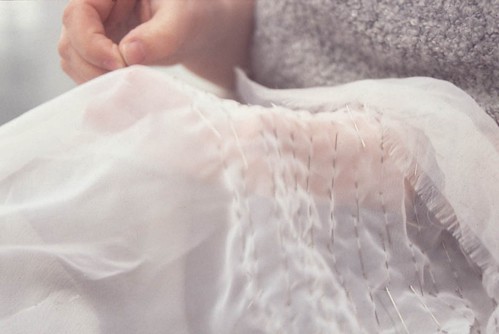
Still sewing sequins on an apron. Lalalalala...

18 Comments

“Art is beautiful but it is hard, like a religion without a purpose.”
Gunter Brus

Close up photograph of artist Kirsty Hall performing Pin Ritual 01
Kirsty Hall: Performing Pin Ritual, Dec 2003

People who aren’t working in a creative profession often think that what we do is easy, fun, glamorous or exciting. And it can be all of those things. But it’s also a time-consuming, brain-melting obsession that will eat your life.

It is not ‘five minutes, boom, you’re done, sit back and drink a martini’ - that is not how the creative process goes for even the most talented people. Techniques take time to learn and perfect. You make mistakes. Then you make bigger mistakes and have to start over. Even once you’ve learnt your craft, it’s twisty: you fret, you fiddle and things go wrong. You can pick away at a problem for months or years with no guarantee that you’ll ever crack it.

Sure, some people make it look easy but I’d bet my granny’s pension that they’re working hard when your back is turned. They’re dreaming their way into a role; they’re thinking about their sculpture on their lunch break; they’re drawing for hours every day.

So you need to enjoy the process of what you do. Because that’s what you’re going to be doing all day.

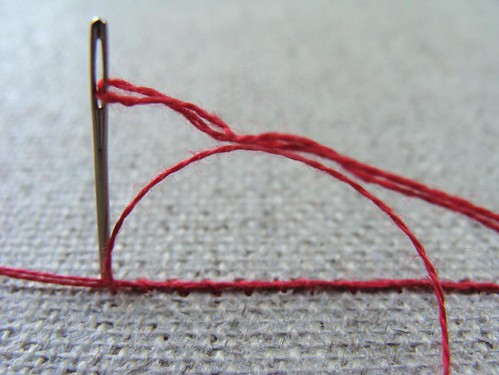
Photograph by Kirsty Hall of red thread and needle
Kirsty Hall: Red thread and needle, May 2008

If you plan to make hats for a living, you’d better love plittering around with felt and feathers. If you’re going to carve wood, you’d better not be allergic to sawdust. If you want to act, you’d better be able to put up with hanging out with other actors, learning lines and spending lots of time waiting around.

Now, obviously no one loves every single thing about their job but if you dislike most of your process, then you’re in the wrong creative field or are using the wrong medium.

I know this sounds stupid but I see a lot of young artists making this mistake. They’re naturally great at video but instead try to make sculptures because they feel they ‘should’. Or they have a talent for colour but feel guilty that it’s ‘too easy’, so they chose to work in monochrome even through they secretly long to pick up that tube of orange.

If you call yourself an artist but find yourself making excuses to write instead of making art, you might really be a writer. If you find oils endlessly frustrating but make watercolours for fun on your days off, you may be using the wrong kind of paint. If you hate having clay under your fingernails, making pots is not for you.

I’m not saying that you shouldn’t challenge yourself by exploring new areas. Nor am I saying that everything needs to be easy – it won’t be. I’m saying that you absolutely must have a deep and abiding love for the actual processes of your craft. You need to be able to think, “Oh wow, sewing sequins on this apron is still kind of great, even through I’ve been doing it for a year & I’m kind of bored now”.

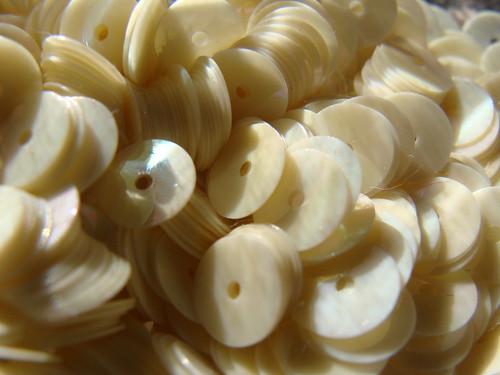
Photograph of cream sequins by Kirsty Hall
Kirsty Hall: Close up of sequins, Oct 2009

Because a lot of the time you will be frustrated, stuck or thoroughly fed up and in my experience, if you don’t have that core passion for your daily reality, then you will quit.

15 Comments


Photograph by Johnny Grim. Used under Creative Commons license

I recently wrote about why there's no excuse for artists not to have websites. If you're still working on yours, here are a few things to avoid like the plague.

1. Overuse of Flash

I'm not a big fan of Flash - it can be useful when used sparingly but it's frequently overdone or used inappropriately. Web designers can start acting like puppies on crack when they get their paws on Flash. You need to smack them firmly with a rolled up newspaper.*

There are other good reasons for avoiding Flash. The web is increasingly moving over to HTML5, so a site that’s designed in Flash now is highly likely to need redesigning in a couple of years. Flash often doesn't work on mobile devices, including iPhones and iPads. Apple have said that they won't integrate Flash into those platforms. Microsoft have also come out in support of HTML5.

Even if your visitors are capable of viewing Flash, it often slows a site down considerably - I do not care how pretty your site is, if it takes several minutes to load, you've lost me.

*Fret not, it's hyperbole. I do not advocate violence against web designers. Or puppies. Or crack addicts.

2. Choosing Form Over Function

Unless your site is an actual art project and a pretentious design is vital part of your evil plan, please resist the urge to overcomplicate things.

I do not want to chase small objects around the screen. I do not want to have to guess what your obscure labels mean. I do not want to search in vain for photographs of your work. You are not a pirate constructing a fiendish puzzle to protect your buried treasure, so knock it off!

Again, this is usually more of a problem with professionally designed sites because the rest of us simply don't have the skills to complicate things in this way. I have a theory that web designers hear the word 'artist' and immediately start cackling like mad scientists thinking about all the crazy things they can get away with.

I don't want to sound as though I'm picking on web designers - most of them do wonderful work - but I have seen a lot of art websites rendered unusable through 'clever' design. Remember: just because you can do something, doesn’t mean you should. People visiting your website don't care how 'arty' your site looks, they just want to find out about your work quickly and easily. Simple, functional and elegant wins out over complex and difficult to use every single time.

ETA: Artist and web designer iamANT pointed out that it's actually often artist clients who demand bizarre and 'creative' sites. If this is you, stop it, you silly artist! Listen to your designer when they tell you that strangely animated Flash sites are a bad idea. They are trained in their field. You are not.

3. Illegibility

It sounds painfully obvious but if you want people to read your site then you need to make it readable.

Large blocks of text are hard to read, so break it up with paragraphs and photographs.

Do not use colours with too much or too little contrast. In particular, be very careful of white text on a black background. This has been popping up all over the web recently like a bad case of shingles and I think it's appalling. I find it painful to read and 9 times out of 10, I simply click away. If you must use white on black, there are things you can do to make it more legible.

Do not use hard to read fonts or text that's too small. Websites are increasingly being read on mobile phones and small text that won't enlarge is one of the major problems. If you're on WordPress, there are various plugins that will make your site compatible with mobile devices. I'm currently testing out Mobilize by Mippin.

4. Clutter

White space is your friend, people.

Busy backgrounds and animated adverts do not enhance anyone's browsing experience. And you don't need to put hundreds of buttons, banners and widgets on your blog sidebar either.

I understand, I do. We’ve all been there. There are all sorts of cute widgets and plugins out there wriggling provocatively at you and promising to show you a good time if you'll just take them home. The temptation to tell people what you’re reading; what you’re twittering; how many fans you have on Facebook; what the weather is like where you are and when you last ate cornflakes is enormous. You could fill your entire blog with sidebar widgets. Unfortunately many people do.

But the human brain can only parse so much information at once: you need to be selective or none of the information will register. I've visited blogs where it's hard to focus on the actual blog post because it's lost in a sea of visual clutter. You need to prioritise & put the most important stuff at the top, especially things you want your visitors to actually DO. These ‘calls to action’ should be clear. If you want people to sign up to your mailing list, don’t make them hunt for it. If you want people to buy your products, make it easy to do so. If you want them to look at your art, direct them to it. And then get rid of as much else as humanly possible.

If you need further help optimising your website, I highly recommend a coaching session with Catherine Caine from Be Awesome Online.

And if you still feel the need to tell people about your breakfast cereal of choice, write a FAQ page.

5. Music

Apparently some artists think that my appreciation of their art will be deepened by tinny elevator music suddenly erupting from my speakers. They are very wrong.

Look, it could be my favourite piece of music in the whole wide world but I still don't want it to start up when your site loads for the very simple reason that I'm usually already listening to music while browsing.

Nothing will make me leave your site faster than music that starts automatically. It also makes me want to hunt you down and stab you but we won't go there...

6. Lousy Content

Are your photographs good enough? Are they properly labelled and easy to navigate? Do they load quickly enough? Is it obvious what things are? Avoid blurry or badly lit photos wherever possible (I do know that photography conditions in exhibitions are sometimes less than ideal but do your best).

What's your writing like? Unless you know you're speaking to an exclusively art audience, don't use art jargon. Use your spellchecker. Read through your stuff before you hit publish. Make a decent stab at using correct grammar, although you can get away with writing that's technically incorrect on a blog because a more conversational style is common in blogging.

Oh, and don't be boring or no one will read it. You have to sign up to a mailing list to get it but I found this free guide to writing 'non-sucky copy' from Laura Belgray of The Talking Shrimp useful.

7. Being Secretive

Do you belong to a secret spy organisation where your identity must be protected at all costs? No, you (probably) do not!

If you’re trying to promote yourself with a blog and/or a website, then you need to reveal something about yourself. Like, say, your name. You don't have to reveal everything but an 'about me' page is a must. Arts business coach Alyson B. Stanfield recommends having a good photograph of yourself too.

A lot of artists also make it far harder than it needs to be for people to contact them. Claire Platt pointed out in the comments that even simple contact information like an email address is often missing.

Get more help
If you'd like more information about building your online presence, check out the free resources section.

I am also available for online consulting if you need one-on-one help.


8 Comments

I am in the midst of a rather intense CFS crash & can't concentrate on writing. I was stressing out about tumbleweeds blowing through the blog, when I thought 'wait a minute, I've got tons of old writing I could reuse'. So here's a slightly edited piece from my college years. It seemed apt to publish a piece about Still Life at a time when my life is essentially standing still.

Still Life - written 1st July 2001

I have come to realise that much of what I make is actually Still Life. My photographs, in particular, definitely have a Still Life sensibility. I am looking at small things, like hot raspberries on the beach or the reflection in a bowl of water and saying that they are small, yet very important.

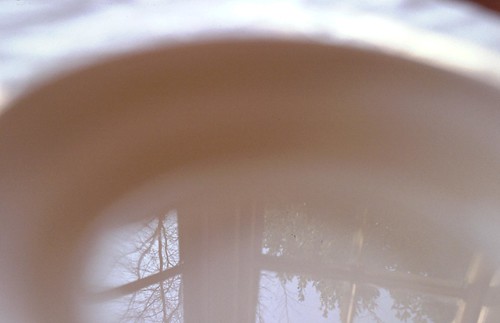
photograph by Kirsty Hall of reflection in a bowl containing salt water
Kirsty Hall: Salt Bowl Reflection, May 2006

It seems to me that that is what most Still Lives do: they take things and set them apart. Still Life demands that we really look at the flagon of wine and the apple, or the bowl of cherries, or the lifeless carcasses. It ponders the flowers, the glass and the tablecloth. It makes us see the texture of everyday life and forces the realisation that actually these things are amazing. The bread we eat, the soft cheese, the pile of fruit, the luscious cakes, the humble or grand spread. This is what keeps us alive after all. This is what nourishes us.

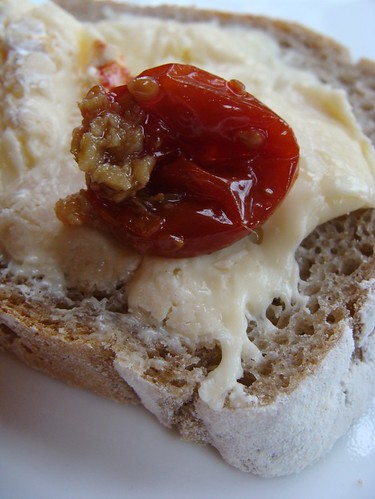
Photograph by Kirsty Hall of bread, cheese and sun-dried tomato
Kirsty Hall: Bread, cheese & sun-dried tomato, Dec 2008

Of course, we also need vast epic pictures of the imagination and portraits that force us to look at our frail human bodies. We need art to consider many things. But it seems sad to me that Still Life should so long have been considered to be the least important subject when it also deals with life and death. To me, mortality seems a vital component of many Still Lives. Those flowers will soon be dead: they are just caught for a moment in time. Caught at the point of perfection? Or perhaps already weeping their petals onto the rough-hewn table or perfect lace. That food will spoil or be devoured by a hoard of hungry mouths. Even that fine glass goblet will eventually be broken or lost. The table itself will be consumed by history. Who knows what happened to the musical instruments, the sheet music or the pile of books? They are lost to us except for the contained, still, captured image.

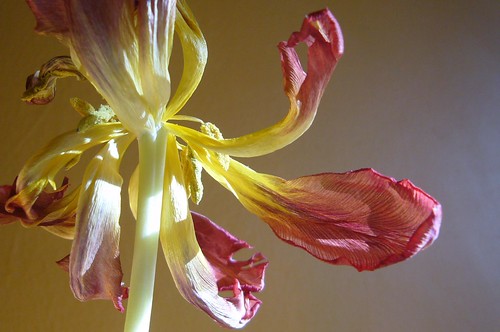
Photograph by Kirsty Hall of a dead tulip against a wall
Kirsty Hall: Dead Tulip, Feb 2008

It is that quality of stillness that I love about Still Life. More and more my work has been edging towards stillness; not actual silence but definitely quietness. I think I am looking for contemplation and the mysterious void. Stillness is a quality that I associate strongly with the colour white, which is perhaps why my work has contained so much paleness in the last two years. I am searching for that perfect moment perhaps, that moment of clarity and stillness?

14 Comments

Sorry for the radio silence - those of you who follow me on Twitter will know I was busy making and installing a brand new piece for an exhibition last week. Then I had to stay in my pyjamas for four days because exhibitions turn me into a zombie artist. Braaaaiiinnnnns (ahh, I feel better after that).

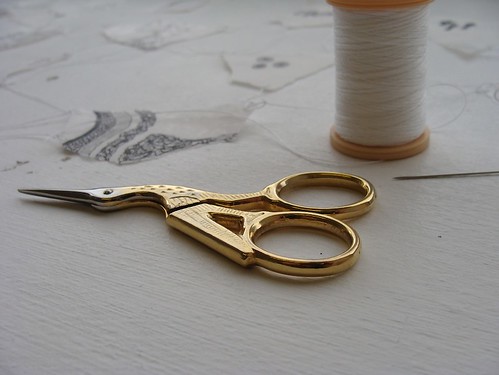
'52 drawings' in progress
Kirsty Hall: '52 Drawings For Claire & Camilla', March 2010

'52' was a group show curated by Camilla Stacey and Claire Platt, who work together under the moniker, Calm Air All Ice. Instead of just putting on a show of their own work, they decided it would be far easier to invite 50 of their favourite artists to show with them in Room212. Did I mention that Rooom212 is the smallest gallery in Bristol.

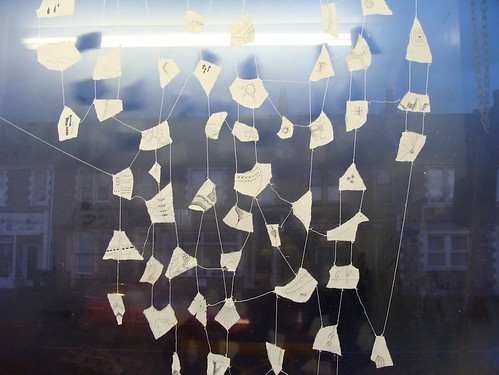
And in my infinite wisdom, I decided five days before the show to do 52 little drawings, coat them in wax so they could be seen from both sides, tie them all together with bits of thread and then suspend them in the window. Instead of doing something utterly crazy and unthinkable like just framing a couple of pieces that might possibly sell!

I'm blaming Camilla for this madness because she foolishly mentioned in passing that she was hoping I'd do a sculptural window piece.

Also, it seemed like a good idea at the time.

These things often do.

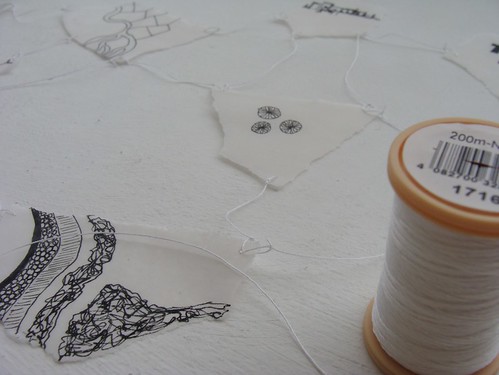
The drawings fell somewhere between realism and abstraction...
'52 drawings' in progress
Kirsty Hall: '52 Drawings For Claire & Camilla', March 2010

...and referred to maps, diagrams, aerial photography, archaeology and suchlike things.
'52 drawings' in progress
Kirsty Hall: '52 Drawings For Claire & Camilla', March 2010

For inspiration I looked at two of my favourite books, The Landscape Of Man by Geoffrey Jellicoe and Susan Jellicoe and Anno's Journey by Mitsumasa Anno.

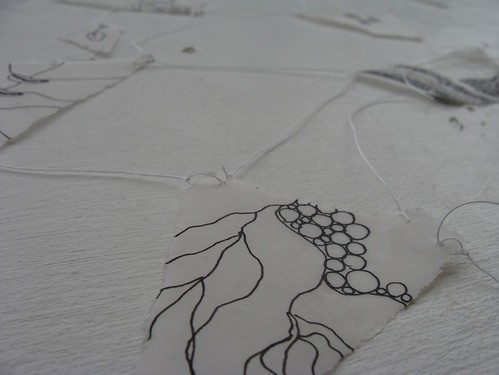
I'm very into torn edges at the moment...
'52 drawings' in progress
Kirsty Hall: '52 Drawings For Claire & Camilla', March 2010

...and I find it freeing to draw on non-rectangular pieces of paper.
'52 drawings' in progress
Kirsty Hall: '52 Drawings For Claire & Camilla', March 2010

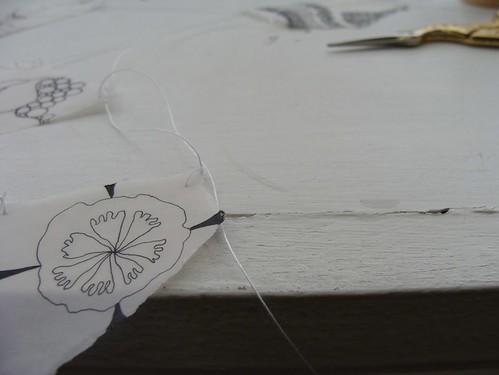
The drawings were easy - tying them together and getting them to hang properly was the tricky bit!
'52 drawings'
Kirsty Hall: '52 Drawings For Claire & Camilla', March 2010

Although I got the work up on time, I was quite mind-bogglingly disorganised about this show. I didn't do a mail-out for it and I didn't go back and get better photos because I collapsed with exhaustion afterwards. I'm feeling quite cross with myself about those two things. I'm trying to work out how I can do better in the future because if I'm being truthful, documentation and mail-outs are always a bit of a problem for me. I need better systems. Or a minion.

I did enjoy making the piece though. Even though it was a bit last minute, it was fun to have a break from the sequin apron (which is still trundling along like some relentless World War One tank) and I enjoyed actually completing a piece in less than a week. I'm still too close to it to know if it was any good or not but hey, I liked it.

The rest of the show was lovely - Claire and Camilla did a stunning job of hanging a huge number of pieces and there was a lot of good quality work. You can read a good review of the show here and there's also a series of mini-interviews with most of the artists over at the Calm Air All Ice blog. I bought a small piece by Cathy Cullis and would happily have bought works by several other artists if I'd had the money.

5 Comments

I don't know about you, but I regularly get email invites to join art sites. It can be daunting working out if they're worth your time and energy. I can't make those decisions for you but I've written this general guide to help you assess this sort of opportunity.

1) Do You Like The Other Art?
People judge your work by the company it keeps. If you'd be embarrassed to be shown on the same gallery wall, then don't place your art in the same online space. The exception to this is when it's an enormous site like Saatchi Online, where there's a huge selection of work in a wide range of styles.

Submitting your work to a curated site can be more work but that 'gatekeeper' aspect often results in a site with a higher quality of art. That exclusivity can also appeal to visitors who may take your work more seriously because it's been vetted.

2) Does It Match Your Values?
Do you like the aesthetics of the site? Does the site have an ethos with which you strongly agree or disagree? How much control do you have over what appears on your page? Are there adverts? In short, does the site chime with your values, both moral and aesthetic?

One important point you must always check is whether the site retains any rights over your images. I know it's a nuisance but you need to read the Terms Of Service (often abbreviated to TOS). These are always available when you sign up to a site - you'll probably have to check a box to say that you've read them - or you can also usually find a link to them at the bottom of the site or in the FAQ.

3) Do They Charge?
Ooh, the big one!

I have no objection to spending money online but I do think that a lot of art sites prey on the desperate and inexperienced. There are many excellent free art sites that offer just as much exposure.

There definitely are good subscription sites out there. Even though I've still not got round to applying, I've long considered AXIS to be worthwhile, especially for UK artists. They're a long-established site with a solid reputation and they provide a lot of 'added value' such as job opportunities, forums, high Google ranking and access to curators. Personally, I'd be incredibly wary of newer sites who want payment without having that sort of proven track record.

However, different rules apply if the site is specifically for artists in your area. These can be very worthwhile. I'm a member of Bristol Creatives and Textile Forum South West. Both charge a small annual membership but they're worth it because they connect me to other local artists, give me access to pertinent news & exhibition opportunities and organise regular offline events that are close enough for me to actually attend. Consequently both sites have a far greater practical value to me than many free national or international sites. Similarly, as a UK artist I wouldn't dream of letting my annual subscription to a-n lapse. An artist at a recent networking event I attended described it as "like Equity for artists". There are masses of benefits but frankly, it's worth it for the free public liability insurance alone.

There's also usually at least one professional organisation specifically for artists using your particular material and many of these now have websites where you can add a profile. Even if their website doesn't give you space for a profile of your own, you'll get access to high quality information that is specific to your field.

So I'm not saying that you shouldn't join websites that charge but you need to research them thoroughly, find out if they're as effective at promoting artists as they claim and and know exactly what you're getting for your money. In my opinion, you should definitely spend your money on your relevant professional organisations and local networks first.

4) How Effective Is It?
Randomly pick a few of their artists (not the ones that show up on the main page) and type their names into Google. How highly do those site profiles rank? If their site profile doesn't come up on the first couple of pages, it may not be worth your time.

Do be aware that if that particular artist already has a broad and effective internet presence that will skew the results. I'm all over the net like a cheap rash, so any site I'm on has to compete with all the other places where I'm active online. But if you check several of their artists and none of their profile pages rank highly, then that site probably isn't promoting its artists very effectively.

The second way to judge whether a site is worth your time is by checking their stats. Diane Gilliland has put together an excellent short video demonstrating how to do this. Her video is specifically about judging other blogs but most of the information still applies.

5) How Much Work Is It?
Is participation necessary or is it a 'set it and forget it' kind of place?

A lot of sites strongly encourage artists to maintain blogs on their sites. In my experience, there's a limit to how much blogging a single artist can do well. Remember that Google punishes duplicate content - it regards it as spam - so simply writing one blog post and plastering it over loads of art sites is counter-productive. I do allow occasional republishing of relevant blog posts from this blog on a few select sites but I would never republish every single post because that would definitely hurt my Google ranking. Many sites also contain forums where regular participation can gain you valuable contacts and further exposure on the site. However, be aware that forums are a notorious time suck.

If you're spending a lot of time on an art site but not getting many visitors to your site, you should question whether it's a good use of your time and energy. Marketing bods call this ROI - 'return on investment'. There's a wealth of information about your visitor numbers and behaviour in Google Analytics. If you've not already got Google Analytics on your website, you absolutely must because you need to know that information.

Now there could be strategic reasons to spend time on a site that's not bringing many visitors to your main site - perhaps it contains lots of people you're trying to get to know or it may just be fun - however, if it doesn't fulfil the criteria you've set, reconsider your participation.

6) Will You Be Seen?
Will your work be lost in the crowd? The smaller, more intimate sites can often be a more effective way of promoting your work than the huge sites. However, if a site has sufficiently huge traffic, you may garner significant eyeballs just by chance.

Are there opportunities to feature in newsletters, on the front page of the site or otherwise be brought to people's attention? I enjoy Central Station, partly because it's a fun place with interesting people but also because they regularly showcase my work. Because it's not a huge site, it's quite easy to stand out there with very little actual effort. In places that showcase new work, it's smart not to upload all your photos at once but to stagger them over a couple of weeks - you're more likely to get featured that way.

7) Who Are Their Audience?
Will your work be seen by the people who matter to you? If you're selling work, are new customers likely to find that site? If you're more interested in coming to the attention of curators, is there any indication that they browse the site? Does the site contain a lot of artists who you'd like to get to know?

If you're marketing your work to a specific niche, consider participating in non-art sites where your customers are likely to congregate. For example, if you paint racehorses, being active on a respected racing forum might be beneficial. Obviously you don't want to spam people but many forums allow you to have a short signature when you post, so you can subtly let people know what you do. Plus, you're presumably painting racehorses because you're interested in them.

Conclusion

If the site is free, matches your values and joining it won't take too much time, then you might as well go ahead and whack up a couple of images and a profile. After all, you don't know exactly who their audience are and you've got nothing to lose. However, if a site charges or requires far greater time participation such as using forums or blogging then you need to carefully weigh up the costs against the benefits.

_____________________________

Get more help
If you'd like more information about building your online presence, check out the free resources section.

I am also available for online consulting if you need one-on-one help.

Comment

I'd love to hear how you decided which sites to join. I'm planning on a follow-up post detailing some of the sites individual artists use, if you'd like to be included with a link to your site, please comment below or get in touch on Twitter.


19 Comments

1. I CAN'T AFFORD IT

Websites used to be an expensive proposition but the costs have dropped considerably over the last few years. Excluding any initial design costs, the annual fees for a self-hosted website should be about £60-£80. If you really can't afford that, there are other options for setting up a simple online portfolio.

a) A free Blogger or WordPress blog and a Flickr account can be set up in a couple of hours and are a surprisingly effective combination.

b) If you don't want a blog, Flickr can be used on its own as a basic art portfolio.

c) Many art sites will host portfolios for you and some of them are quite sophisticated. There are too many to link to but type the words 'free artist portfolio' into Google and you can research the many options available. Do check that their artists rate highly in Google and choose a site that gives you a short URL so you can easily add it to your email signature and put it on business cards.

d) A Facebook fan page is a fourth option. Most artists use Facebook fan pages as a subsidiary to their main site but at a pinch you could use it as your sole online portfolio. However, this is not something I'd recommend as a longterm option because they're overly fond of suddenly changing things around and there's some debate over how much control they have over any images you post there.

Any free site will have limitations but if it's a choice between whacking up something free now or waiting until you can afford something better, go with the free option. You can always move to your own site later if you want to. But get something. Hell, use MySpace if you have to! And I say that as someone who hates MySpace and thinks it should be your last port of call unless you're a musician.

2. I DON'T HAVE TIME

I won't lie to you, setting up a full website like mine is not an instant process. My site took about 6 months from start to finish and was a lot of work for both myself and my web designer. Even if you work with a designer, there's still blurb to write, design decisions to be made and photos to edit. In addition, all websites need low levels of ongoing maintenance. Blogging is an even bigger commitment and ideally needs to be done at least once a week to be effective.

However, setting up a simple portfolio site in the ways detailed above is relatively quick. If you've already got edited photographs of your work and a reasonable artists' statement, you could do it this weekend.

If you're serious about your art career then you must make time to get some sort of website up and running. Take a good hard look at what you're currently doing and what your priorities are. Can you let go of any commitments? Are you using your time wisely? As Gary Vaynerchuk says, quit watching Lost!

If you definitely don't have time to commit to a large website project right now, free up a weekend and put up a quick free version for now.

If you decide you do want something a bit more swanky, you can gradually start working towards your permanent website by doing preliminary things like researching designs and deciding what you want. Start a digital scrapbook of other artists' sites that you like - a site like Evernote is good for saving this sort of research. If you look right at the bottom of the page it will usually say which templates or designers they used. Equally importantly take note of what you don't like. Now look at your work and think about what sort of presentation would suit it. Do you want quirky or classic? Colourful or monochrome?

Laying the foundations like this will shorten the time taken by the final design process and if you do decide to pay a designer, you'll save money if you're clear on your design brief from the beginning. Although I changed my mind about plenty of things during the design process, I was very consistent about the basic parameters of the brief. I knew I wanted something elegant, simple and easy to navigate in neutral colours that would subtly compliment my often monochrome or pale work.

3. I CAN'T CODE OR DESIGN

Then pay someone who can!

Artists are absolute buggers for believing they have to do absolutely everything themselves. I understand the reasoning: money is often tight and even when it's not, that starving artist mentality is tenacious. I tried to put together my own site 4 or 5 times over the space of a decade. I taught myself HTML at least twice! Finally I had to admit that while I was perfectly capable of learning to code, I was monumentally shitty at the design side.

If you've got a good grasp of design but no coding skills, there are masses of customisable templates out there. If you're willing to pay for a premium WordPress template, I hear very good things about both Thesis and Headway. There are also lots of cheaper and free templates available: type 'free WordPress themes' into Google.

4. MY GALLERY PUT UP A PAGE FOR ME, SO I DON'T NEED A SITE OF MY OWN

Oh really? And how much say do you have over how that page looks? Do you plan to be with that gallery forever? What happens if they drop you or go bust?

Please don't give your power away like this: ceding control of your career is never smart. There's nothing wrong with having a page on your gallery's website but it shouldn't be your only online presence.

5. MY FRIEND SAID THEY'D MAKE ME ONE

This is one I hear surprisingly often.

Unless your friend is a professional web designer, you may be waiting a long time for what turns out to be a sub-standard site. Are you willing to put such an important part of your promotion in the hands of a untrained mate who probably has better things to do with their time? Even if your friend does know what they're doing, the process can be fraught with problems. What if you don't like their work? Are you going to fire your friend? What if working together sours your friendship?

I'm being slightly hypocritical here since my site was designed by a friend. However, he is a professional web designer and we were both very clear that I was employing him but we wouldn't let it get in the way of our friendship. We worked hard to keep the boundaries firm and managed to come through mostly unscathed. I'm quite certain that I was far more annoying during the process than he was but thankfully he still talks to me!

6. I DON'T KNOW WHAT I WANT

Yep, that's going to make life difficult!

Start mindmapping what you do want. Follow the steps mentioned in Excuse 2 and Excuse 7. Again, if you recognise that this is going to be a long process for you, slap up something quick and cheap like a simple Flickr portfolio now (are you sensing a theme yet?)

And remember that the website you have now doesn't have to be the website that you have forever. Websites are not static things. If you make a mistake or your needs change, you can always redesign the site. Even though the basic design template for this site has stayed the same since we launched three and half years ago, I've changed multiple things since then. Things change. You can change too. Website nirvana does not exist and perfectionism is just another excuse.

7. I JUST DON'T KNOW WHERE TO START

I'm always sympathetic to cases of overwhelm because it's something I'm extremely prone to. But you don't have to conquer the internet instantly. Break it down into small manageable chunks.

If a full website is too overwhelming for you to consider right now, there's absolutely no shame in going with any of the other options I've discussed. It's OK to just set up a Flickr account, whack some photos on there and a bit of blurb about your practice and then stop. It won't be the absolute 'best' website option but it's far better than being so frozen by indecision and fear that you wind up doing nothing at all.

If you do decide that you want a 'proper' website, your first step should be deciding what you want that website to achieve. Do you plan to sell from your site? Is it a virtual portfolio/business card? Are you planning to drive traffic to your site with a blog? Do you want to deepen your relationship with existing collectors?

Your second step is to decide on your professional name. If you've got an unusual name you've got an instant advantage. Artists with more common names may need to be more inventive.

Your third step is to buy that domain name. It'll cost you less than £10 for a year.

There you go, you've made a good start towards having a website and you've only spent a couple of quid!

8. I DON'T BELIEVE I NEED TO BE ONLINE

Don't be daft! As I hope I've demonstrated, you don't need a fancy website hosted on your own domain but you need something. If you don't want to deal with any of this stuff yourself, hire someone who's willing to take over the whole process for you.

I personally believe that a well designed website hosted on your own domain name is the ideal option but you can still have an effective and beautiful online presence by using one of the simpler methods detailed above. What won't work is sticking your head in the sand and hoping all this crazy internet stuff will go away. It won't.

Get more help
If you'd like more information about building your online presence, check out the free resources section.

I am also available for online consulting if you need one-on-one help.

............................................

Well, I hope that was helpful. What website solutions do you use? Please join the conversation by commenting below or tweeting the article.


33 Comments

I have an art school monster. It lives in my head. It feeds on my fears and starts nasty little rumours.


Image by autumn_bliss, used under Creative Commons license

Maybe my monster was there before art school, a cute little baby monster perhaps? But art school gave it shape and helped it grow. Art school gave it the words to wound me.

I had a great and challenging time at art school. I learnt a lot and grew immensely. I met amazing people, had fantastic experiences, drank a huge amount of tea and worked extremely hard.

I wouldn’t give up that time for anything - but it did leave behind a few scars and a monster. And boy is it hard to create when you have a whispering monster taking up space in your studio!

Right now my monster is telling me that creating with fabric is a stupid thing to do. A girly thing. An embarrassing thing. Even though I love fabric, fibre and thread and adore the work that other artists make with it, my monster says that people will think I’m rubbish if I use it. Not serious enough, not clever enough, not arty enough.

Real contemporary artists shouldn’t use textiles according to my art school monster.

This is all nonsense, of course. Many wonderful artists use textiles. No one says boo to Louise Bourgeois or Ann Hamilton when they use fabric. One of my fellow students happily used felt all through her final year and as far as I recall no one said squat about it. Heck, she even got a couple of grants to go to a felt conference somewhere wacky like Uzbekistan and we all thoroughly enjoyed the presentation she gave when she returned. I sometimes used fabric when I was at art school and no one gave me a hard time about it either.

So where on earth does my monster get these crazy ideas?

I’ve been trying to take a leaf out of the wonderful Havi’s book and speak kindly to my monster. I tell it that I understand that it’s just trying to protect me from criticism and harm. But honestly, I think my monster is just a frightful snob and I wish it would take its stupid opinions and shove them!


Image by herlitz-monster-talent, used under Creative Commons license

I'd love to hear about your monsters in the comments...

18 Comments

Many artists approach the world from a place of fear.

'Am I good enough? What if no one likes my work? Why can't I sell? I'm rubbish, aren't I! If I've not made it by the time I'm 30, I'm never going to. Picasso worked really hard every single day, what the hell's wrong with me? If I don't have lots of shows every year, they'll all forget about me.'

And so on and so forth...


Photo by Alex E. Proimos, used under a Creative Commons license

I've been actively trying to get away from that angst-ridden headspace in recent months. But taking a step back from those ingrained fears feels like stepping off a mountain path in the dark. I don't know if I'll fall. Maybe there will be soft mossy grass under my feet or bouncy heather? Or maybe there's a 50ft drop!

My own first lesson in letting go of these Art Fears is to ignore the temptation to desperately apply for exhibitions in 2010. While applying for exhibitions can certainly be useful and necessary, I'm tired of it. If applying for exhibitions works for you, that's great. It used to work for me too. However, right now it makes me feel sad, pitiful, powerless and often quite angry. It makes me feel like a beggar outside the temple of art and I'm DONE feeling like that.

Naturally, if things come knocking on my door, I'll certainly consider them. I do still want exhibitions and other cool opportunities. Nor am I sticking my head in the sand: I'm still visible and active both off and online and I wouldn't rule out applying for something if it was perfect for me. But I've stopped pushing constantly. It's a difference in attitude.

Somewhat to my surprise, this new approach seems to be working, I've been offered several great opportunities lately including the ECCA talk in London last month and I'm taking part in this exhibition later this month. Yet it's still scary as hell to stop pushing. I want to believe that the Universe will catch me, that I'll be OK without all that frantic busyness but believing that goes against a lifetime of conditioning.

What are your Art Fears? Can you trust yourself enough to walk away from them? Can you step off a mountain with me? We could hold hands and jump...


Photo by danorbit, used under a Creative Commons license

19 Comments

I'm very sad to report that while I was away in Scotland, the lovely Pepper was nabbed by a fox and she is no more.

It was upsetting but we always knew it was a possibility because our chickens room around the garden most afternoons. Even though we keep an eye on them when they're out of their run, the urban foxes around here are quite bold & unfortunately they only need to get lucky once.

When I got back, Ginger was clearly very unsettled and lonely. It's a bad idea to keep chickens singly because they are flock birds and need at least one other hen around. So on Saturday we headed over to our local supplier and scored a new chicken.

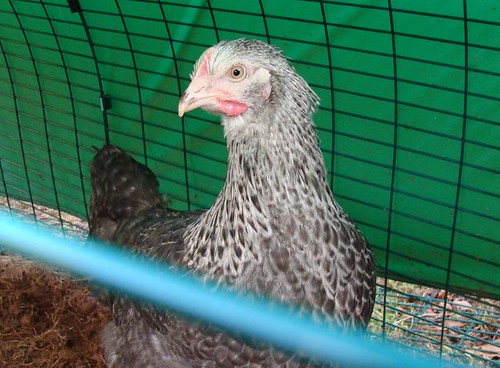
Meet Colette.

Photograph of Colette, our black and grey Cou Cou Maran Chicken. Photo by Kirsty Hall
Kirsty Hall: Colette, February 2010

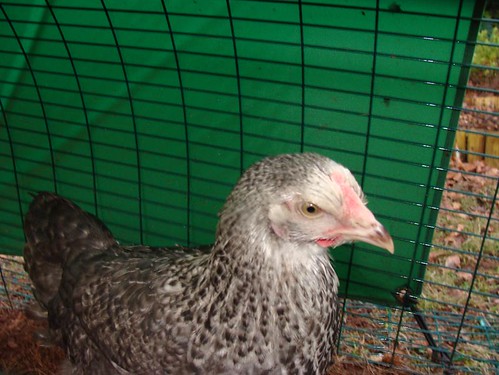
She's a beautiful Cou Cou or Cuckoo Maran - the 'cuckoo/cou cou' part refers to the speckled silver and black colouring. Marans are originally a French breed, so naturally we had to go with an appropriately French name. She's a 'point of lay', which means that she's not laying yet but should start in a week or two once her comb grows in.

Photograph of Colette, our black and grey Cou Cou Maran Chicken. Photo by Kirsty Hall
Kirsty Hall: Colette, February 2010

Because Ginger & Pepper had always been such good friends, I didn't anticipate any problems introducing Colette. Boy, was that a rookie mistake! Ginger took huge exception to this interloper in her run & was absolutely rotten to poor Colette. She wouldn't let Colette anywhere near the food & water and defended her territory with quite shocking levels of violence.

After a day of a traumatised Colette refusing to come out of the coop, I admitted defeat & asked on Freecycle for a spare run. Fortunately someone had a small rabbit run that they were planning to take to the dump, so I collected that on Monday evening and ever since Ginger has been spending her days in solitary confinement with a dish of food and water. She is less than happy!

Fortunately this is just a temporary measure - I've ordered another set of feeders from ebay & when those arrive, I shall divide the run with bamboo canes during the day. They'll be near each other but they'll both be safe and Ginger will have more room. I'm going to carry on separating them during the day until they can get along, which apparently can sometimes take months. I am making progress though, they managed to room around the garden together today without fighting and they're sleeping together quite happily: the problems just seem to be over food.

Thankfully Colette has been slowly regaining her confidence over the last few days. She's still jittery though - I let her out of the run today so I could clean out the coop and then she wouldn't let me anywhere near her and wouldn't be persuaded back in again. I couldn't even tempt her back in with food. Fortunately she went back in on her own accord eventually & I was able to shut her in. Ginger is easy to get into the run - she'll go anywhere for a handful of grain, the wee strumpet!