Blog

7 Comments

You know that internet joke that goes:
1. Set up online business
2. ???
3. Profit!

Um yeah, that kind of IS my business plan!

I mean, it's slightly more sophisticated than that. It actually goes:
1. Make lots of work
2. Show work online and in exhibitions
3. Build up reputation
4. ???
5. Make lots of money, er well, some money anyway

Seven years after graduating, I have come to the conclusion that it's not the world's most efficient business plan. Steps 1 to 3 are coming along nicely but unsurprisingly, steps 4 and 5 continue to elude me.

I have been struggling a lot with the money thing lately, most particularly with how it relates to my art. Recently I came to the conclusion that I'm just not comfortable with money.

Don't get me wrong, I have no problem spending it - although actually I'm usually pretty sensible with that side of things. My problem is more with the concept of getting paid for what I do.

I think on some level my image of myself just doesn't include the idea, 'earns lots of money'. Certainly I'm much more mentally comfortable in the voluntary/low income sector. I have no idea why this is. Some misplaced notion of bohemianism, perhaps? Some basic insecurity or lack of self belief? I suspect both these things come into play but looking back, I can see that I've never been motivated by money. I don't care about status symbols like fancy cars and designer clothes and as long as I have enough money to get by, I'm perfectly content.

My motivation has always been internal rather than external. I had a hard time when I was at school because I hated what I saw as all the 'jumping through hoops'. I've become somewhat better at that over the years but I'm still the sort of person who will work my fingers to the bone if I'm interested in something but if I'm not interested then it's like pulling teeth, no matter how much money you offer me.

Naturally I understand that everyone has to do things that they dislike and I'm not so spoilt that I'll refuse to do boring things. I've done my share of mind-numbing paid jobs in the past and if my health was better, I probably still would be. There are also plenty of art tasks that don't fill me with joy: I dislike documenting my work, writing exhibition proposals and doing graphics for posters but I crack on and do them because they are part of being an artist. However, I'm doing these things because getting my work out there matters to me; again it's self motivation rather than the external motivation of money. I don't want to get the work out there to make money, I want to get the work out there so that the work is out there. I find this makes quite a fundamental difference when it comes to the 'getting paid' part of the equation.

One of the most obvious ways that my conflicted relationship with money manifests is the difficulty I have with the idea of selling my art. I have wavered back and forth on this for years. There are some real practical issues - most of what I make doesn't lend itself easily to selling. For example, because of the length of time my work takes, most of it would not be economically viable unless I charged astronomical prices.

However, I've noticed that I'm also extraordinarily resistant to the thought of selling my drawings, even though they're a much easier and more realistic prospect. Oh sure, I have a ton of excuses for that one - "they're not good enough", "I don't know how to sell", "I just don't feel ready" and "I don't like putting a value on things that I make" - but I can see that it all comes down to my fundamental unease with money.

Another example: before today, it had never once occurred to me that my photographs might have a market. Because I don't think of them as 'art', attempting to sell them had never even crossed my mind. And now that I have thought about it, I want to run away really fast! I am formulating new excuses in my head already. It's abundantly clear that the true problem is not with the kind of work I make; it's with the very idea of selling.

It often feels as though money is a strange language that I don't speak. In fact, it's as though my brain is wired in such a way that it doesn't even recognise that it IS a language. I think I have 'earning money blindness', in the same way as I have 'pass blindness' - you could be showing very obvious interest in buying my work and I simply wouldn't notice. Yes, this has actually happened to me - the person in question had to spell it out to me and when she did, I was completely floored and didn't know what to do.

You see the problem - I truly suck at this stuff. Plus I clearly have ISSUES.

Expect more posts on this subject, as I work my way through this money thing. Yes, internet, you are my therapy. Aren't you lucky!

10 Comments

    'I don’t know what you're thinking of doing,' said Pippi, 'but as for me, I'm not one who can take things easy. I happen to be a turnupstuffer, so of course I never have a free moment.'
    'What did you say you were?' asked Annika.
    'A turnupstuffer.'
    'What's that?' asked Tommy.
    'Somebody who finds the stuff that turns up if only you look, of course. What else would it be?' said Pippi...'The whole world is filled with things that are just waiting for someone to come along and find them, and that's just what a turnupstuffer does.'
    Pippi Longstocking by Astrid Lindgren, translation by Edna Hurup

Isn't that just the perfect description of what an artist does - I knew there was a reason that Pippi was one of my childhood heroines.

    'What sort of things?' asked Annika.
    'Oh all sorts,' said Pippi. 'Gold nuggets and ostrich feathers and dead mice and rubber bands and tiny little grouse and that kind of thing.'

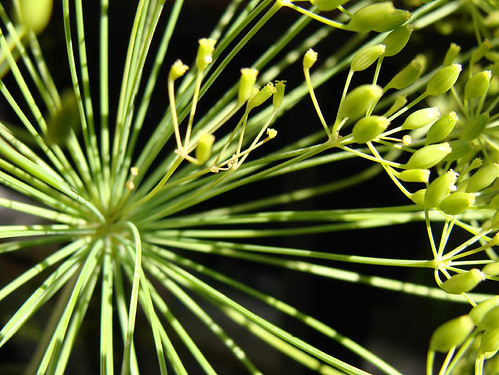
Yesterday, I turned up these images of my dill plant.

Dill 02
Kirsty Hall: Dill, July 2009

Dill 03
Kirsty Hall: Dill, July 2009

Dill 04
Kirsty Hall: Dill, July 2009

Today I turned up: several hours of art time, some thoughts that turned into art journal pages, my original Puffin copy of Pippi Longstocking, the first hint of ripening on one of my tomatoes and a quite unseemly amount of chocolate. No tiny little grouse though.

What small wonders have you turned up today?

4 Comments

I was reading this post about titles over at The Painter's Keys.

Here's the original question:

"What are your thoughts on changing the names of artwork to fit a venue, exhibit, or buyer? For example, is it okay to modify my often generic titles to more specific places, particularly when sending things off to shows? Is this wrong or deceitful? And, if changed, should new titles stay that way?"

In my opinion, if you need to change the title, then you just didn't get it right in the first place!

Of course, this doesn't apply to 'working titles', which are merely placeholders until you have a proper title but I think that there is a point at which the title is set in stone. For a book, this is when it goes to the printers or when the advance publicity goes out. For a work of art, it's usually when the work is exhibited.

There are exceptions, of course. If you're constantly remaking a piece in different places, then altering the title for each remake can be an appropriate way to differentiate them. Antony Gormley does this with his well known piece, The Field but they all still contain the word 'field' in the title. Repeatedly changing a title could conceivably also be an important conceptual part of a work - for example, if your actual subject matter is the way that perceptions of the art change depending on how the work is 'framed' by the title. But I see a big difference between both these examples and changing the title just to suit other people or to try and score a sale.

I know that titles aren't important to all artists but for me, they're a vital part of the work. I don't consider a piece properly finished until it has a title and I think about them a lot. I keep lists of possible words or phrases in my sketchbooks and often find scraps of paper scattered randomly around the house with prospective titles written on them.

The only time I've ever changed a title is when the title I've given it didn't 'stick' for some reason.

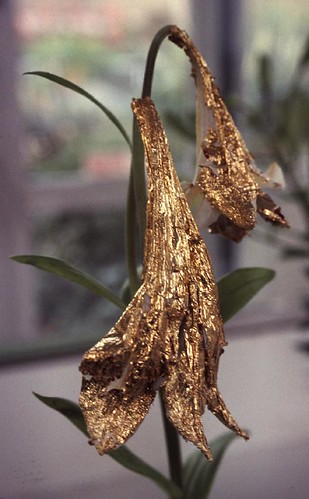
For example, this piece was originally called Do More With Less. The whole piece was my sarcastic riposte to my college tutor telling me to 'do more with less' - because naturally, when accused of 'gilding the lily' my response was to do exactly that!

gilded lily 01
Kirsty Hall: Gilded Lilies, 2001

But the original title was clunky and I could never remember exactly how it went, so it was discarded in favour of the more prosaic Gilded Lilies. And in retrospect, I can see that the more fanciful title was, er... gilding the lily.

gilded lily 02
Kirsty Hall: Gilded Lilies, 2001

I've also accidentally named things twice when I've forgotten that I'd already titled a work. When this happens, it's obvious to me that the original title wasn't quite right or I would have remembered it. When I name my work, I'm trying to find a title that so precisely and elegantly captures the essence of the piece that a name change would be utterly inconceivable.

I try never to change a name once the piece has been formally exhibited (although I couldn't swear that this has never happened). Changing a title in order to make the work more palatable (something I've been asked to do only once) or simply in order to try and sell the work, makes me very uncomfortable. Certainly, I think that changing titles multiple times simply in order to suit the audience, venue or exhibition is confusing and dubious: the work needs to have integrity.

So what do you think? Is titling important to you? Would you re-title a work in order to sell it?

6 Comments

I was VERY flattered to make it into the 'Best Artists Blog' section of the 100 Best Scholarly Art Blogs list this week.

Congrats to Katherine from Making A Mark, who also made it into the Best Artists Blog section and to Dion from the Art News Blog, who very deservedly made it into the Art News section. I was also pleased to see the New Curator blog mentioned - I only discovered this blog fairly recently through Twitter but it's rapidly becoming a favourite.

I haven't checked out all the other blogs mentioned yet but it looks like there's plenty of good stuff to get your teeth into.

5 Comments

Britain is in the midst of a heatwave (well, what we call a heatwave) and it's too hot to write properly. So instead here's a quick look at the work of Liza Lou, whose obsessive work with beads naturally appeals to me.

Liza Lou first came to prominence with her beaded kitchen - a work that took her five years to make and involved her covering an entire kitchen in beads.

lizalou_sink
Liza Lou: Beaded Kitchen (Sink Detail)

Her more recent work has taken a more overtly political turn with beaded wire fences and prison cells that are partly inspired by her move to South Africa, where she now works with skilled local artisans to produce her sculptures. I find it intriguing that she's scaled up her production in this way. Originally she did all her beading herself but she was finding it impossible to continue working that way after developing acute tendinitis in her hands.

684.x600.art.lou.Install11
Liza Lou: Security Fence

artwork_images_424046260_199279_liza-lou
Liza Lou: Security Fence

liza-lou-security-fence
Liza Lou: Security Fence

Make sure you check out this interview with her - I love what she has to say about artists using their powers for good. The rest of that online textile magazine, HandEye, is well worth a look.

And here's another article that explores the deeper motivations for her work.

8 Comments

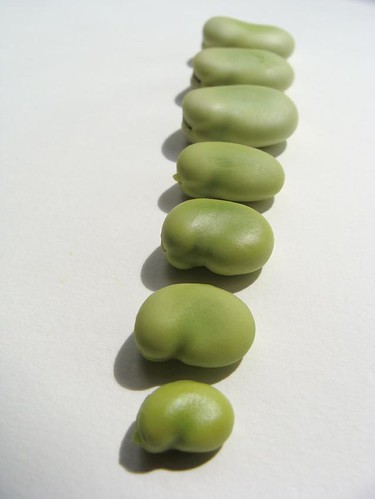
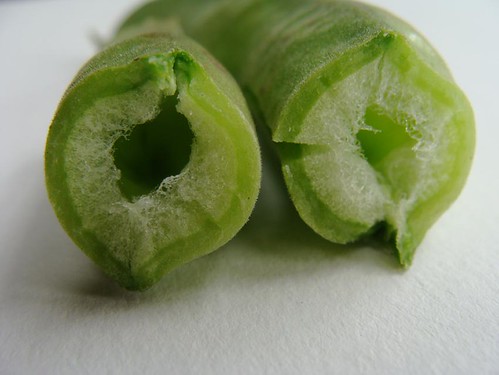
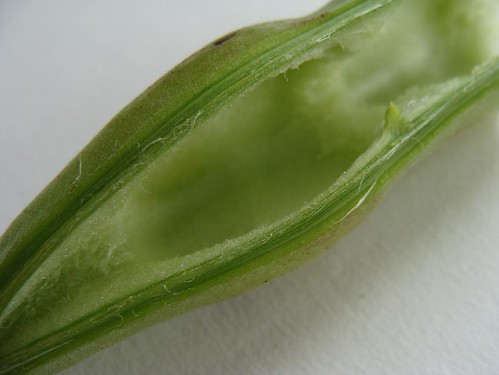
Simple household tasks can take a lot longer when you're an artist. Shelling these beans took about an hour because I was compelled to document the process as I went along.

Broad beans 05
Kirsty Hall: Broad Beans, June 2009

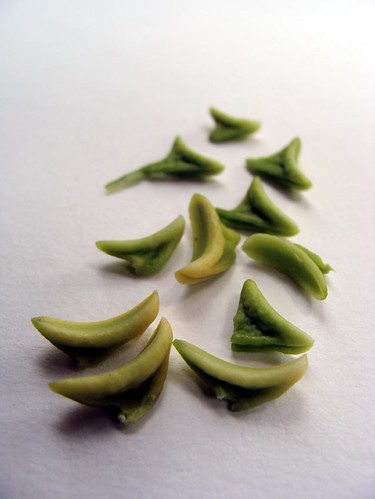
Although they're edible, I couldn't leave these little triangles on because they were spoiling the symmetrical aesthetic of the beans. Sigh.

Broad Beans 03
Kirsty Hall: Broad Beans, June 2009

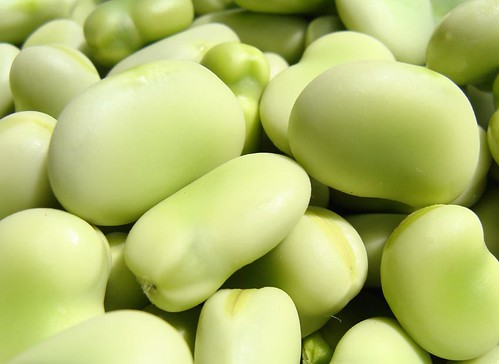
I don't even particularly like the taste of broad beans but I am always utterly seduced by their waxy pale green.

Broad Beans 12
Kirsty Hall: Broad Beans, June 2009

I wish you could have heard the crisp snapping and stroked the soft furry insides of the pods.

Broad Beans 09
Kirsty Hall: Broad Beans, June 2009

Broad Beans 08
Kirsty Hall: Broad Beans, June 2009

4 Comments

It's Friday afternoon - time to slack off at work and browse the net instead! Fortunately I'm here to enable your procrastination.

ARTISTS

Really loving this post on DudeCraft about the work of Jim Denevan who creates incredible largescale freehand drawings in sand.

Stephen J. Shanabrook makes rather strange work, including collages of heroin paraphernalia.

For those of us with gothic sensibilities - I'm loving the crazy Victorian aesthetic of Wilhelm Staehle's site.

Beautiful drawings from Rachel Mosler.

This project gets points for sheer chutzpah - curator Anna Ricciardi is asking people to send her their gallery rejection letters for inclusion in an exhibition at Islington Arts Factory. So far, so good. But here's the cheeky bit - she's also asking for a £7 submission fee! I hope she's done this deliberately as a comment on the increasing tendency for venues to charge artists to apply for exhibitions. Because if it's not ironic, it would be too depressing for words.

ARTICLES

I like Joanne Mattera's blog very much; she writes so eloquently about the realities of being an artist. In this post, she recommends that we define what success means to us (something art coach, Alyson Stanfield also strongly recommends) and suggests considering options beyond the narrows confines of the art world.

Daniel Sroka ponders how to survive as an artist in a struggling economy.

Lori Woodward Simons with some advice about how to negotiate with art galleries. This was published on Clint Watson's FineArtViews, a blog with masses of articles about every aspect of the art world, including this great one about how to sell your art. Boy, do I need help in that department!

Lisa Call gets things done by setting goals and having a system.

HUMOUR

Step away from the metaphors and no one will get hurt! A piece of quite remarkable prose that, amazingly, was actually published. I wouldn't drink anything while attempting to read this, if I were you.

Have I mentioned Wrongcards before? As their tagline says: 'E-cards that are wrong for every occasion.' Including zombie attacks...

When I lived in Leeds, a friend and I used to delight in that urban harbinger of summer - the sight of goths with thick white make up slowly melting down their faces. So as you can imagine, I was delighted to discover the blog Goths In Hot Weather.

And because it takes one to know one, here's a delightful visual guide to goths. OK, so I've never actually been a full-on goth but I've come pretty close over the years and definitely have aspects of at least three of these!

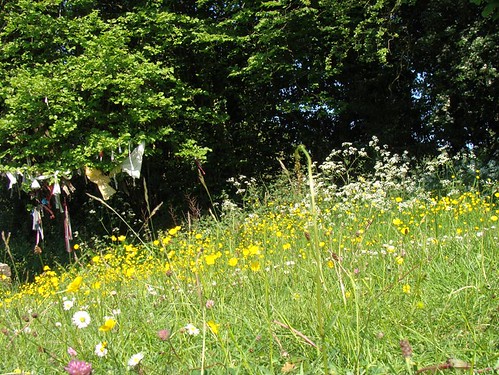
Last Tuesday, the weather was so glorious that we took the opportunity to visit our beloved Virtuous Well over at Trellech. The joy of working from home is that you can occasionally take a day off in the middle of the week and go for day trips when it's quiet.

And what a delight to sit in blazing sunshine having a picnic surrounded by this!
Meadow 01
Kirsty Hall: Welsh Meadow, June 09

The colourful rags were still on the tree, although there seemed to be less of them than last year. But perhaps this mass of green and yellow just made them less visible.
Meadow 02
Kirsty Hall: Welsh Meadow, June 09

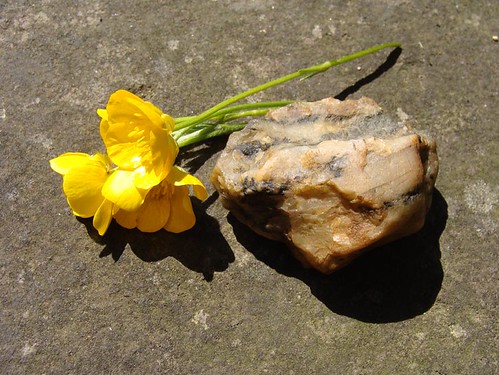
I left a small offering beside the well.
Offering
Kirsty Hall: Small Offering, June 09

Afterwards we walked over to visit the stones - one of these days we'll manage to visit the unusual, historical sundial at the local church as well.

12 Comments

I am lazy.

"What's that?', I hear you cry, 'you spend months patiently tying knots in string, sticking pins through fabric or drawing every day for a year, how can you possibly call yourself lazy?'

Ah, but it's a very specific kind of laziness and over the years - as I have come to understand it - I have adjusted my art practice to accommodate it.

I know myself and if I worked with the sort of materials that needed a specialist working environment like a forge or a foundry, I wouldn't get much art made. If I undertook huge expensive projects that involved lots of paperwork, funding bids and meetings with planners and architects, I would never get any art made.

Heck, even if my studio was in another building, I would struggle. When I graduated, I hired a studio space on the other side of town because I thought that's what you were meant to do. I kept it for a couple of months before recognising that I was working extra hours to pay for it but was hardly ever there and even when I was, I found it an uninviting place to work.

Eventually I realised that when I'd been a student, I used to make most of my work at home and then take it into college when it was finished. I tended to use my studio in college as an experimental installation space or somewhere to think, rather than somewhere to physically make work. I'm sure this is partly because I'd grown accustomed to fitting my art around parenting when my son was young. Having evolved as an artist whilst making work in the evenings on the kitchen table, a separate studio space felt like a barren and alien environment to me.

So now my studio is on the top floor of my house. Yet even that is not close enough and I tend to make my art in my study, my bedroom, my living room, my garden, on the dining room table and only occasionally in my studio.

I do enjoy the quiet and contemplative space of my studio, especially when I need to think, draw or make more mess than usual. But I also need my art to be part of my daily life; something I can pick up and put down as easily as the morning paper or my cup of tea. So art, for me, is largely a domestic affair and you'll often find me making my more repetitive pieces in front of the TV or while listening to a podcast on my computer.

In addition, the sort of materials I use in my art - small, unregarded things like matches, pins, sequins or envelopes - are easily available, safe to use and relatively cheap. This is a deliberate choice on my behalf. Partly because I'm very interested in everyday objects that are so commonplace that they become effectively invisible but also because I am passionate about 'owning the means of production'. I hate to be dependant on other people before I can even start to make my art.

I've never done well if I have to go through multiple steps to get something done and so wherever possible, my practice is organised to minimise that. For example, when I graduated I took out a loan so that I could upgrade my computer equipment and digital camera because I wanted access to the technology I'd used at college without having to go off to a library or rent out office premises.

My materials are a continuation of that desire for independence. I don't need to work a day job to buy the sort of materials I use. Nor do I need to scrabble around for grants or sponsorship or jump through anyone else's hoops before my work can come into being. I've learnt from experience that projects that do need access to specialist knowledge or equipment or more funding than I can provide myself are the ones that invariably end up on on the backburner.

Again, I'm sure my formative years of trying to combine art with parenting also informed my preference for cheap, readily available materials. Although I always bought the best I could afford, I was on a low income and got used to making do with what I had. And I found that I actually preferred it because it was easier to be loose and experimental with thousands of cheap, everyday things than with very rare or precious materials.

Some artists need the heroic struggle; it motivates and inspires them and forms a vital part of their practice. Others find that getting out of the house and into a separate studio space makes them more focused and dedicated. Yet others relish the challenge of working in very expensive materials.

But for me that stuff just gets in the way.

I need the path of least resistance because I find making good, meaningful art quite difficult enough without adding extra obstacles. I am perfectly capable of putting mental road blocks in the way of my own art practice and I realised early on that it would be disastrous if I added further restrictions such as the need for funding, planning permission, specialist studio requirements or expensive materials. So I have consciously set up my practice so that the only thing standing in the way of my art is myself - and believe me, that's usually more than enough!

It's vital as an artist to recognise your strengths and weakness and to play to both of them. Don't make it any harder than it needs to be.